
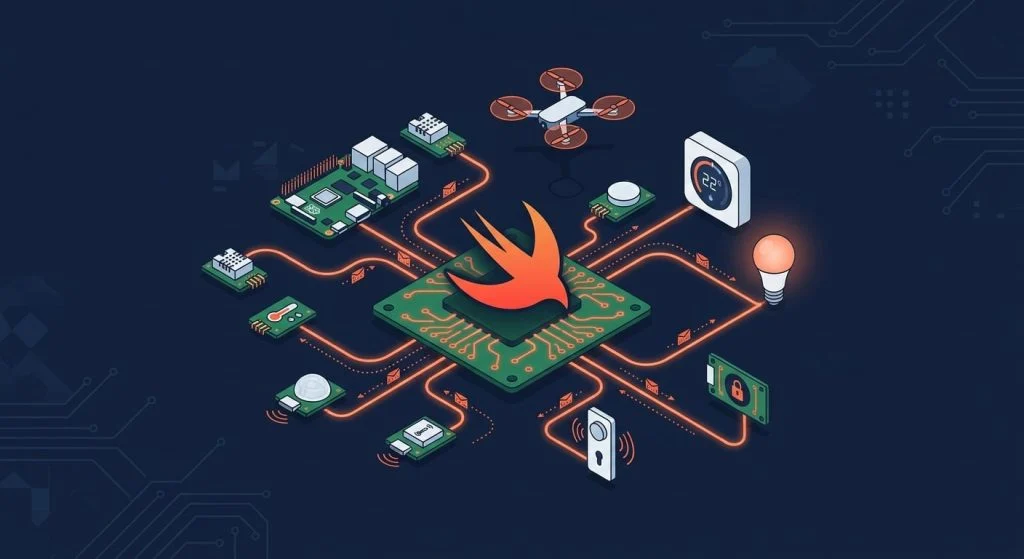

Amazon Web Services (AWS) has unveiled a series of significant updates, headlined by the general availability of the AWS IoT Device SDK for Swift, marking a strategic expansion of the Swift language into the burgeoning fields of Internet of Things (IoT) and edge computing. Concurrently, AWS has substantially advanced its generative AI offerings by making OpenAI’s GPT-5.5, GPT-5.4, and Codex models generally available on Amazon Bedrock, providing enterprises with secure, managed access to cutting-edge AI capabilities. Further bolstering its cloud infrastructure, AWS also announced multi-Region replication for Amazon Cognito to enhance identity management resilience and introduced Bring Your Own Media (BYOM) support for Amazon RDS for SQL Server, addressing critical aspects of cost-efficiency and license portability for database migrations. These developments collectively underscore AWS’s commitment to empowering developers, facilitating enterprise cloud adoption, and leading innovation across key technology domains.
Swift’s Strategic Expansion into IoT and Edge Computing
The general availability of the AWS IoT Device SDK for Swift represents a pivotal moment for developers within the Apple ecosystem and the broader Swift community. This new SDK provides production-ready connectivity for Swift applications running on macOS, iOS, tvOS, and Linux, enabling them to seamlessly interact with AWS IoT services. Key functionalities delivered by the SDK include robust MQTT 5 connectivity, Device Shadow for persistent device state management, IoT Jobs for remote operations, and fleet provisioning for scalable device onboarding. The integration of MQTT 5 is particularly noteworthy, offering enhanced messaging features, improved session management, and more efficient data transfer compared to its predecessors, which are crucial for resource-constrained IoT environments.
This move aligns with a broader industry trend of expanding Swift’s utility beyond mobile and desktop application development. As a prominent member of the Swift Server Workgroup (SSWG), AWS has been instrumental in advocating for Swift’s capabilities in server-side and distributed systems. Over the past few years, Swift has matured significantly in server environments, demonstrating its performance, safety, and developer-friendly syntax for backend services. The extension into IoT devices is a natural progression, enabling a unified language approach from the cloud to the edge.
The concept of "Swift at the edge" is rapidly gaining traction. Projects like WendyOS, an open-source operating system designed for physical AI, exemplify this trend by offering first-class Swift support for deploying applications on powerful edge hardware such as NVIDIA Jetson and Raspberry Pi. This capability allows developers to leverage Swift’s performance characteristics for on-device inferencing, data processing, and local control, reducing latency and reliance on continuous cloud connectivity. The global IoT market, projected to exceed $1.5 trillion by 2030, presents immense opportunities for optimized device management and application development. The AWS IoT Device SDK for Swift empowers developers to tap into this market with a familiar, high-performance language, fostering innovation in areas like smart manufacturing, connected vehicles, smart cities, and healthcare. This strategic integration by AWS positions Swift as a viable and increasingly attractive option for end-to-end solutions, from enterprise backend to the smallest edge devices, unifying development efforts and potentially accelerating time-to-market for complex IoT solutions.
Unleashing Advanced Generative AI with OpenAI Models on Amazon Bedrock
In a significant stride for enterprise AI adoption, AWS has announced the general availability of OpenAI’s highly capable GPT-5.5, GPT-5.4, and Codex models on Amazon Bedrock. This integration empowers businesses to leverage state-of-the-art large language models (LLMs) and code generation capabilities within a secure, managed, and compliant environment. Amazon Bedrock, launched as a fully managed service, simplifies the development of generative AI applications by offering a choice of foundation models (FMs) from leading AI companies, alongside AWS’s own models, through a single API. This approach abstracts away the complexities of managing underlying infrastructure, allowing developers to focus on building innovative AI-powered experiences.
GPT-5.5 stands out as OpenAI’s most advanced model available on Bedrock, exhibiting exceptional prowess in agentic coding, sophisticated data analysis, and the execution of multi-step autonomous tasks. Its capabilities are particularly valuable for complex enterprise workflows that require reasoning, planning, and iterative problem-solving. For instance, developers can utilize GPT-5.5 to automate intricate business processes, generate comprehensive reports from diverse datasets, or create intelligent agents that interact dynamically with various systems.
Complementing the powerful GPT models, Codex is now available to accelerate AI-powered software development. Codex facilitates code generation, code completion, debugging assistance, and refactoring, significantly boosting developer productivity. It is accessible through the Codex App, the Codex CLI, and direct integrations with popular Integrated Development Environments (IDEs) such as Visual Studio Code, JetBrains IDEs, and Xcode. This widespread availability ensures that developers can seamlessly incorporate AI assistance into their existing development workflows, leading to faster development cycles and higher code quality.
The strategic decision by AWS to offer OpenAI’s models on Bedrock reflects a broader commitment to providing customers with a diverse selection of best-in-class FMs. This open approach allows enterprises to choose the most suitable model for their specific use cases, whether it’s for natural language processing, content generation, summarization, or code development. Critically, Bedrock ensures that these powerful AI models are deployed with the same stringent security, governance, and operational controls that enterprises expect from AWS. This includes data privacy, access management, and compliance with industry regulations, which are paramount concerns for organizations adopting generative AI in production environments. Pricing for these OpenAI models on Bedrock aligns with OpenAI’s first-party rates, and usage contributes to existing AWS commitments, offering cost predictability and optimized resource utilization. The global generative AI market is projected to reach over $1 trillion in the coming decade, and by integrating OpenAI’s flagship models, AWS solidifies its position as a leading enabler of enterprise-grade AI solutions, driving innovation across industries from finance and healthcare to media and manufacturing.
Enhancing Resilience and Cost Efficiency: Cognito Multi-Region Replication and RDS BYOM
Beyond developer tools and AI, AWS has also focused on bolstering foundational services for resilience and cost management, introducing multi-Region replication for Amazon Cognito and Bring Your Own Media (BYOM) support for Amazon RDS for SQL Server.
Amazon Cognito Multi-Region Replication:
Reliable identity and access management (IAM) is paramount for any modern application, and an outage can have catastrophic consequences for user experience and business operations. Amazon Cognito, AWS’s fully managed service for user sign-up, sign-in, and access control, now addresses this critical need with multi-Region replication. This new feature enables near real-time synchronization of user and machine identity data – including credentials, user pool configurations, and federation setups – to a secondary user pool in a standby AWS Region.
In the event of a disruption or outage in the primary Region, this capability ensures that signed-in users can continue accessing their applications without the need for re-authentication. New or registered users can also sign in with their existing credentials, maintaining seamless service continuity. This dramatically improves application resilience, minimizes recovery time objectives (RTO), and reduces recovery point objectives (RPO) for identity-dependent applications. For global enterprises operating across multiple geographies, multi-Region replication is not just a convenience but a necessity for meeting stringent service level agreements (SLAs) and regulatory compliance requirements related to data availability and business continuity. The feature is available as an add-on for user pools in Essentials or Plus feature tiers across 16 AWS Regions, providing broad geographic coverage for enhanced disaster recovery strategies. This enhancement reflects AWS’s ongoing commitment to building highly available and fault-tolerant infrastructure, ensuring that identity services, which form the bedrock of application security and user experience, are as resilient as the applications they protect.
Amazon RDS for SQL Server Bring Your Own Media (BYOM):
Migrating on-premises databases to the cloud often involves complex licensing considerations, which can be a significant barrier for enterprises with substantial existing investments in proprietary software. To address this, AWS has introduced Bring Your Own Media (BYOM) support for Amazon RDS for SQL Server. This feature allows customers to reuse their existing Microsoft SQL Server licenses, including those with Software Assurance, by leveraging Microsoft’s License Mobility program on Amazon RDS.
BYOM provides a crucial pathway for enterprises to optimize costs associated with cloud migrations. Instead of purchasing new licenses for their cloud deployments, organizations can now port their existing licenses, translating into substantial savings, particularly for large-scale database environments. The integration with AWS License Manager further streamlines this process, offering centralized tracking of license usage and ensuring compliance with licensing terms. This is particularly valuable for organizations navigating complex Microsoft licensing agreements, as License Manager provides a clear, auditable record.

This initiative underscores AWS’s dedication to providing flexibility and choice for enterprise customers, especially those with hybrid cloud strategies. It removes a significant friction point for companies looking to modernize their SQL Server workloads by moving them to a managed database service like RDS, which offers automated backups, patching, and scaling. By simplifying licensing and reducing costs, BYOM on Amazon RDS for SQL Server accelerates cloud adoption for mission-critical applications, enabling businesses to leverage the agility and scalability of AWS while maximizing their existing software investments. This is a critical enabler for enterprises undergoing digital transformation, offering a clear path to cloud modernization without prohibitive licensing overheads.
Broader Market Implications and Strategic Outlook
These diverse announcements collectively paint a picture of AWS’s strategic direction: empowering developers with specialized tools, democratizing access to cutting-edge AI, and fortifying core cloud services with enterprise-grade resilience and cost-efficiency. The expansion of Swift into IoT and edge computing via the new SDK positions AWS as a key enabler for a growing segment of developers seeking unified language environments from cloud to device. This move is not just about a new SDK; it’s about fostering an ecosystem where Swift can thrive across the entire compute spectrum, potentially attracting new talent and accelerating innovation in connected devices and physical AI.
The integration of OpenAI’s leading models into Amazon Bedrock reinforces AWS’s multi-faceted approach to generative AI. By offering a curated selection of best-of-breed models from various providers, alongside its own FMs like Amazon Titan, AWS aims to be the go-to platform for enterprises looking to build, deploy, and scale AI applications responsibly. The emphasis on security, governance, and operational controls within Bedrock is a direct response to enterprise demand for production-ready AI solutions that comply with internal policies and external regulations. This strategy positions AWS to capture a significant share of the rapidly expanding generative AI market by providing the infrastructure and services that enterprises need to transform their operations.
Furthermore, the enhancements to Amazon Cognito and Amazon RDS for SQL Server address fundamental enterprise requirements: continuous availability for critical identity services and financial optimization for database workloads. These updates demonstrate AWS’s ongoing commitment to refining its core services, ensuring they meet the stringent demands of mission-critical applications and large-scale enterprise migrations. By reducing the friction associated with licensing and enhancing disaster recovery capabilities, AWS is making it easier and more cost-effective for organizations to fully embrace the cloud paradigm.
Industry analysts suggest that AWS’s strategy of broad platform enablement, combined with deep vertical integrations and a focus on enterprise readiness, will continue to drive its leadership in the cloud computing market. These latest announcements reflect a responsive and forward-looking approach, adapting to evolving developer preferences, leveraging advancements in AI, and consistently enhancing the reliability and economic benefits of its cloud infrastructure. As the digital transformation continues to accelerate across all sectors, AWS’s comprehensive suite of services aims to provide the foundational tools necessary for businesses to innovate and thrive.
For a comprehensive overview of all new releases and updates, developers and enterprises are encouraged to regularly consult the "What’s New with AWS" page and explore upcoming AWS-led events, including Summits and Community Days. These resources offer invaluable opportunities to learn more about the latest innovations and connect with the broader AWS builder community.
This week’s developments underscore AWS’s relentless pursuit of innovation and its dedication to providing a robust, flexible, and secure cloud environment capable of supporting the next generation of applications, from intelligent edge devices to sophisticated AI-driven enterprise solutions.
