
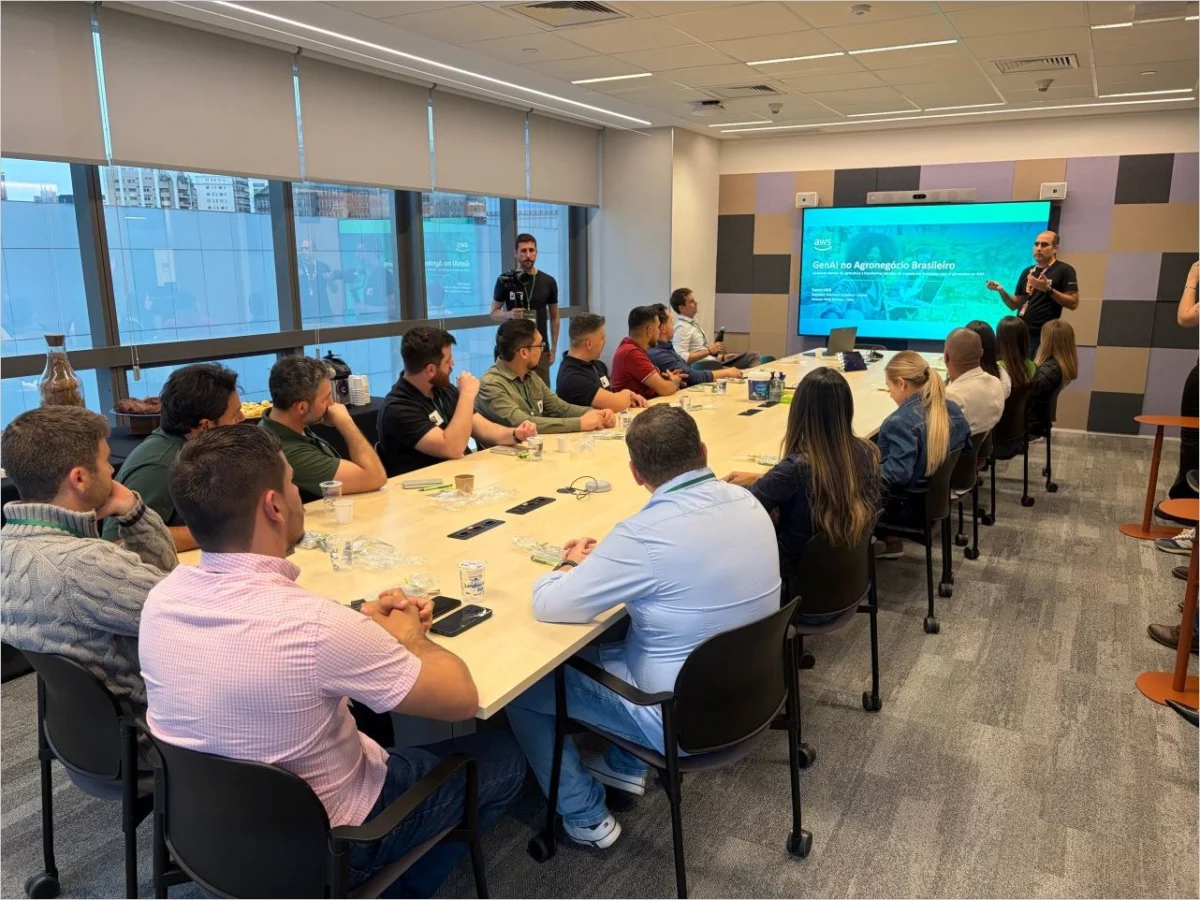

Amazon Web Services (AWS) has rolled out a sweeping series of infrastructure upgrades, developer tool integrations, and specialized security frameworks designed to address accelerating enterprise workloads. The updates, highlighted by recent presentations on the intersection of artificial intelligence and traditional sectors like agribusiness, emphasize the cloud provider’s strategic push into zero-downtime migrations, granular container networking, and real-time vulnerability remediation. As cloud architectures grow increasingly complex, these deployments reflect a broader industry mandate: shifting defensive measures from reactive patching to proactive, automated containment.
Generative AI in Traditional Industries: The Agribusiness Case Study
The intersection of advanced artificial intelligence and foundational global markets took center stage during a recent briefing at the AWS regional headquarters in São Paulo, Brazil. Addressing a delegation of technology and commercial leaders from the Brazilian agricultural sector, industry specialists examined the operational integration of generative AI across various stages of the agricultural supply chain. Discussions focused heavily on delivery mechanisms—specifically how insights are communicated to operators in the field.
For agricultural professionals managing operations while actively transiting between remote farms, traditional graphical user interfaces often prove impractical. Consequently, voice-driven interfaces have emerged as the primary conduit for enterprise interaction. Underscoring this operational shift, Amazon Web Services announced a major expansion of its Amazon Polly Generative engine. The latest update introduces 14 new voices spanning nine locales, bringing the service catalog to a total of 57 generative voices across 11 languages. Significantly for the South American market, the release includes two native Brazilian Portuguese voices, Leo and Carolina. Because the enhancement functions as a drop-in upgrade, enterprise users can leverage the improved auditory realism and natural cadence without altering existing SynthesizeSpeech application programming interfaces (APIs) or incurring additional cost structures.
Automating Vulnerability Management with AWS Continuum
While edge-interface improvements address user accessibility, enterprise security posture dominated the engineering updates for the week. AWS announced the general availability of AWS Continuum, a specialized security service engineered to bridge the widening gap between vulnerability disclosure and active exploitation. Historically, vulnerability management relied heavily on static scanners that generated extensive lists of CVEs, leaving security operations teams to manually triage severity labels.
AWS Continuum redefines this lifecycle by constructing a comprehensive context graph linking an organization’s code repositories directly to its active cloud environment. When a vulnerability is identified, the system assigns an evidence-based risk level and safely reproduces exploitable findings within an isolated sandbox environment. By generating proof-of-concept code, the platform demonstrates the tangible risk to system architecture rather than relying on abstract severity metrics. Issues are systematically ranked according to the proximity of the identified attack path to business-critical workloads. Furthermore, Continuum can automatically draft remediation fixes as pull requests. To maintain rigorous governance control, every remediation currently requires manual human review and approval before merging, establishing a secure framework that balances automated speed with administrative oversight.
The urgency underpinning tools like AWS Continuum was underscored by recent data published by Amazon Threat Intelligence. Telemetry extracted from internal honeypot networks—specifically designated as MadPot—revealed exploitation attempts of the PHP2shell vulnerability (tracked under CVE-2026-109618 and CVE-2026-109619) as early as October 17. This activity preceded the public disclosure of the vulnerabilities by four full days. Furthermore, functional proof-of-concept exploits were actively circulating on public networks approximately twelve hours before the official embargo lifting. This timeline provides definitive evidence that traditional patch windows measured in days are no longer viable against modern threat actors. Consequently, incident response teams are advised to evaluate potential breaches starting from the earliest recorded exploitation telemetry rather than the formal CVE release date. AWS concurrently published dedicated AWS WAF (Web Application Firewall) mitigation rules to protect vulnerable endpoints, with Continuum currently deployed in the US East (N. Virginia) and US West (Oregon) regions.
Streamlining Container Networking via Amazon ECS Gateway
In the realm of cloud infrastructure and container orchestration, AWS introduced Amazon ECS Gateway to simplify the complex mechanics of service exposure. Traditionally, configuring ingress traffic, Transport Layer Security (TLS) certificates, listener rules, and WAF web ACLs required extensive coordination between dedicated network engineering teams and application developers.
Amazon ECS Gateway establishes a clear operational boundary by allowing platform teams to define a centralized gateway encompassing organizational subnets, security groups, and security policies. Application developers can subsequently opt into this architecture by incorporating a simple gateway connector directly into their service definition files. Upon integration, Amazon ECS automatically provisions an AWS Certificate Manager (ACM) certificate, generates a unique DNS hostname, configures listener rules, and establishes dedicated target and security groups ensuring traffic is exclusively routed from the designated Application Load Balancer (ALB).
The architectural efficiencies of this model are substantial. A single ALB can now efficiently share traffic across up to 25 distinct container services. Amazon ECS provisions infrastructural load balancers automatically upon initial connection and decommissions them when services are retired. Furthermore, a single gateway can associate with up to 10,000 individual clusters, with a maximum limit of five gateways per cluster. Enterprise teams can adopt the gateway incrementally using the UpdateService API without disrupting existing legacy load balancer deployments. The service is available at no additional charge across all commercial regions supporting Amazon ECS.
Advancing Machine Learning: Hardware Flexibility and Managed Training
Machine learning infrastructure received significant enhancements, aimed primarily at reducing the operational overhead associated with distributed model training and hardware provisioning. AWS announced the public beta of TorchNeuron, an open-source PyTorch backend designed to facilitate seamless execution of machine learning models on AWS Trainium hardware. By utilizing a simple code adjustment—specifically transitioning model execution via .to('neuron')—developers can deploy models onto Trainium2 and Trainium3 instances without engaging in extensive code rewrites. The backend maintains native compatibility with eager execution modes and standard torch.compile directives, integrating directly with the Neuron Kernel Interface to support custom operator definitions.
Complementing this hardware flexibility, Amazon SageMaker AI introduced fully managed training sessions. This capability hands developers granular control over the post-training loop—including custom loss functions and specialized reward signals—while SageMaker abstracts the underlying infrastructure complexities. The platform automatically manages GPU allocation, distributed execution parameters, fault recovery contingencies, and checkpoint storage. Billing metrics operate on an active-processing model, pausing automatically while custom reward functions compute batch evaluations. This release coincides with expanded model support for Muse Glimmer, Qwen 3.8, and Ministral 3.

In addition to custom training loops, Amazon Bedrock expanded its enterprise utility by introducing native structured output capabilities for Anthropic Claude models. Accessible across both bedrock-runtime and bedrock-mantle endpoints, developers can now enforce strict, schema-compliant JSON outputs directly from the model layer. This advancement eliminates the need for complex custom parsing logic, regex filters, or retry loops, substantially increasing the reliability of automated workflows in heavily regulated sectors such as financial reporting analysis, clinical document parsing, and intelligent support ticket routing.
Zero-Downtime Data Migration and Tokenomics for AI Agents
Database modernization efforts also achieved a significant milestone with the introduction of online zero-downtime migration capabilities for Amazon ElastiCache Serverless for Valkey. Enterprises operating self-managed Valkey or Redis OSS instances on Amazon EC2 can now migrate their datasets directly into ElastiCache Serverless without incurring client-side application errors or service interruptions. The migration process is managed natively through the platform—eliminating the need for third-party replication utilities—and allows administrators to execute either manual or automated cutovers following data synchronization. The capability is deployed globally across all commercial AWS regions, China regions, and US GovCloud environments.
To help organizations quantify the financial implications of deploying autonomous workflows, AWS published comprehensive frameworks addressing the "tokenomics" of coding agents. Because software-development assistants continuously reprocess growing interaction transcripts during iterative coding sessions, their underlying cost models diverge sharply from traditional single-turn inference workloads. Open-source benchmarking tools released by AWS enable engineering teams to measure model accuracy, infrastructure overhead, and latency costs directly against proprietary codebases, empowering organizations to optimize routing configurations for cost-efficiency without sacrificing code quality.
Enterprise Migration Milestones and Upcoming Industry Events
Demonstrating the scalability of AWS migration pipelines, recent case studies highlighted monumental database transitions. U.S. Bank successfully migrated four enterprise Oracle Exadata databases totaling 119 terabytes to Amazon RDS for Oracle. Utilizing a configuration-driven pipeline orchestrated via Oracle XTTS (Cross Platform Transportable Tablespaces), AWS DataSync, and Amazon EFS, the initial baseline data synchronization was completed in approximately seven days over a bandwidth-restricted Direct Connect network. Subsequent cutovers averaged roughly four hours per database with zero recorded data loss.
Looking ahead, the cloud community is preparing for the upcoming AWS re:Invent conference, scheduled to run from November 30 to December 4 in Las Vegas. Featuring over 2,200 specialized technical sessions, the official session catalog is currently active for attendee registration and reserved seating. Regionally, the Brazilian community season will officially conclude with the AWS Community Day Brasil Norte, taking place in Belém on October 31. These gatherings continue to serve as primary forums for enterprise architects, developers, and technology leaders to evaluate the evolving landscape of cloud computing, artificial intelligence integration, and infrastructure security.
