
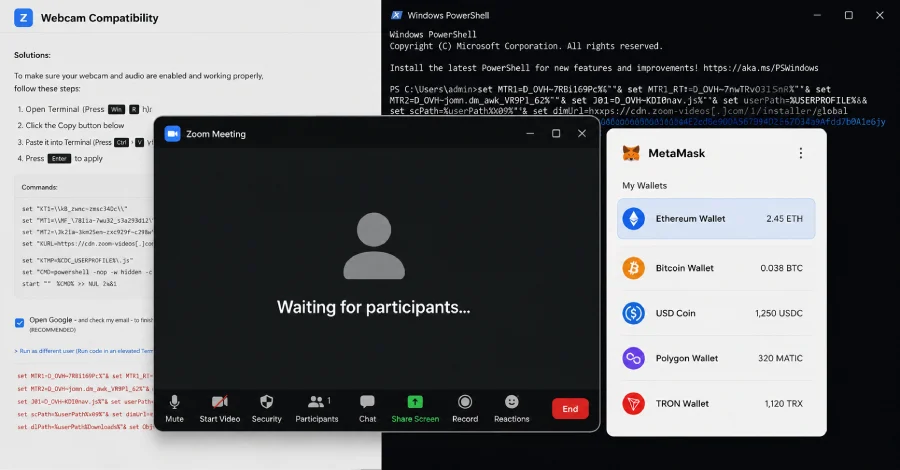

A sophisticated and actively developed phishing kit, operated by the North Korean threat actors known as BlueNoroff, has been identified as impersonating leading videoconferencing platforms, Zoom and Microsoft Teams. These campaigns, characterized by their "ClickFix-style" lures and the use of typosquatted domains, are designed to execute highly targeted social engineering attacks aimed at delivering malware and compromising high-value individuals within the cryptocurrency and financial sectors. This new level of operational sophistication marks a significant escalation in BlueNoroff’s tactics, as detailed in a comprehensive report by cybersecurity firm JUMPSEC, shared with The Hacker News. The threat actors have meticulously engineered a multi-stage victim acquisition pipeline that abuses trust, performs reconnaissance on cryptocurrency wallets, and integrates AI-generated deepfakes to enhance the illusion of legitimacy.
The Anatomy of a Highly Targeted Attack
The core of BlueNoroff’s strategy revolves around what JUMPSEC describes as an "operator-driven victim acquisition platform." This platform initiates attacks by leveraging compromised "trusted contacts" as the primary vector for initial access. These are individuals within the targeted industries whose legitimate communication channels, particularly Telegram accounts, have been hijacked. The attackers then use these compromised accounts to message high-ranking employees of major companies, often within the cryptocurrency space, sharing seemingly innocuous Calendly meeting links. This method creates a self-propagating attack chain, where each successful compromise of a Telegram account potentially provides new avenues for further attacks, effectively feeding the campaign with fresh, trusted contacts. JUMPSEC underscored the gravity of this self-sustaining mechanism, noting, "Every victim who runs the payload with Telegram Web open or Telegram Desktop installed is a candidate for their Telegram session to be stolen and reused against their own contacts."
Upon clicking the Calendly link, victims are not directed to a genuine meeting platform but rather to a meticulously crafted fake domain that mirrors the legitimate Zoom or Microsoft Teams interface. These typosquatted domains are designed to appear authentic, exploiting subtle misspellings or clever subdomain structures to deceive unsuspecting users. For instance, domain schemes like ‘us.zoom.06webin.us’ have been observed, closely mimicking legitimate Zoom URLs. Once on the phishing page, victims are prompted to enter their name and grant permissions, crucially including access to their webcam. This seemingly standard request is a critical step in the attack, as the webcam stream is then stealthily transmitted to the operators’ control panel via mediasoup WebRTC, a real-time communication framework. This provides the attackers with live visual intelligence on their targets, a significant advantage in tailoring subsequent social engineering efforts.

The Deepfake Deception and Malware Delivery
After granting webcam permissions, victims are advanced to another page, giving the impression that they have joined a Zoom or Teams call, but they appear to be the sole participant, greeted by a message like "waiting for other participants." This stage is a calculated maneuver to set the scene for the final phases of the attack. Simultaneously, the phishing kit conducts a sophisticated fingerprinting process on the victim’s web browser, inventorying any cryptocurrency wallets installed. This reconnaissance step is crucial for BlueNoroff, allowing them to selectively target "high-value victims" who possess significant digital assets.
Once this profiling is complete, an "admin" (the attacker) appears to join the fake meeting. However, the video feed the victim sees is not a live stream of a real person. Instead, it is a pre-edited, AI-generated deepfake video. This deepfake is a composite creation, featuring AI-generated headshots, often crafted using tools like OpenAI ChatGPT, superimposed over authentic body movements. These body movements are cleverly captured from previous, legitimate meetings involving individuals who were previously compromised by the same campaign. JUMPSEC revealed the chilling efficiency of this method: "So, each successful attack feeds source material into the composites used against the next target." This innovative use of AI, combined with the Telegram account takeover, allows the attackers to present a plausibly familiar-looking face moving with the genuine body language of someone previously captured on camera, dramatically increasing the campaign’s deceptive power.
The operator, now in control of the simulated meeting, can manipulate the victim’s perception further. They can send fake messages, such as "your mic isn’t working," creating a sense of urgency or technical difficulty. The ultimate goal is to trigger the "Zoom SDK Update" or a similar prompt, which, when clicked, delivers the "ClickFix" payload – the intended malware. The ClickFix attack chains have been developed to be compatible with both Windows and macOS operating systems, broadening the potential victim pool.
Evolution and Attribution: The "John" Connection
The sophistication of these campaigns is further evidenced by the continuous development and refinement of the phishing kit. Cybersecurity researchers observed five distinct versions of the kit between May 31 and July 14, 2026, indicating a rapid iteration cycle and active fine-tuning efforts by the threat actors. JUMPSEC noted two distinct lure variants, one for Zoom and one for Microsoft Teams. The Teams variant, in particular, was assessed to be more polished, incorporating features like emoji reactions, mobile/tablet blocking, and more advanced wallet probes prior to malware delivery, suggesting an adaptive and responsive development team.

Further analysis into the campaign’s infrastructure and malware revealed crucial attribution details. The Telegram exfiltration function, embedded within the stealer binary, hard-codes the bot token and chat ID. Querying the Telegram API using this bot token led researchers to an operator known by the name "John" (@alchemy_john_mac). This individual has been observed actively engaging in cryptocurrency-related discussions, including inquiries about vesting contracts and fund withdrawals within the MAIV cryptocurrency group as recently as May 2026. This linkage provides a direct thread to the individuals orchestrating these sophisticated attacks.
Strategic Targeting: Why Zoom and Teams?
The specific focus on Zoom and Microsoft Teams, while seemingly arbitrary, is a deliberate strategic choice by BlueNoroff, as explained by Sean Moran, head of threat research and enablement at JUMPSEC. Moran highlighted three key factors:
- ClickFix Pretext Compatibility: The "SDK out of date" lure is most effective on platforms perceived to have robust desktop clients, such as Zoom and Teams. Google Meet, being primarily browser-based and lacking a heavy desktop application, does not offer a credible context for such a prompt, making it an unsuitable target for this specific deception.
- Target Audience Fit: Zoom and Teams are the default videoconferencing platforms for many professionals in the cryptocurrency, venture capital, and broader finance worlds, particularly for "investor/partnership calls." Google Meet, Moran suggested, often feels more like a "customer calling platform," making it less ideal for impersonating high-stakes financial interactions.
- Typosquatting Surface: The complex domain schemes used for Zoom, with multiple subdomains (e.g., ‘us.zoom.06webin.us’), provide a fertile ground for typosquatting and spoofing. In contrast, simpler and more direct URLs like ‘meet.google.com’ are harder to convincingly impersonate through typosquatting.
While a Google Meet equivalent was found as an unimplemented stub in the source code, Moran concluded that the current setup is actively successful, and the aforementioned factors likely informed the deliberate decision to prioritize Zoom and Teams.
BlueNoroff’s Broader Context and Motivation
BlueNoroff is a subgroup of the notorious Lazarus Group, a state-sponsored hacking collective from North Korea, primarily known for its extensive cyber espionage and cybercrime activities. These groups are widely believed to be responsible for generating illicit revenue for the North Korean regime, circumventing international sanctions and funding its weapons of mass destruction programs. Their targets frequently include financial institutions, cryptocurrency exchanges, and blockchain companies worldwide.

The evolution of BlueNoroff’s tactics from earlier, somewhat simpler "ClickFake Interview" campaigns, which involved job-seekers being tricked into running malicious commands under the pretext of fixing camera or audio issues (as documented since early 2025), to the current deepfake-enabled, self-propagating scheme, demonstrates a continuous drive towards greater sophistication. Previous reports have extensively detailed their activities, including the "GhostCall" campaigns and social engineering efforts targeting organizations like Axios in April 2026. The shift towards weaponizing trust, leveraging compromised real-world contacts, and integrating AI into their social engineering arsenal represents a significant leap in their operational capabilities.
Implications for Cybersecurity and Digital Asset Security
The implications of BlueNoroff’s advanced phishing kit extend far beyond the immediate targets of this specific campaign. As the Web3 ecosystem and digital assets continue their rapid maturation, threat actors are increasingly recognizing that compromising the individuals who control access to these assets can be as lucrative, if not more so, than directly attacking the underlying infrastructure. This campaign underscores a critical shift in the threat landscape:
- Erosion of Digital Trust: The use of compromised trusted contacts and AI-generated deepfakes fundamentally erodes the basis of digital trust. Users are now forced to question the authenticity of interactions even with familiar faces or known contacts.
- Sophistication of Social Engineering: This campaign highlights the advanced level of social engineering employed by state-sponsored actors. It moves beyond generic phishing emails to highly personalized, multi-stage attacks that combine technical prowess with psychological manipulation.
- Vulnerability of Communication Channels: Platforms like Telegram, while popular for their perceived security, become critical attack vectors when account credentials are stolen. Organizations must reassess the security of all communication channels used by their employees, especially those handling sensitive information or digital assets.
- AI as a Weapon: The integration of AI-generated deepfakes marks a worrying trend in cyber warfare. As AI technology becomes more accessible, its weaponization for deception will likely increase, posing new challenges for detection and mitigation.
- Heightened Risk for Web3 and Finance: The explicit focus on cryptocurrency wallet reconnaissance and targeting high-value individuals in the Web3 and finance sectors emphasizes the severe and evolving threat to these industries. Security postures must adapt to defend against identity theft, sophisticated social engineering, and the compromise of key personnel.
JUMPSEC concluded its report with a stark warning: "BlueNoroff’s continued refinement demonstrates that organisations must consider identity, relationships and communication channels as critical parts of their security posture." This means that traditional perimeter defenses are no longer sufficient. A holistic security strategy must encompass robust identity and access management, continuous security awareness training focusing on advanced social engineering tactics, and stringent protocols for verifying the authenticity of digital communications, even from seemingly trusted sources. The battle against sophisticated state-sponsored groups like BlueNoroff demands vigilance, adaptability, and a proactive approach to cybersecurity.
