
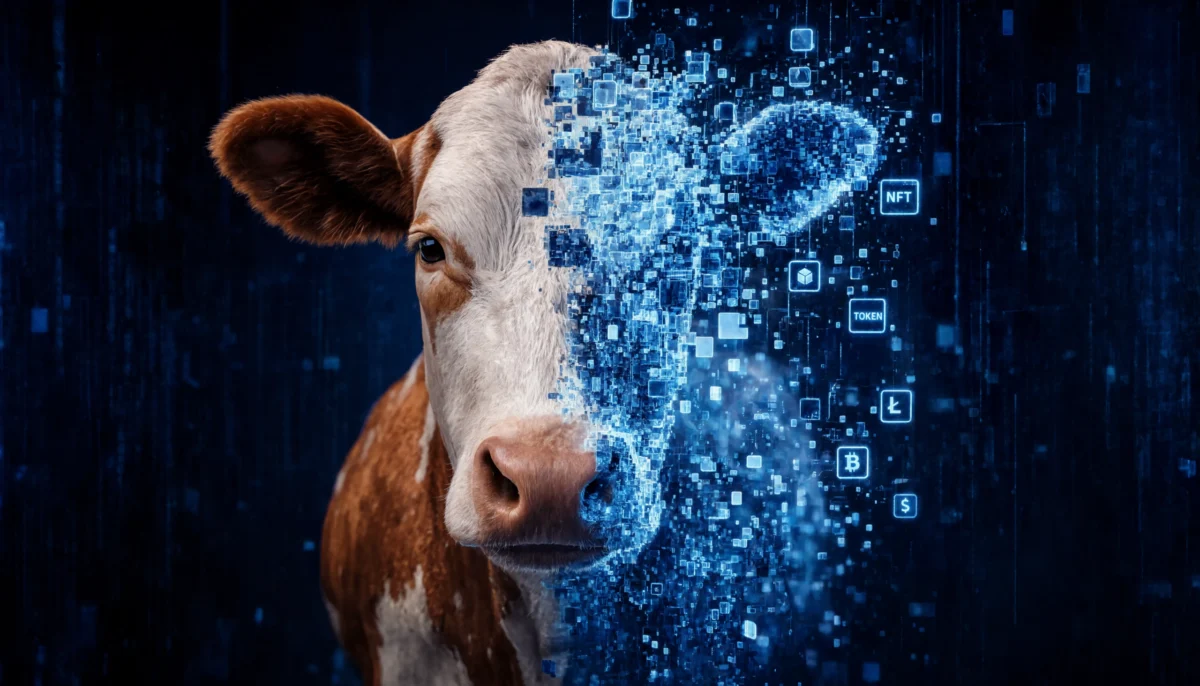

Ten dairy cows on a farm in Paranã, Brazil, have marked a historic moment by becoming the first livestock collateral to be formally registered on the country’s stock exchange, B3. This groundbreaking transaction, underpinned by blockchain technology and artificial intelligence-powered sensor collars, represents a critical real-world test of the cryptocurrency world’s ambitious concept of tokenizing physical assets and its potential to offer vital financial lifelines to farmers facing mounting economic pressures.
The pioneering operation was conducted at Fazenda Engenho Velho, located in Imbituva. The farm utilized ten high-value cows, collectively valued at R$120,000 (approximately $23,310 USD), to secure a CPR-F (Cédula de Produto Rural Financeira). This Brazilian rural credit certificate allows agricultural producers to leverage livestock or crops as collateral for loans. The CPR-F, valued at R$100,000 (approximately $19,420 USD), was issued by BMP, a direct credit company authorized by the Central Bank of Brazil. Subsequently, BMP transferred these credit rights to Target FIDC, a fund specializing in acquiring and monetizing receivables, which then facilitated the formal registration of the entire financial instrument on B3, Brazil’s primary stock exchange.
The core of this innovative financial mechanism lies in the "tokenization" of the cows. Each animal was assigned a unique, encrypted digital identity. This digital representation was generated through a sophisticated system developed by Cowmed, an agricultural technology startup. Cowmed employs AI to monitor dairy herds, and its system captures vital data points related to each cow’s health, behavior, and location via smart collars. These data streams are then cryptographically hashed, creating a tamper-resistant identifier that is intrinsically linked to the credit contract. This technological integration eliminates the traditional need for on-site farm inspections to verify the collateral’s existence and condition, a process that has historically led to significant discounts by financial institutions.
Traditionally, banks have been hesitant to lend against livestock due to inherent risks and the difficulty in continuously monitoring an animal’s welfare and status. This often results in livestock being discounted by as much as 60% when used as collateral. For instance, a cow with a market value of R$20,000 (approximately $2,380 USD) might only be valued at R$8,000 (approximately $1,600 USD) for loan purposes, a stark illustration of the valuation gap driven by lender uncertainty. "With monitoring, that uncertainty is eliminated," stated Humberto Brenner, a director at Target FIDC, in comments to Globo Rural. He further emphasized the growing demand for such solutions, noting, "Banks will increasingly demand real collateral and new information." This sentiment underscores a shift in financial expectations, pushing for greater transparency and verifiable data in collateral assessments.
The broader context of Brazil’s agricultural sector amplifies the significance of this development. The nation’s agribusiness has been grappling with a severe credit crunch, exacerbated by a confluence of factors including high interest rates, declining commodity prices, and the increasing frequency and intensity of climate-related shocks. The ramifications are starkly evident in the surge of agribusiness bankruptcy protection requests. According to data from Serasa Experian, these requests, known as "recuperação judicial" in Brazil (akin to Chapter 11 bankruptcy in the United States), skyrocketed to 1,990 in 2025, a dramatic increase from the 534 filed in 2023. This represents a nearly fourfold rise in a short period, painting a picture of widespread financial distress within the sector.
Thiago Martins, CEO of Cowmed, framed the tokenization initiative as a direct response to this challenging economic environment. "We took the cow, a real and tangible asset, and transformed it into a digital asset backed by a unique code monitored in real time," Martins explained to CNN Brazil. "This digitalization allows formal registration on B3 as a financial security—the process gives the farmer an advantageous opportunity to get financing, opening a new collateral alternative at a time of strong credit restrictions in agribusiness." He further elaborated on the benefits for producers, stating, "The operation allows the farmer to access more attractive credit in terms of cost and limit. We want to connect the farmer and the financial institution with a new alternative." This initiative aims to bridge the gap between agricultural producers and financial institutions by offering a more flexible and data-driven approach to securing credit.
This innovative transaction aligns with the burgeoning global trend of tokenizing real-world assets (RWAs). RWA tokenization involves converting tangible or intangible assets, such as real estate, commodities, or even livestock, into digital tokens that can be traded and utilized as financial instruments on blockchain platforms. This burgeoning market has already seen significant growth, with the total value locked across decentralized finance (DeFi) platforms via tokenized U.S. Treasuries and real estate surpassing $10 billion. Cowmed’s pioneering use of livestock as tokenized collateral, complete with its unique biological characteristics, adds a novel dimension to this expanding RWA landscape.
Cowmed’s operational footprint is substantial, currently monitoring a herd of 100,000 cows across 1,200 farms. These farms are spread across Brazil, the United States, Canada, Uruguay, Paraguay, and Bolivia. The combined estimated value of this monitored herd is approximately R$2 billion (roughly $395.4 million USD). Looking ahead, Martins projects that within the next two years, 20% of this monitored herd, equating to R$400 million (approximately $77.6 million USD), could be leveraged as tokenized collateral. The momentum behind this model is palpable, with four additional Brazilian farmers currently undergoing evaluation by Target FIDC. The collaborating entities are ambitiously targeting R$5 million (around $971,000 USD) in credit facilitated through this tokenized collateral model by the end of 2026, signaling a clear intent to scale this innovative financial solution.
The Technological Underpinnings: AI, Blockchain, and Smart Collars
The success of this landmark transaction hinges on the sophisticated integration of several cutting-edge technologies. Cowmed’s smart collars are central to the operation. These devices are equipped with a suite of sensors that continuously collect vital data from each cow. This data includes real-time physiological metrics, such as temperature and heart rate, which can indicate early signs of illness or distress. Behavioral patterns, like rumination times and activity levels, are also monitored, providing insights into the animal’s overall well-being and productivity. Crucially, GPS tracking within the collars ensures the precise location of each animal is recorded, offering an added layer of security and traceability.
This continuous stream of data is then processed by Cowmed’s proprietary AI algorithms. These algorithms analyze the collected information to generate a comprehensive profile for each cow, assessing its health, productivity, and adherence to standard farming practices. The AI’s ability to detect anomalies or deviations from normal parameters is key to providing lenders with reliable, up-to-the-minute information about the collateral’s condition.
The data generated by the AI is then fed into a blockchain system. Blockchain technology, renowned for its immutability and transparency, provides a secure and auditable ledger for this information. Each cow’s unique data set is cryptographically hashed, creating a digital fingerprint that is impossible to alter or forge without detection. This hash is directly linked to the CPR-F contract and the tokenized representation of the cow. This process ensures the integrity of the collateral’s digital identity and its associated financial instrument.
The tokenization itself involves creating a digital representation of the credit rights tied to the cows. This token, residing on a blockchain, acts as a digital certificate of ownership for a portion of the credit. When Target FIDC purchases the credit rights from BMP, these rights are effectively represented by these tokens, which are then registered on B3. This digital form allows for efficient transfer, management, and verification of ownership, bypassing many of the administrative complexities and delays associated with traditional paper-based financial instruments.
Historical Context and the Evolution of Agricultural Finance
The concept of using livestock as collateral is not new to agricultural finance. For centuries, farmers have pledged their herds to secure loans, enabling them to purchase feed, equipment, or expand their operations. However, the inherent challenges of verifying and monitoring livestock have historically limited the extent to which this collateral could be utilized and the favorable terms that could be obtained. Traditional methods often involved periodic physical inspections, which were costly, time-consuming, and prone to subjective assessment. Furthermore, the risk of disease, theft, or unforeseen mortality meant that lenders often applied significant haircuts to the perceived value of livestock collateral.
The introduction of digital technologies, particularly AI and blockchain, offers a transformative solution to these long-standing problems. The ability to continuously monitor an animal’s health and location in real-time provides an unprecedented level of transparency and certainty for lenders. This data-driven approach shifts the paradigm from a static valuation based on periodic assessments to a dynamic valuation informed by ongoing, verifiable information.
The Brazilian financial landscape, with its robust agribusiness sector, has been particularly fertile ground for exploring such innovations. The country’s reliance on agriculture for its economic output means that the health of its farming sector has a significant impact on the national economy. As such, there is a strong incentive for both financial institutions and agricultural producers to find more efficient and accessible ways to secure credit. The CPR-F, a well-established financial instrument designed to facilitate agricultural lending, provided a ready framework for this novel application of tokenization. By embedding digital RWA principles within this existing structure, Brazil has created a pathway for agricultural assets to integrate more seamlessly into the broader financial markets.
Broader Implications and Future Outlook
The successful registration of tokenized cows on B3 has far-reaching implications for both the agricultural sector and the broader financial industry. For farmers, it represents a significant opportunity to unlock greater value from their assets, potentially accessing larger loan amounts at more competitive interest rates. This can be particularly crucial for small and medium-sized enterprises (SMEs) that often struggle to meet the stringent collateral requirements of traditional banks.
For financial institutions, this model offers a way to mitigate risk and expand their lending portfolios into the agricultural sector with greater confidence. The verifiable data provided by the smart collars and blockchain technology enhances due diligence processes and reduces the potential for fraud or misrepresentation. This could lead to a more robust and liquid market for agricultural debt.
The RWA tokenization wave, of which this livestock collateral initiative is a part, signals a fundamental shift in how physical assets are perceived and utilized in finance. As more real-world assets are tokenized, we can expect to see increased efficiency, liquidity, and accessibility in financial markets. This could democratize access to investment opportunities and financing, breaking down traditional barriers.
However, challenges remain. Regulatory frameworks for tokenized assets are still evolving globally, and ensuring compliance and investor protection will be paramount. The scalability of these technologies, the cost of implementation for farmers, and the education of all stakeholders are also critical factors for widespread adoption.
Despite these hurdles, the pioneering move by Fazenda Engenho Velho, Cowmed, BMP, and Target FIDC underscores the immense potential of blending agricultural innovation with financial technology. It demonstrates that tangible assets, when enhanced by digital intelligence and blockchain security, can indeed serve as powerful financial instruments, offering much-needed solutions in an increasingly complex economic environment. The "tokenized cow" may well be a harbinger of a new era in agricultural finance, where technology bridges the gap between the farm and the financial markets, creating new avenues for growth and stability.
