
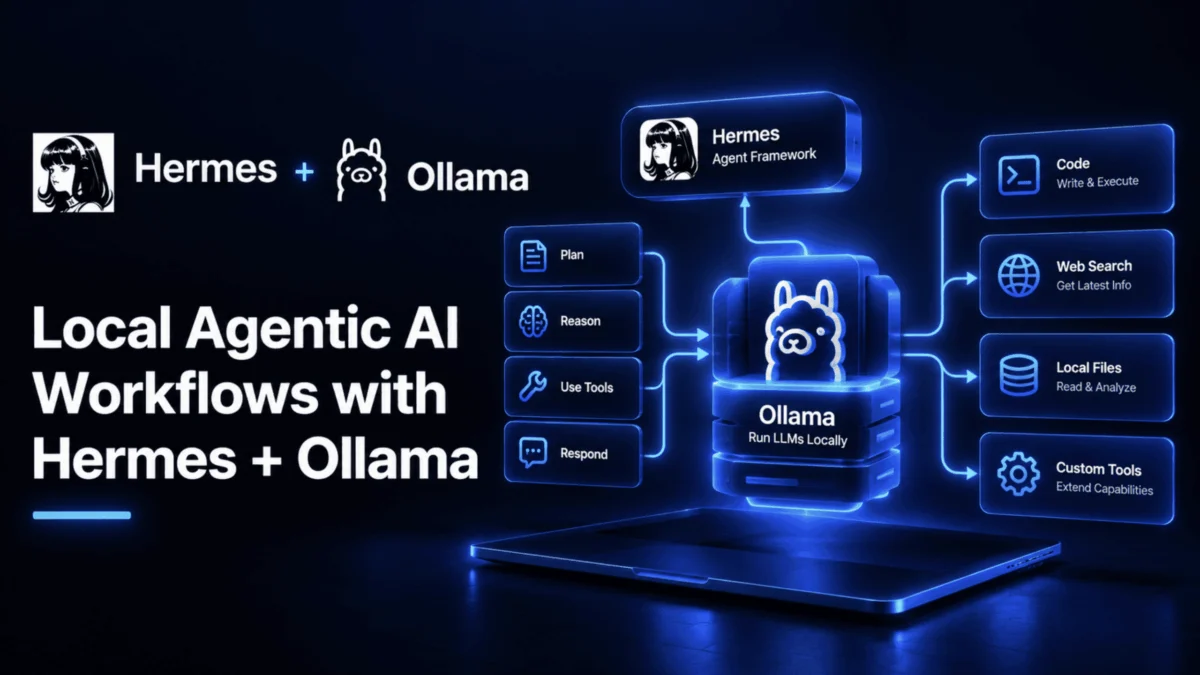

The rapid proliferation of large language models (LLMs) has revolutionized personal and professional productivity, yet this innovation has brought with it a significant financial and privacy-related burden. As developers and power users increasingly rely on agentic AI—systems capable of performing tasks, managing files, and executing code—the cost of cloud-based API usage has become prohibitive. A standard coding session utilizing cloud-native AI can cost anywhere from $0.60 to $0.80 per interaction, with intensive, long-running agentic tasks frequently exceeding $20 per session. Beyond these mounting financial obligations, users are forced to relinquish control over their data, as every file, code snippet, and private conversation must be transmitted to third-party servers. To address these concerns, a new paradigm of local-first computing has emerged, centered on open-source tools like Hermes Agent and Ollama. This architecture allows users to maintain full sovereignty over their hardware and data while achieving enterprise-grade automation at zero marginal cost.
The Evolution of Local Agentic Infrastructure
The shift toward local AI agents is not merely a reaction to cost; it is a fundamental change in how software interacts with sensitive user environments. Historically, AI models were too computationally expensive to run on consumer-grade hardware. However, the release of high-performance, open-weights models and efficient inference engines has democratized access to sophisticated machine intelligence.
Ollama, which serves as the foundational inference layer, provides a robust API for managing and running LLMs locally. It effectively abstracts the complexity of model deployment, offering an OpenAI-compatible endpoint that allows software to communicate with a local model as if it were a cloud-based service. Hermes Agent, developed by Nous Research, acts as the "brain" or the orchestrator. Unlike simple chatbots, Hermes is designed for autonomous action, featuring native capabilities for file system interaction, terminal command execution, and web browsing. By pairing these two technologies, users can construct a closed-loop system where data never traverses a public network.
Chronology and Deployment Strategy
The implementation of a local agentic workflow typically follows a structured deployment sequence designed to ensure stability and performance. The process begins with the installation of the Ollama runtime. As of late 2024 and early 2025, versioning for such tools has reached a level of maturity that allows for seamless integration across Windows, macOS, and Linux.
Once the environment is initialized, the selection of the model becomes the most critical technical decision. For an agent to be truly useful, it must support "tool calling"—a technical capability where the model identifies which software function to invoke based on a user’s prompt. While models like Gemma 2:9B or Llama 3.2:3B are excellent for conversational tasks, they lack the complex reasoning required for reliable tool invocation. Consequently, models in the 30B parameter range, such as Gemma 4:31B, are currently considered the industry standard for local agentic reliability.
After the model is pulled from the registry, the configuration of the Hermes Agent involves pointing its local configuration file to the Ollama API endpoint. This creates a bridge: Hermes issues a prompt; Ollama processes it locally on the CPU or GPU; and Hermes executes the resulting tool-call command locally. This handshake occurs in milliseconds, bypassing the latency inherent in cloud-hosted solutions.
Technical Requirements and Hardware Considerations
While local AI is "zero-cost" in terms of subscription fees, it imposes hardware requirements. The following table summarizes the recommended specifications for maintaining a fluid agentic experience:
| Component | Minimum Specification | Recommended Specification |
|---|---|---|
| RAM | 8 GB | 32 GB or higher |
| Storage | 5 GB available | 50 GB+ for multiple model variants |
| Processor | 4-Core CPU | 8-Core CPU or Apple Silicon M-series |
| GPU | N/A | NVIDIA RTX 30/40 series (8GB+ VRAM) |
For users operating on CPU-only hardware, the response time may vary significantly. A 9B parameter model can achieve a reasonable throughput of 10 tokens per second on a modern processor, whereas a 31B model may drop to 2–5 tokens per second. While this is sufficient for background task automation and file management, it is noticeably slower than cloud-based alternatives, representing the primary trade-off for privacy and cost savings.
Data Privacy and Security Implications
The security profile of a local-first AI workflow is fundamentally different from that of a cloud-based model. In a cloud environment, the service provider acts as a data processor, creating potential attack vectors for data breaches or unauthorized access to proprietary source code. By contrast, a local Hermes Agent environment operates entirely within the user’s "sandboxed" domain.
The sandboxing capabilities integrated into Hermes allow for five distinct isolation backends: local execution, Docker containers, SSH, Singularity, and Modal. This ensures that even if an agent were to execute an erroneous command, the blast radius is limited to the isolated environment, preventing accidental modification of host system files. This architecture is increasingly attractive to enterprise organizations concerned with the leakage of trade secrets and intellectual property via generative AI.
Enhancing Performance and Scalability
To move beyond basic utility, users often implement optimizations to keep the system responsive. One such optimization is the expansion of the context window. Ollama’s default context limit is often insufficient for complex file-based reasoning. By utilizing a "Modelfile," users can define custom parameters, such as increasing the context window to 64,000 tokens. This enables the agent to maintain a "memory" of large projects, reading through multiple files and documentation simultaneously without losing track of the initial instructions.
Furthermore, managing the persistence of the model in VRAM is essential for power users. By default, Ollama may unload models after a period of inactivity to save resources. Configuring the keep_alive parameter to 24 hours ensures that the agent is immediately available, which is particularly beneficial when the agent is accessed via remote gateways like Telegram or Slack.
Broader Industry Impact and Future Outlook
The emergence of Hermes and Ollama represents a broader movement toward "de-centralized intelligence." As AI models become more efficient, the reliance on massive, centralized server farms may diminish for specific, highly personalized tasks. Industry analysts note that this shift could lead to a bifurcation of the AI market: massive, general-purpose models will remain in the cloud, while specialized, context-aware agents will increasingly reside on the edge—directly on user laptops, workstations, and local servers.
This trend is also fostering a new wave of open-source collaboration. Because these tools are MIT-licensed, developers are creating custom "skills" for the Hermes agent, allowing it to interface with niche software or specific industrial protocols. This customization is rarely possible with closed-source, cloud-locked alternatives.
Conclusion
The implementation of a local agentic workflow using Hermes Agent and Ollama provides a sustainable, secure, and cost-effective blueprint for the future of personal computing. By eliminating the per-token cost of traditional AI, users can experiment with automation, file management, and code analysis without fear of escalating expenses or data privacy compromises. While it requires an upfront investment in hardware and a degree of technical configuration, the resulting autonomy is a significant leap forward. As the software matures, the gap between local and cloud-based performance will likely narrow, further entrenching the local-first approach as the preferred standard for developers, researchers, and privacy-conscious professionals.
