
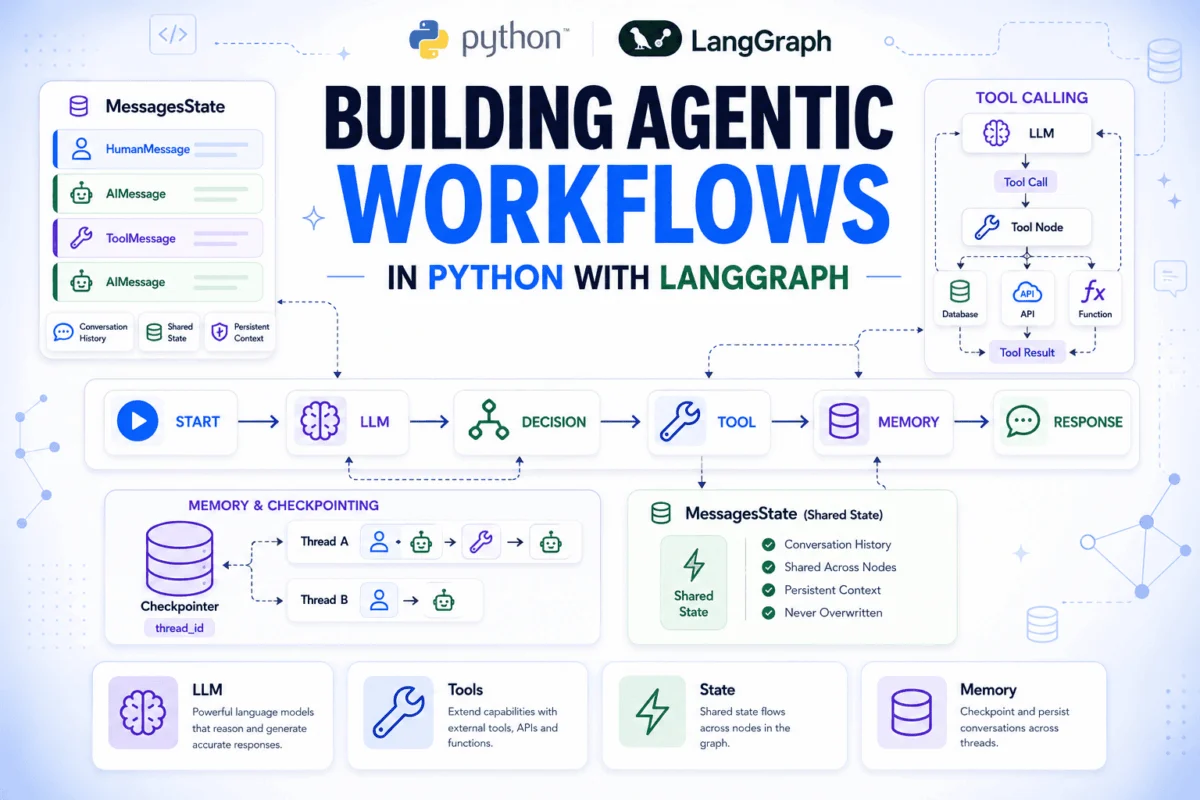

The rapid evolution of artificial intelligence has propelled the development of sophisticated AI agents from theoretical constructs to practical applications, necessitating robust frameworks for their orchestration. While initial AI agent setups often sufficed for single-turn interactions, the real-world demands of complex, multi-step tasks – such as querying databases, maintaining conversational context, and providing transparent decision-making – quickly expose the limitations of ad-hoc implementations. It is in addressing these challenges that LangGraph, a library built atop the popular LangChain ecosystem, emerges as a pivotal tool, offering a structured, graph-based approach to building highly capable and observable AI agents.
The Evolution of AI Agents and the Imperative for Orchestration
The journey from basic chatbots to intelligent, autonomous agents capable of complex reasoning and interaction with external environments marks a significant paradigm shift in AI development. Early large language models (LLMs) excelled at generating human-like text and answering queries within their training data. However, their inherent statelessness and lack of external interaction capabilities limited their utility in dynamic, real-world scenarios. This led to the concept of "AI agents" – systems that can perceive their environment, reason about their observations, decide on actions, and execute those actions to achieve a goal.
The challenges in building such agents are multifaceted. Managing the state of a conversation across multiple turns, especially when an agent needs to remember previous user inputs, its own responses, and intermediate tool outputs, is a non-trivial problem. Furthermore, enabling an agent to interact with external systems – whether internal databases, APIs, or specialized tools – requires a reliable mechanism for tool invocation, result interpretation, and subsequent decision-making. Traditional software development patterns often fall short in elegantly handling the dynamic, non-linear flow of an agent’s reasoning process, leading to brittle and hard-to-debug codebases.
LangGraph directly addresses these pain points by representing an agent’s logic as a directed graph. In this architecture, nodes represent discrete units of work, edges define the flow of execution between these units, and a shared state object meticulously tracks the complete message history and any other relevant information throughout the agent’s operation. This graph-centric approach provides unparalleled visibility into the agent’s decision-making process, making it inspectable, debuggable, and inherently more resilient than linear, hard-coded workflows.
LangGraph’s Foundational Principles: State, Nodes, and Edges
At the core of every LangGraph agent are three fundamental components: State, Nodes, and Edges. A clear understanding of these primitives is crucial for constructing any agentic workflow, from a simple conversational agent to a complex multi-agent system.
State: The Agent’s Shared Memory and Context
The State in LangGraph is defined as a TypedDict, serving as the single source of truth for the entire graph. It functions as the agent’s shared memory, accessible by every node during its execution. When a node processes information, it reads from the current state and returns a dictionary of fields it wishes to update. Any fields not explicitly modified by a node remain unchanged, ensuring a predictable and controlled flow of information. This mechanism is critical for maintaining conversational context, tracking user preferences, or storing intermediate results that multiple nodes might need. The use of TypedDict also brings the benefits of static typing, enhancing code readability and reducing potential errors in complex graphs.
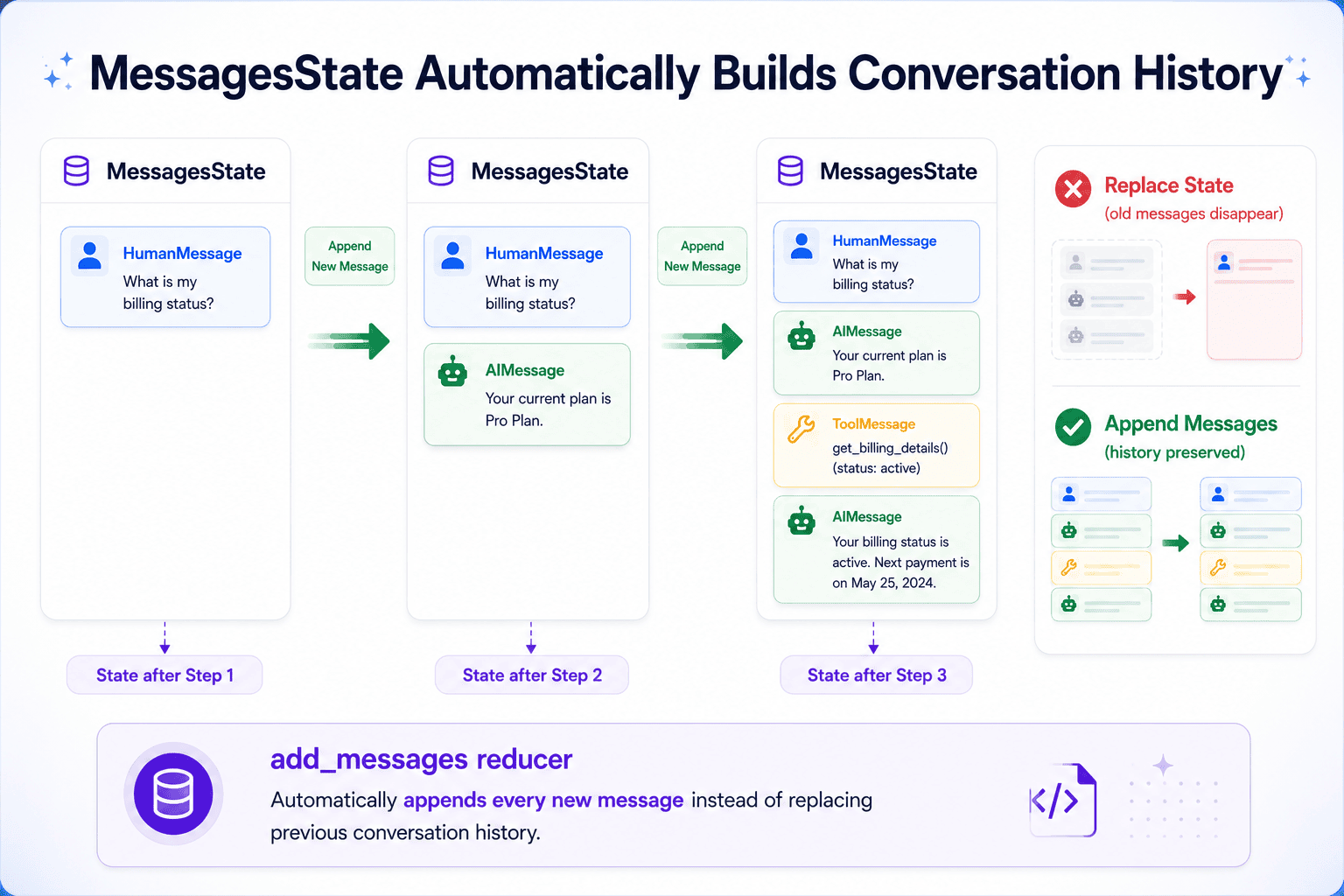
A key feature for managing dynamic state is the concept of reducer functions. By default, when a node returns a value for a state field, it replaces the existing value. However, for fields that need to accumulate information across multiple steps – such as a log of operations or a history of messages – reducer functions like operator.add for lists (which appends elements) can be specified. This powerful feature ensures that critical historical data is preserved and built upon, rather than being overwritten, facilitating the continuity required for sophisticated agent behaviors.
Nodes: Atomic Units of Work
Nodes are the operational backbone of a LangGraph agent. Each node is implemented as a standard Python function, taking the current graph state as its argument and returning a dictionary of state updates. The simplicity of using plain Python functions for nodes promotes modularity, testability, and ease of integration. There is no need for special decorators or base classes; registering a function with StateGraph.add_node() is all that’s required to incorporate it into the graph. This design choice aligns with modern software engineering principles, allowing developers to focus on the logic within each node without being burdened by framework-specific boilerplate. Examples of nodes include invoking a language model, calling an external tool, or performing a data transformation.
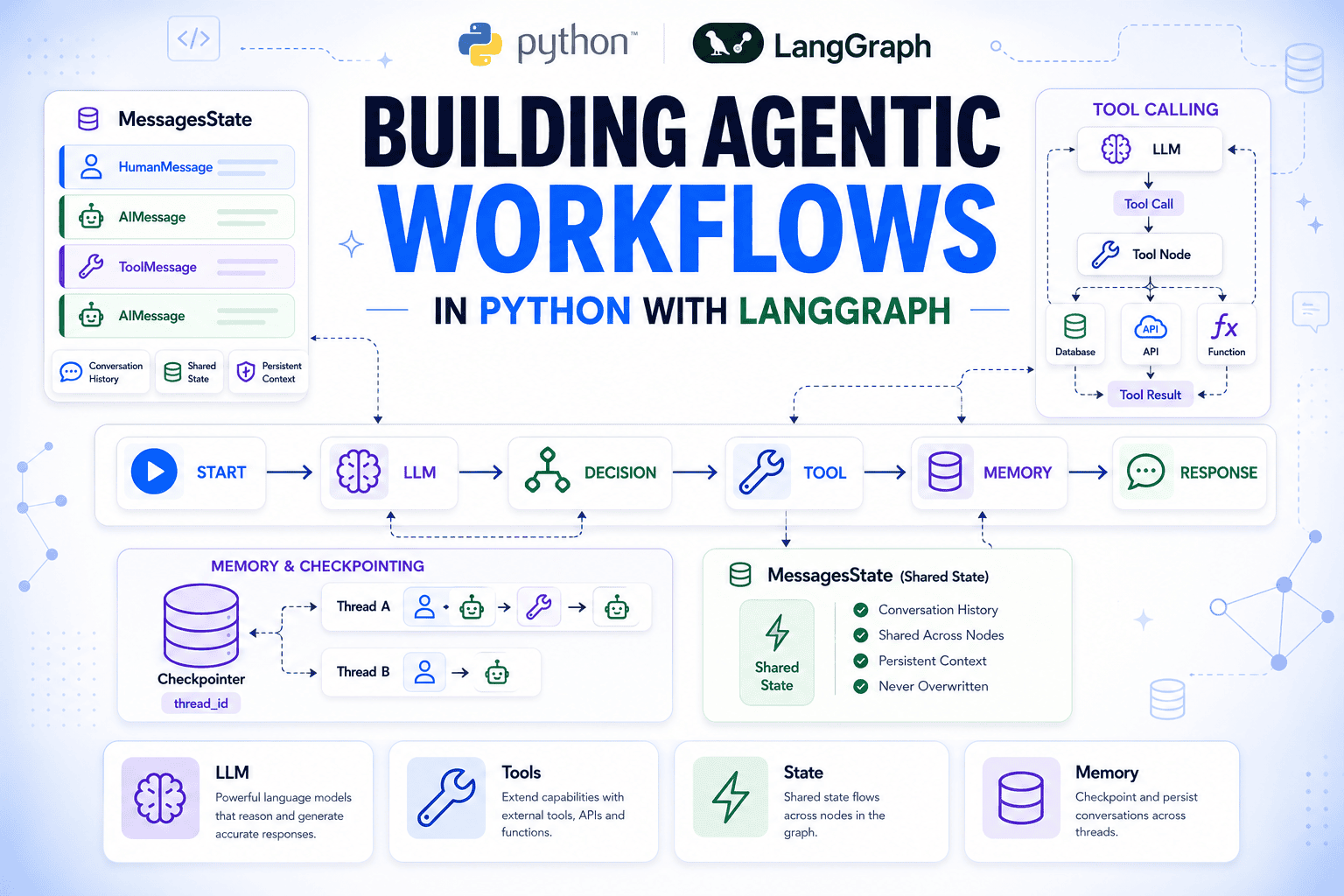
Edges: Orchestrating the Flow of Logic
Edges dictate the execution order within the graph. A basic edge, defined using StateGraph.add_edge(A, B), specifies that node B should run immediately after node A completes its execution. However, the true power of LangGraph’s orchestration lies in its conditional edges, established via StateGraph.add_conditional_edges. This mechanism allows for dynamic routing based on the outcome of a preceding node. After a node A finishes, a designated routing function is invoked. This function analyzes the current state and returns the name of the next node to execute, or __end__ to terminate the graph’s current invocation. This capability is indispensable for building intelligent agents that can adapt their workflow based on intermediate results, user input, or tool outcomes, enabling complex decision trees and dynamic problem-solving paths. Every graph requires a START entry point and at least one path leading to END, defining the boundaries of the agent’s operation.
Streamlining Conversation Memory with MessagesState
For any conversational AI agent, maintaining a coherent and comprehensive history of interactions is paramount. Without it, an agent would effectively suffer from amnesia after each turn, unable to reference past statements or build upon previous context. LangGraph simplifies this critical aspect with its built-in MessagesState.
MessagesState is a specialized TypedDict designed specifically for managing conversational history. It features a single messages field, which, crucially, uses the add_messages reducer function. This reducer intelligently appends new messages to the existing list, rather than replacing it, while also handling deduplication and proper ordering of message objects. This eliminates the common developer headache of manually stitching together conversation history, ensuring that the language model always has access to the full context it needs to generate relevant and informed responses. Developers can extend MessagesState with additional custom fields (e.g., customer_id, session_metadata) to tailor the agent’s memory to specific application requirements, demonstrating its flexibility.
Integrating Language Models: The Agent’s Brain
The core intelligence of any LangGraph agent stems from its integration with language models. Within a LangGraph node, the process of invoking an LLM and incorporating its response into the shared state is remarkably straightforward.
The run_model node typically leverages a chat model interface, such as ChatOpenAI from langchain_openai, which provides a standardized way to interact with various LLM providers. This abstraction allows for seamless swapping between different models (e.g., GPT-4o-mini, Anthropic Claude, Google Gemini, or even local models via Ollama) by simply changing the import and model string, without altering the node’s core logic.
A SystemMessage is frequently used to set the model’s persona, define its role (e.g., "You are a support agent for a SaaS product. Be concise and helpful."), and establish guardrails for its behavior. This message is passed with every invocation but is not permanently stored in the MessagesState, ensuring that the persistent history remains clean and focused solely on the user-agent interaction. The model’s response, typically an AIMessage, is then returned within a dictionary keyed to "messages," which the add_messages reducer automatically appends to the MessagesState. This elegant integration ensures that every thought and response from the LLM becomes an observable part of the agent’s ongoing state.
Empowering Agents with Tools: Bridging LLMs to the Real World
While LLMs are powerful, their knowledge is limited to their training data. To perform actions, retrieve real-time information, or interact with specific domain-bound data (like customer subscription tiers or database records), AI agents require tools. LangGraph facilitates seamless tool integration, allowing agents to transcend their inherent limitations and connect with the external world.
Tools are defined as standard Python functions, enhanced with the @tool decorator from langchain_core.tools. The function’s docstring plays a critical role here, serving as the natural language description that the LLM reads to understand the tool’s purpose, its required arguments, and its expected output. A well-crafted, precise docstring is paramount for enabling the model to accurately decide when to invoke a tool and how to format its arguments. Vague descriptions can lead to missed opportunities for tool use or malformed inputs, hindering the agent’s effectiveness.
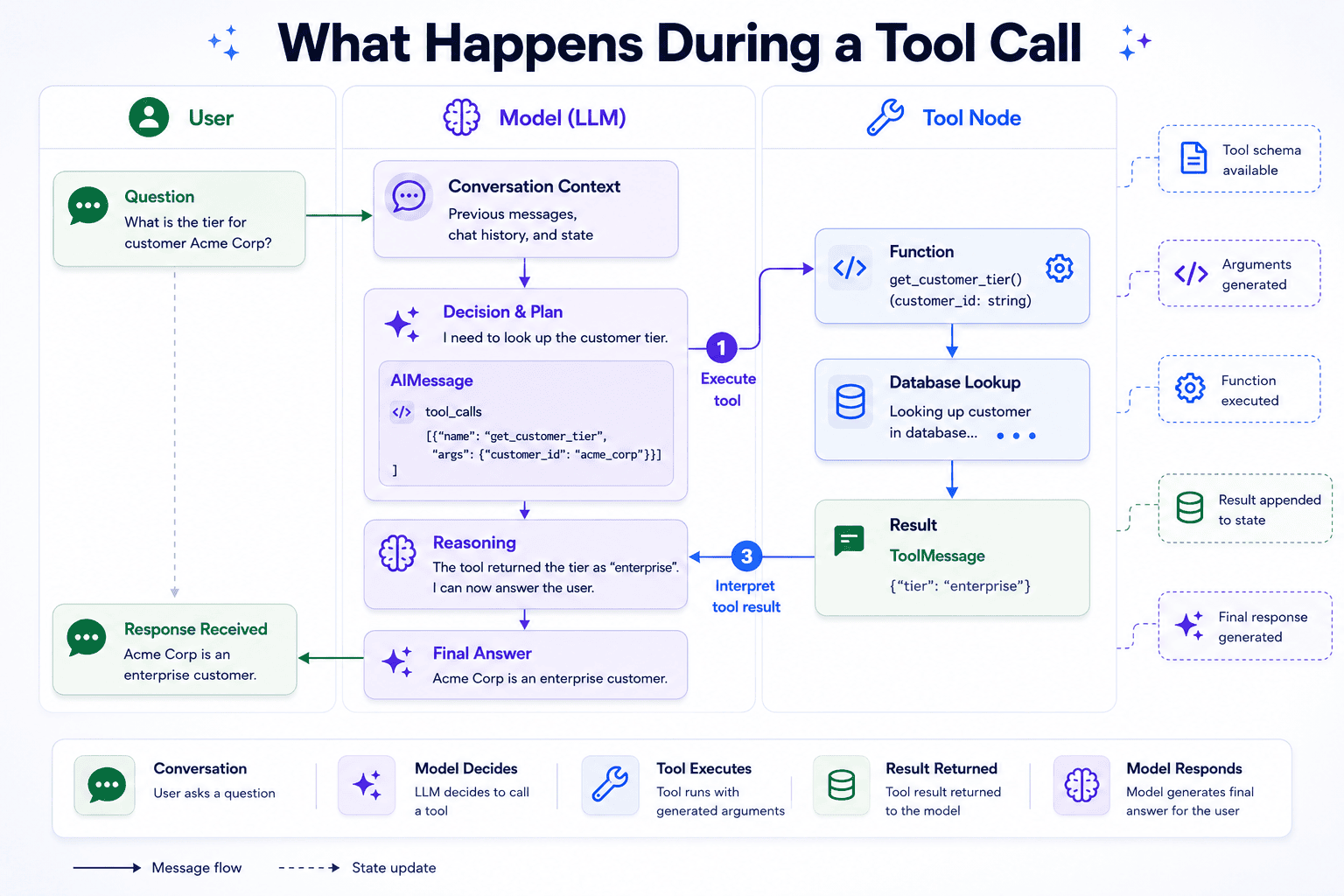
Once defined, tools are bound to the language model using llm.bind_tools(). This process sends the tool’s schema (derived from the function signature and docstring) to the LLM alongside every request. When the model determines that a tool is necessary to fulfill a user’s query, its response is no longer plain text. Instead, it returns an AIMessage with a populated tool_calls field, specifying the tool’s name and the arguments it intends to pass.
The ReAct Pattern in Action
This dynamic interaction between the model and tools perfectly exemplifies the ReAct (Reasoning and Acting) pattern. In a ReAct loop, the agent alternates between "thinking" (generating an AIMessage with potential tool calls) and "acting" (executing the specified tool). LangGraph orchestrates this pattern using the ToolNode and conditional routing.
The ToolNode, a prebuilt component in LangGraph, is responsible for executing the tools specified in the tool_calls field of the last AIMessage. It takes the output of the tool and wraps it in a ToolMessage, which is then appended to the shared state. Following the execution of a tool, a tools_condition function (a conditional edge) checks the last AIMessage. If tool_calls are present, it routes back to the run_model node, allowing the LLM to interpret the tool’s output and continue its reasoning. If no tool_calls are found, it routes to __end__, signifying the completion of the agent’s turn.
This iterative process – model decides, tool executes, model interprets, model responds – is a powerful mechanism for complex problem-solving. It’s important to note that each tool use typically incurs two model calls: one to decide what to do and another to interpret the tool’s result and formulate a final answer. This has implications for latency and computational cost, a key consideration for developers designing scalable agentic systems.
Tracing the Reasoning Loop: Gaining Observability
One of the significant advantages of LangGraph’s explicit graph structure is the inherent observability it provides. By logging or inspecting the sequence of messages within the MessagesState, developers can meticulously trace the agent’s entire reasoning loop. This transparency is invaluable for debugging, understanding unexpected agent behavior, and optimizing the agent’s prompts and tool definitions.
When an agent utilizes a tool, the message history reveals a sequence like:
- HumanMessage: The initial user query.
- AIMessage (with
tool_calls): The model’s decision to call a tool, including the tool name and arguments. Itscontentfield will typically be empty here. - ToolMessage: The result returned by the executed tool.
- AIMessage (with
content): The model’s interpretation of the tool result and its final, natural language answer to the user.
This granular view allows developers to pinpoint exactly where an agent might be misinterpreting a prompt, failing to call a tool, or misinterpreting a tool’s output. This level of transparency is a significant improvement over monolithic black-box AI systems, fostering trust and enabling continuous improvement.
Ensuring Continuity: Persisting Conversations with Checkpointers
For practical, user-facing AI agents, the ability to remember past interactions across separate invocations is not merely a convenience but a necessity. Without persistence, every interaction with the agent would start from a blank slate, leading to a fragmented and frustrating user experience. LangGraph addresses this with its robust checkpointer mechanism.
A checkpointer stores the complete graph state for a given "thread" (representing a single conversation or session). By attaching a checkpointer when compiling the graph (e.g., InMemorySaver for development, or a database-backed solution for production), the agent can automatically save its state after each turn and restore it before the next.
The process involves providing a unique thread_id (e.g., "ticket-7741", "user-abc-session-123") with every graph.invoke() call. If a state for that thread_id exists, the checkpointer loads it, allowing the agent to pick up exactly where it left off. After the current turn, the updated state is saved back to the checkpointer. This seamless state management ensures that users can have multi-turn conversations, resume sessions after a break, and that the agent maintains context over extended periods.
While InMemorySaver is excellent for rapid prototyping and testing due to its simplicity, production deployments typically demand more durable and scalable solutions. LangGraph supports various persistent checkpointers that can be backed by databases (e.g., SQLite, PostgreSQL) or other storage mechanisms, ensuring that conversational history is preserved even across application restarts or system failures. The beauty of this design is that the core graph code remains unchanged, offering flexibility in deployment without re-architecting the agent’s logic.
Checkpointers vs. Stores: Differentiating Persistent Data
It’s crucial to distinguish between LangGraph’s checkpointers and stores. Checkpointers are specifically designed to persist the graph state for a particular conversational thread. They save and restore the exact snapshot of the agent’s internal memory and messages.
Stores, on the other hand, provide durable application-level storage for data that exists independently of any single conversation. This might include user profiles, system configurations, long-term memories shared across multiple agent threads, or complex knowledge bases. Agents can access and update stores during their execution, but stores are not tied to a specific thread_id in the same way checkpointers are. Stores complement checkpointers by providing a mechanism for agents to access and modify persistent data that transcends individual conversational boundaries, enabling more sophisticated and personalized agent behaviors.
The Broader Landscape: Implications and Future Directions
LangGraph represents a significant step forward in democratizing the development of advanced AI agents. By providing a clear, modular, and observable framework, it lowers the barrier for developers to build complex, multi-step AI applications that were once the domain of highly specialized research teams. The graph-based approach inherently promotes good software engineering practices, such as modularity, testability, and clear separation of concerns, which are vital for maintaining and scaling sophisticated AI systems.
The implications of such frameworks are far-reaching. In customer service, agents can move beyond simple FAQs to perform complex diagnostic steps, retrieve account-specific information, and even initiate corrective actions. In data analysis, agents can orchestrate intricate data pipelines, running queries, generating visualizations, and interpreting results. For personal assistants, the ability to remember context, use tools, and adapt workflows leads to truly intelligent and helpful companions.
Furthermore, the foundational primitives of LangGraph – state, nodes, and edges – are not limited to single-agent systems. They scale elegantly to multi-agent systems, where multiple specialized agents cooperate to solve a larger problem. A coordinator agent, for instance, can be designed as a graph that routes requests to different specialist agents, each of which might itself be a LangGraph agent. This hierarchical and collaborative architecture opens the door to building highly resilient and capable AI systems that can tackle challenges currently beyond the scope of monolithic LLMs.
While powerful, developers should also consider the trade-offs. More complex graphs can introduce higher latency due to multiple turns and tool calls. Cost implications also arise from increased LLM invocations. However, the benefits of enhanced reliability, transparency, and capability often outweigh these considerations, particularly for critical enterprise applications. As the field of AI continues to mature, frameworks like LangGraph will undoubtedly play a central role in shaping the next generation of intelligent, autonomous systems.
