
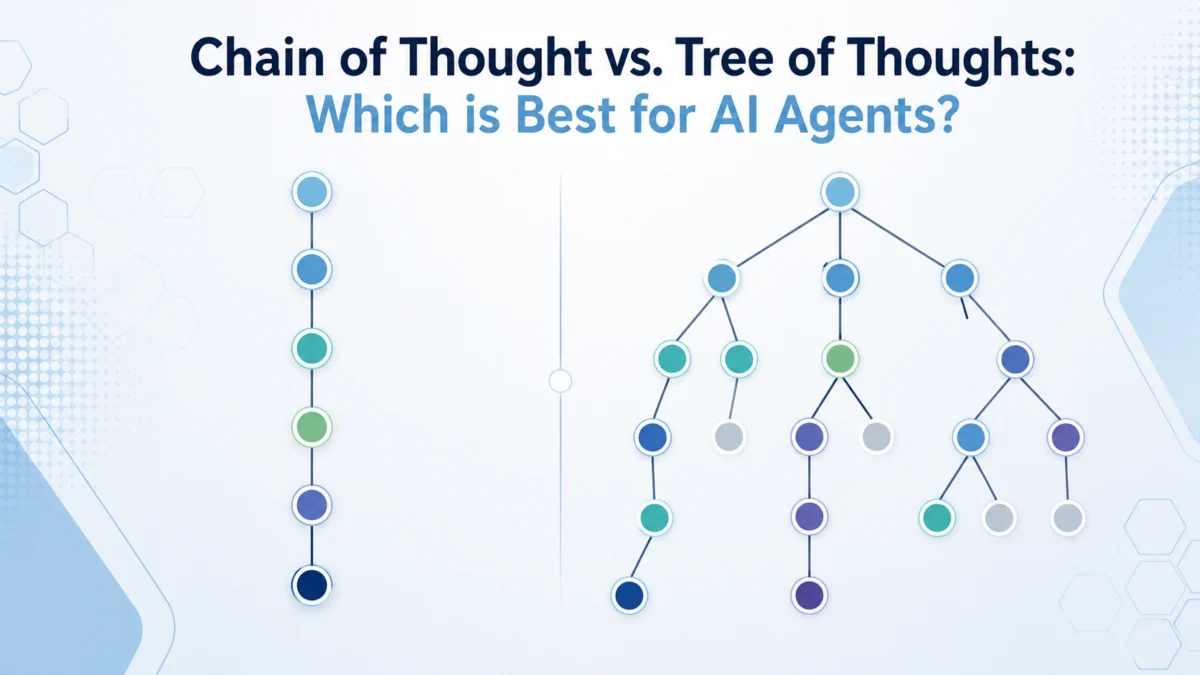

Large language models (LLMs) operate fundamentally on a probabilistic basis, predicting the next token in a sequence based on training data patterns. While this architecture allows for remarkable fluency, it creates a structural deficiency in complex reasoning: models are predisposed to bypass deep analysis in favor of immediate, pattern-matched responses. This tendency toward "fast thinking" often results in logical fallacies, hallucinated facts, and errors in multi-step planning. To mitigate these shortcomings, researchers have developed two primary reasoning frameworks—Chain of Thought (CoT) and Tree of Thoughts (ToT)—that force models to decompose problems into modular segments before concluding. The selection between these two frameworks represents a critical engineering decision in the development of autonomous AI agents, directly impacting latency, cost, and task success rates.
The Evolution of Machine Reasoning
The historical trajectory of LLM development shows a clear shift from simple query-response patterns toward complex, multi-stage reasoning. In the early era of generative AI, models were evaluated primarily on their ability to complete text or answer basic factual queries. However, as developers pushed these systems toward enterprise applications, the limitations of "zero-shot" reasoning became evident.
The concept of Chain of Thought was formally popularized around 2022 by researchers at Google, who demonstrated that by encouraging a model to "show its work," performance on arithmetic and symbolic reasoning tasks improved significantly. Shortly thereafter, in early 2023, the academic community introduced Tree of Thoughts to address the fragility of linear reasoning. This evolution reflects a broader trend in artificial intelligence: moving from static, monolithic outputs to dynamic, process-oriented workflows.
Chain of Thought: The Linear Paradigm
Chain of Thought functions as a structured approach to problem-solving that requires the model to articulate a sequence of intermediate reasoning steps. By inserting these steps between the input and the final output, the model creates a "trail" that allows the final conclusion to be derived from logical progression rather than probabilistic association.
The primary mechanism for CoT is often as straightforward as prompting the model with the instruction: "Let’s think step by step." This simple intervention acts as a cognitive constraint, forcing the model to allocate more tokens to the reasoning process.
Strengths and Limitations:
- Efficiency: CoT is computationally inexpensive compared to more advanced search algorithms, requiring only a single forward pass through the model.
- Transparency: Because the reasoning is linear, it is highly auditable. Developers can trace where a model went wrong, making it an ideal choice for debugging and monitoring AI behavior.
- The "Error Cascade" Problem: The fundamental weakness of CoT is its inability to self-correct. Because the process is linear, a single logical error at step two will propagate through all subsequent steps, inevitably leading to a faulty conclusion. Once the model commits to a path, it cannot backtrack, meaning it lacks the ability to explore alternative hypotheses.
Tree of Thoughts: The Branching Strategy
Tree of Thoughts (ToT) addresses the limitations of linear reasoning by introducing a search-based framework inspired by classical computer science algorithms, such as Breadth-First Search (BFS) and Depth-First Search (DFS). In this model, the system treats reasoning as a tree structure where each "thought" is a node.
At each step, the model generates multiple potential next steps (branches). A secondary evaluation process—which can be a heuristic function or a separate LLM call—scores these branches based on their likelihood of leading to a correct outcome. If a branch proves unproductive, the system discards it and backtracks to a previous, more promising node.
Technical Implications:
- Computational Cost: The primary drawback of ToT is its resource intensity. If a model generates three potential paths at every step over a five-step process, the system may require dozens of individual model inferences. This results in significantly higher latency and increased API costs.
- Error Recovery: Unlike CoT, ToT is inherently self-correcting. By maintaining a state-space of possibilities, the system can abandon "dead-end" logic, effectively simulating human trial-and-error reasoning.
- Search Algorithms: The sophistication of ToT is often determined by the underlying search algorithm. Advanced implementations use tree-search algorithms to prioritize paths, allowing the agent to focus its computational budget on the most promising avenues of inquiry.
Comparative Analysis: Data and Performance
Data from recent benchmarks—such as the Game of 24, creative writing, and cross-domain planning tasks—indicate that ToT consistently outperforms CoT in complex problem domains. For instance, in tasks requiring creative problem-solving or non-linear planning, ToT has demonstrated success rates up to 70% higher than CoT.
However, this performance delta is highly dependent on the task. In standard mathematical benchmarks, the performance gain of ToT over CoT is marginal, often not justifying the 10x or 20x increase in token usage. The following table summarizes the trade-offs:
| Feature | Chain of Thought (CoT) | Tree of Thoughts (ToT) |
|---|---|---|
| Reasoning Path | Linear | Branching/Non-linear |
| Error Handling | None (Propagates) | Active (Backtracking) |
| Latency | Low | High |
| Cost | Low | High |
| Ideal Use Case | Routine/Simple Logic | Strategic/Creative/Complex |
Implications for AI Agent Architecture
For developers building autonomous agents—systems that can interact with APIs, manage databases, and execute multi-step workflows—the choice of reasoning framework dictates the "intelligence" of the agent.
In practice, high-performing agents utilize a hybrid approach. The reasoning framework is treated as a modular component, with the system dynamically switching between CoT and ToT based on the complexity of the incoming task. A sophisticated agent might first perform a "classification" step to determine the difficulty of the user’s request. If the request is a simple data retrieval task, it employs CoT to save time and money. If the request involves, for example, designing a software architecture or conducting multi-variable market research, the agent triggers a ToT workflow.
Future Perspectives
Industry leaders and AI researchers suggest that the next phase of agent development will focus on "adaptive reasoning." Rather than forcing developers to choose between CoT and ToT, future systems will likely be capable of self-determining the optimal search depth. If a model detects a high degree of uncertainty in its own reasoning, it may autonomously shift from a linear chain to a branching tree.
As the underlying models become more efficient, the "cost barrier" of ToT is expected to drop, potentially making it the default reasoning mode for all high-stakes agentic interactions. However, until such efficiency gains are realized, the strategic allocation of reasoning resources remains a hallmark of high-quality AI engineering. By understanding the structural differences between these frameworks, developers can ensure that their agents balance the competing needs of accuracy, speed, and cost-effectiveness.
