
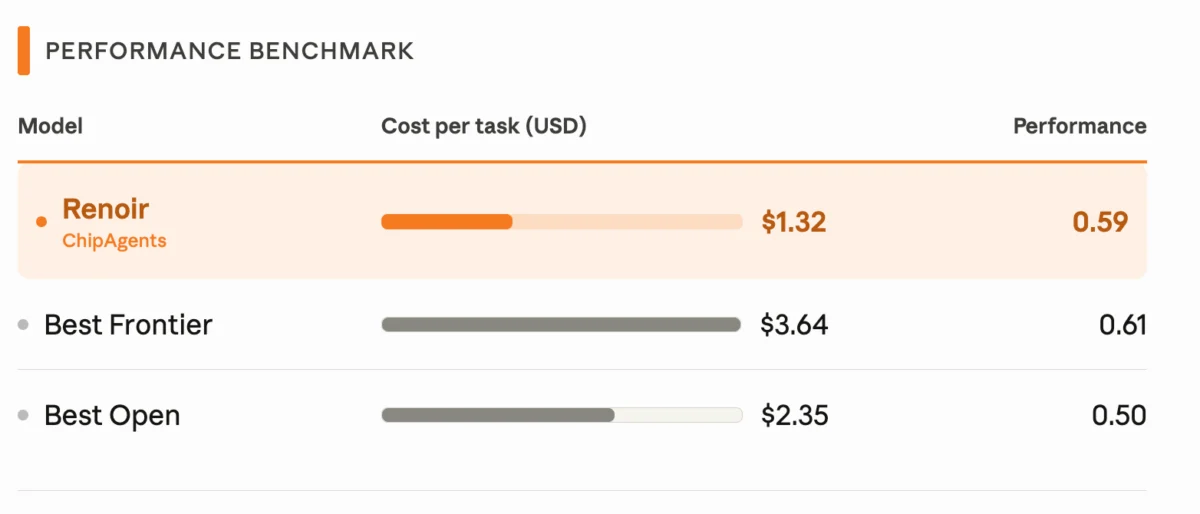

The semiconductor industry is witnessing a transformative shift in design methodology with the introduction of Renoir, a specialized agentic large language model (LLM) developed by the research team at ChipAgents. Named after the French word for "renew," Renoir represents a significant leap forward in the application of generative artificial intelligence to hardware engineering. By fine-tuning an open-weight, mixture-of-experts (MoE) architecture on proprietary and curated semiconductor datasets, ChipAgents has produced a model that matches the performance of frontier-level closed models while addressing the unique security and economic constraints of the chip design sector. In early benchmarking, Renoir has demonstrated the ability to outperform its base model significantly while reducing operational costs by more than 50%, signaling a new era of localized, high-performance AI for electronic design automation (EDA).
The development of Renoir was driven by a trio of systemic challenges that have historically hindered the adoption of general-purpose LLMs, such as OpenAI’s GPT-4 or Anthropic’s Claude, within the semiconductor workspace. While software engineering has benefited immensely from AI-driven coding assistants, the hardware domain faces distinct hurdles: data scarcity, stringent intellectual property (IP) security requirements, and the prohibitive costs and latencies associated with external cloud-based APIs. By creating a model that can run entirely on-premises and within air-gapped environments, ChipAgents aims to provide semiconductor firms with the tools to accelerate development cycles without compromising the integrity of their most sensitive design files.
The Evolution of AI in Semiconductor Design
The trajectory of semiconductor design has always been defined by the quest for higher levels of abstraction. From manual layout to the advent of Register Transfer Level (RTL) design and Electronic Design Automation (EDA) tools in the 1980s and 90s, the industry has constantly sought ways to manage increasing complexity. However, the recent explosion in generative AI presented a paradox for chip designers. While the potential for AI to assist in Verilog coding, bug localization, and specification-to-code translation was clear, the practical application was stalled by the nature of the industry’s data.
Unlike general software engineering, where massive repositories of open-source code are available on platforms like GitHub, the vast majority of semiconductor design knowledge is proprietary. This data scarcity means that general-purpose LLMs often lack the deep, domain-specific nuance required for high-fidelity hardware design. Furthermore, the semiconductor industry is arguably the most IP-sensitive sector in the global economy. A single leak of a next-generation architecture could result in billions of dollars in lost competitive advantage. Consequently, the reliance on third-party cloud environments for AI inference was a non-starter for many major players. Renoir was designed specifically to bridge this gap, offering a "walled garden" approach to AI training and deployment.
Technical Architecture and Training Methodology
At the core of Renoir is a mixture-of-experts (MoE) large language model. Unlike traditional dense models where every parameter is activated for every token generated, an MoE architecture uses a gating mechanism to activate only a subset of specialized "expert" networks for any given task. This allows the model to possess a vast knowledge base while remaining computationally efficient during inference. ChipAgents selected an open-weight MoE base to ensure transparency and the ability to deploy on local hardware.
The fine-tuning process involved a multi-stage training stack developed by ChipAgents. This stack utilized a carefully curated mix of public semiconductor data—including technical documentation, academic papers, and open-source RTL—combined with high-quality proprietary data generated through internal curation methods. This synthetic and curated data approach is critical in overcoming the "data desert" of hardware engineering. By training the model on specific hardware description languages (HDLs) like Verilog and VHDL, as well as internal debugging logs and natural language specifications, the researchers were able to sharpen the model’s reasoning capabilities in a way that general-purpose models cannot replicate.
Performance Benchmarks and Cost Analysis
The efficacy of Renoir was evaluated using an internal chip design benchmark suite developed by ChipAgents. This suite is designed to mimic the day-to-day workflows of hardware engineers, focusing on three primary categories: RTL generation, bug localization, and the translation of natural language specifications into functional code.
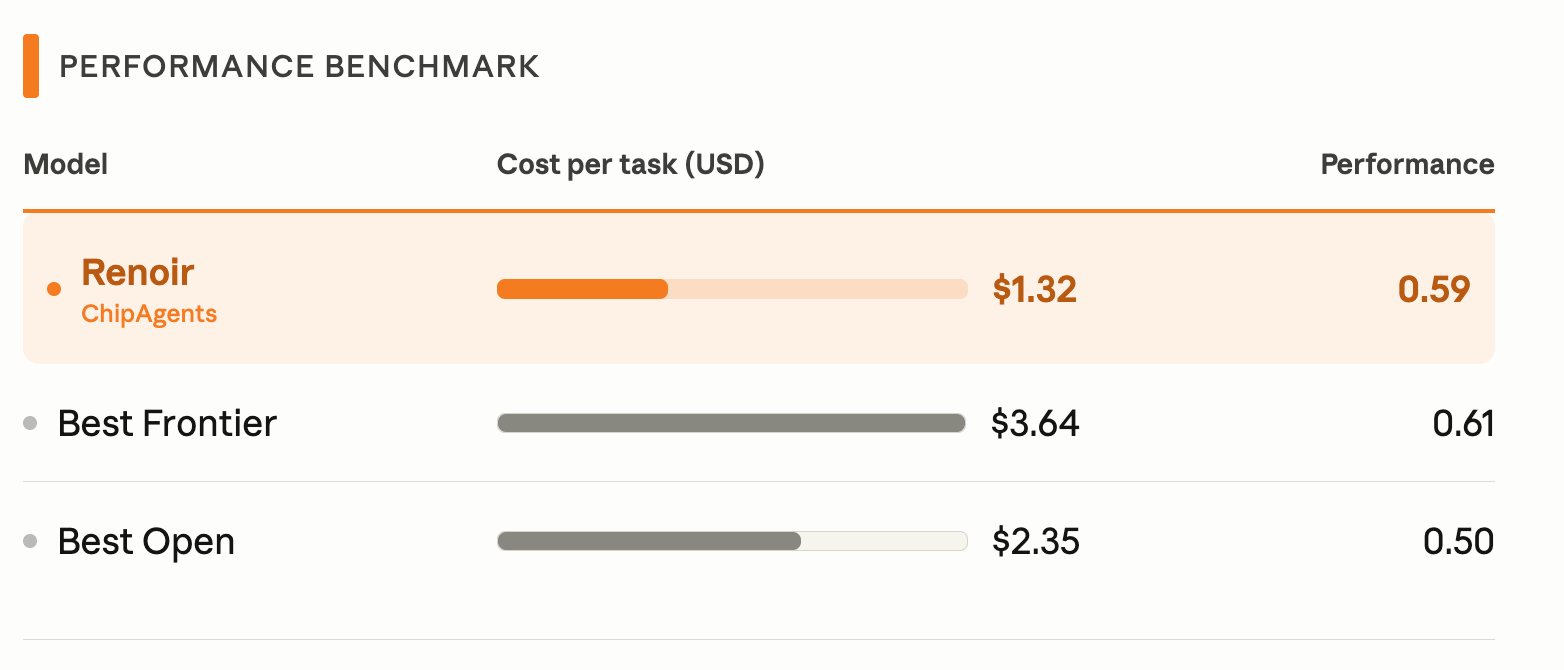
In these tests, Renoir achieved performance levels approaching Claude Opus 4.6, currently considered one of the most capable frontier models in the world. Specifically, in the natural language specification-to-code implementation task, Renoir demonstrated a sophisticated understanding of complex hardware constraints that often trip up general models. When compared to its own base model—the un-fine-tuned version of the MoE LLM—Renoir showed a marked improvement in both accuracy and the "cleanliness" of the generated code, producing fewer syntax errors and more efficient logic structures.
From an economic perspective, Renoir represents a "Pareto-optimal" solution on the cost-performance frontier. By optimizing the model for local inference, ChipAgents has eliminated the per-token billing cycles common with cloud providers. In a production environment, this translates to a cost reduction of over 50% compared to using frontier-grade external APIs. Additionally, because the model runs on local infrastructure, teams can avoid the latency issues inherent in cloud communication, leading to a more seamless integration into the engineer’s IDE (Integrated Development Environment).
Security and the Air-Gapped Advantage
For semiconductor giants, the primary value proposition of Renoir is security. The industry operates under strict compliance and IP protection policies that often forbid the transmission of code or logs to external servers. Renoir’s ability to operate in an air-gapped environment—disconnected from the public internet—is a critical feature.
This local deployment allows companies to maintain full ownership of their data and security policies. It also enables a unique "virtuous cycle" of training: as engineers use the model locally, the resulting debugging logs and corrected code can be fed back into the model for further fine-tuning within the company’s own secure infrastructure. This ensures that the AI becomes more specialized to the company’s specific architectural style and internal standards over time, without that knowledge ever leaving the premises.

Chronology of Development and Future Outlook
The development of Renoir followed a structured research and development timeline:
- Phase 1: Limitation Assessment: The ChipAgents team spent the initial months identifying the specific failures of general LLMs in hardware contexts, focusing on the lack of Verilog-specific reasoning.
- Phase 2: Data Curation: The team developed a proprietary training stack to synthesize and curate high-quality semiconductor data, addressing the scarcity of public hardware repositories.
- Phase 3: Fine-Tuning and Optimization: The MoE architecture was selected and fine-tuned using a constrained budget of compute and time to establish a performance baseline.
- Phase 4: Benchmarking and Validation: The model was put through rigorous internal testing against industry-standard models to verify its "frontier-grade" status.
- Phase 5: Collaborative Expansion: ChipAgents has now moved into a phase of active collaboration with industry partners to create bespoke versions of Renoir trained on specific corporate "walled garden" datasets.
The current iteration of Renoir is described by the research team as an "audition." Despite the constrained budget of data and compute used for the initial version, the results have been robust enough to justify larger-scale training runs. The team, led by researchers Tanay Biradar, Surya Gunukula, Tengxiao Liu, and Kexun Zhang, expects performance to continue its upward trajectory as larger datasets and longer training durations are applied.
Broader Industry Implications
The introduction of Renoir has significant implications for the broader semiconductor ecosystem. As chip complexity grows—driven by the demands of AI, 5G, and automotive electronics—the "design gap" (the difference between what can be manufactured and what can be designed within a reasonable timeframe) continues to widen. Agentic AI models like Renoir offer a potential solution to this productivity crisis.
By automating the more rote aspects of RTL generation and providing rapid bug localization, Renoir allows human engineers to focus on higher-level architectural innovation. Furthermore, the shift toward on-premises AI may force established EDA vendors to rethink their cloud-first strategies. If semiconductor companies prioritize "sovereign AI" that they can control and customize, the demand for open-weight models and local hardware acceleration for AI inference will likely surge.
In the long term, ChipAgents envisions Renoir becoming the defining frontier agent model for the industry. By working within the walled gardens of the world’s leading chipmakers, Renoir is positioned to evolve into a highly specialized assistant that understands the unique "dialects" of hardware design used by different firms. As the project moves beyond its initial audition, the semiconductor industry may finally have an AI tool that is as secure as it is intelligent, marking a renewal of how the world’s most complex hardware is conceived and verified.
