

The Evolving Landscape of AI Agents and the Memory Imperative
The rapid advancement of AI, particularly in large language models (LLMs) and agentic systems, has underscored the critical role of memory. Early conversational AI systems often struggled with maintaining context beyond a few turns, leading to frustrating user experiences where agents "forgot" previously provided information. As AI agents transition from simple chatbots to more autonomous, task-oriented entities capable of complex interactions, problem-solving, and even learning, the demand for sophisticated memory management has escalated. Industry reports from entities like Gartner and McKinsey consistently highlight that robust context management, including effective memory, is a key differentiator for successful AI deployments, with studies indicating that up to 40% of AI project failures can be attributed to inadequate context handling, a category where memory plays a central role.
Memory in an AI agent is not a monolithic concept; it encompasses various mechanisms designed to store, retrieve, and process different types of information over varying durations. Just as human cognition relies on short-term, long-term, semantic, and episodic memory, AI agents require a diverse memory portfolio. The challenge lies in determining how long specific pieces of information should persist, how they should be retrieved, and what form they should take. Failing to address these questions leads to common pitfalls: agents re-asking for information, providing irrelevant responses due or to stale data, or incurring excessive computational costs by searching vast, undifferentiated data stores. Leading AI researchers, such as those at DeepMind and OpenAI, consistently emphasize that the development of more "human-like" AI hinges on sophisticated memory systems that can mimic cognitive functions like recall, learning, and adaptation.
Understanding the Core Memory Layers in AI Agents
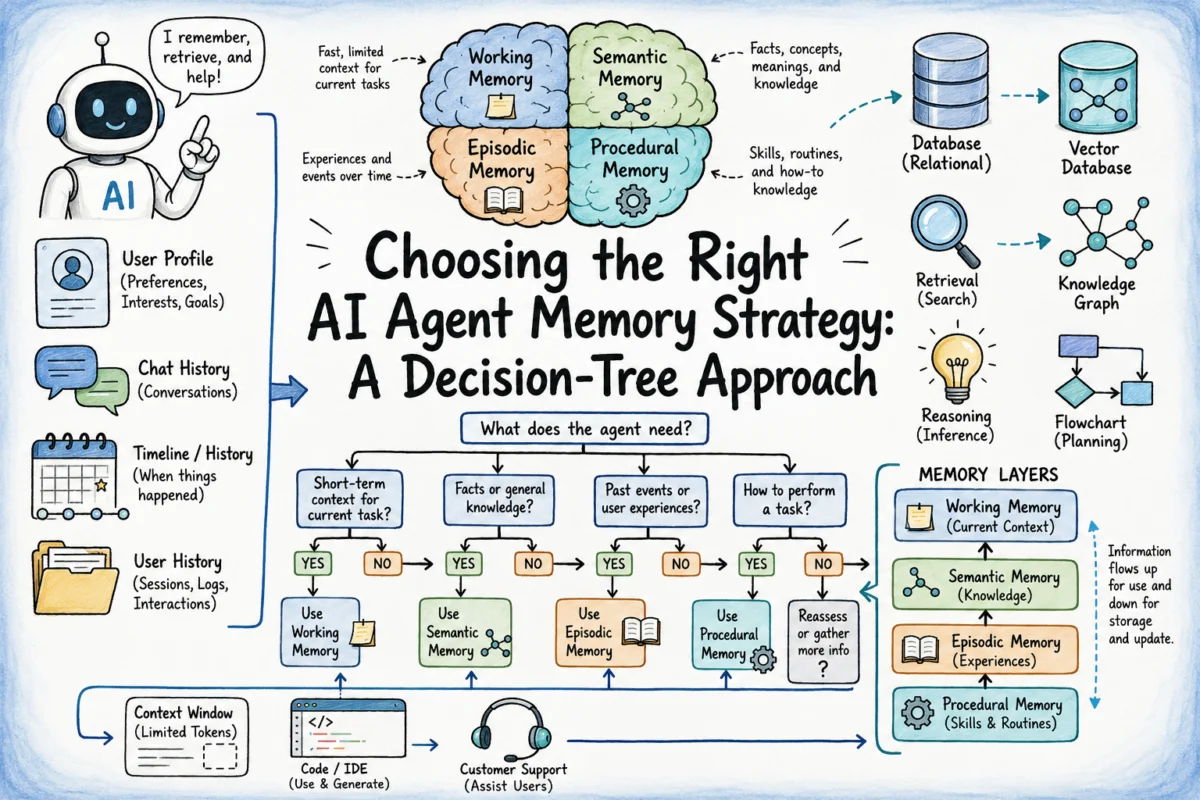
Before delving into the decision tree, it’s crucial to understand the fundamental memory layers and their inherent assumptions about information. These layers are often conceptualized to mirror human cognitive memory types, each serving a distinct purpose:
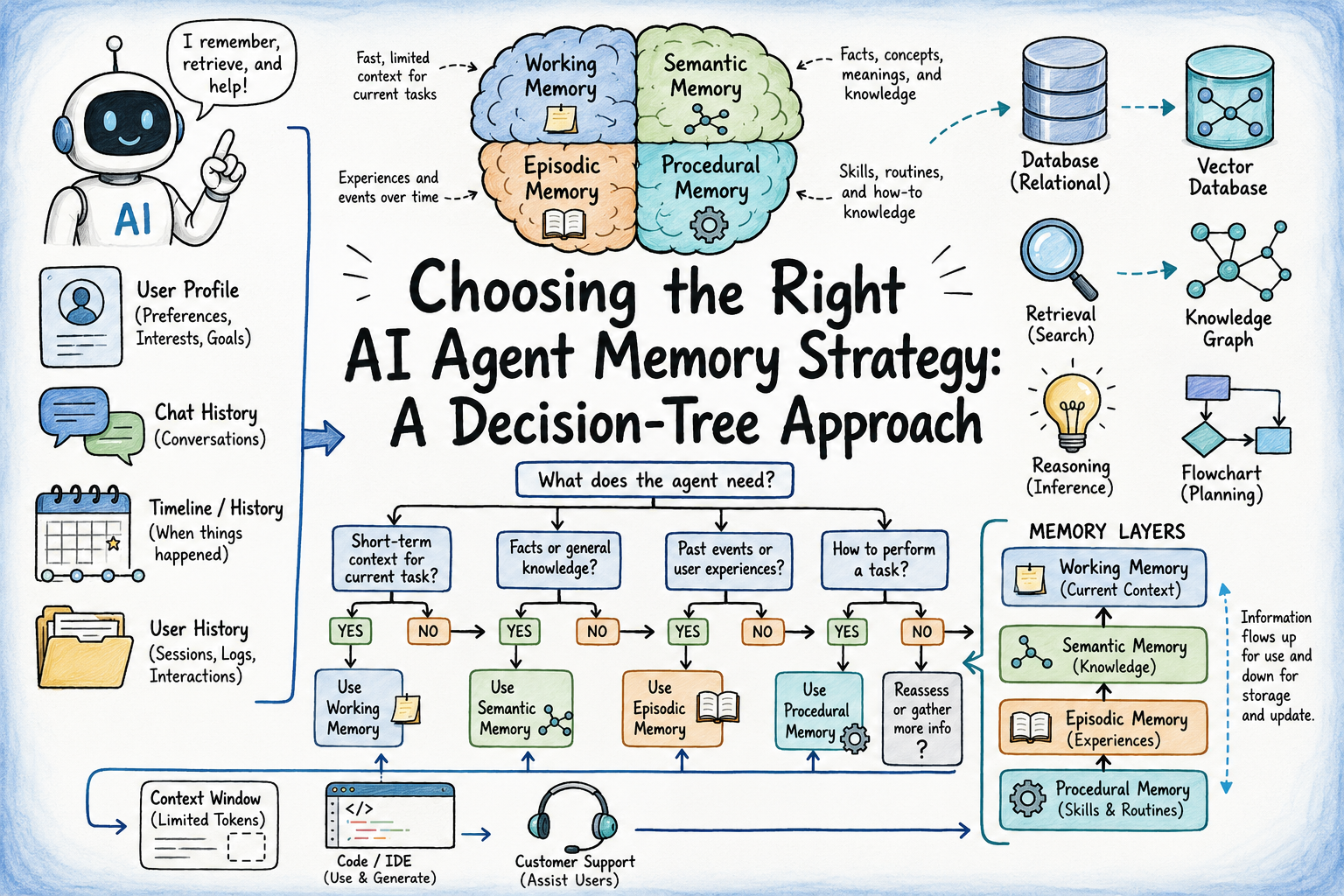
- Working Memory: This layer is analogous to human short-term memory. It holds information relevant to the immediate conversation or task, typically for the duration of a single interaction session. It’s designed for rapid access and frequent updates, crucial for maintaining conversational flow and immediate context.
- Semantic Memory: This layer stores stable facts, generalized knowledge, and conceptual understanding. It’s akin to human long-term knowledge of facts and concepts (e.g., "Paris is the capital of France"). Information here is typically structured, durable, and persists across sessions, often forming the agent’s foundational knowledge base.
- Episodic Memory: This layer stores specific events, past interactions, and experiences, often with temporal and contextual details. Similar to human episodic memory (e.g., "I met John last Tuesday at the coffee shop"), it allows the agent to recall past events, learning from successes and failures, and understanding the history of interactions with a user or environment.
- Procedural Memory: This advanced layer stores learned routines, skills, and "how-to" knowledge. It enables the agent to remember and execute sequences of actions or strategies that have proven effective in the past. This is crucial for agents that need to automate complex tasks and improve their performance over time, moving beyond explicit instructions to internalized "habits" or workflows.
The interplay of these layers is what gives an advanced AI agent its intelligence and adaptability. For instance, a sophisticated customer support agent might leverage working memory for the immediate query, semantic memory for product specifications and company policies, episodic memory for a customer’s past complaint history, and procedural memory for a learned escalation protocol for complex issues. Each layer is critical, and misplacing information within them can lead to inefficiency, inaccuracy, and a degraded user experience.
The Decision Tree for Optimal AI Agent Memory Strategy
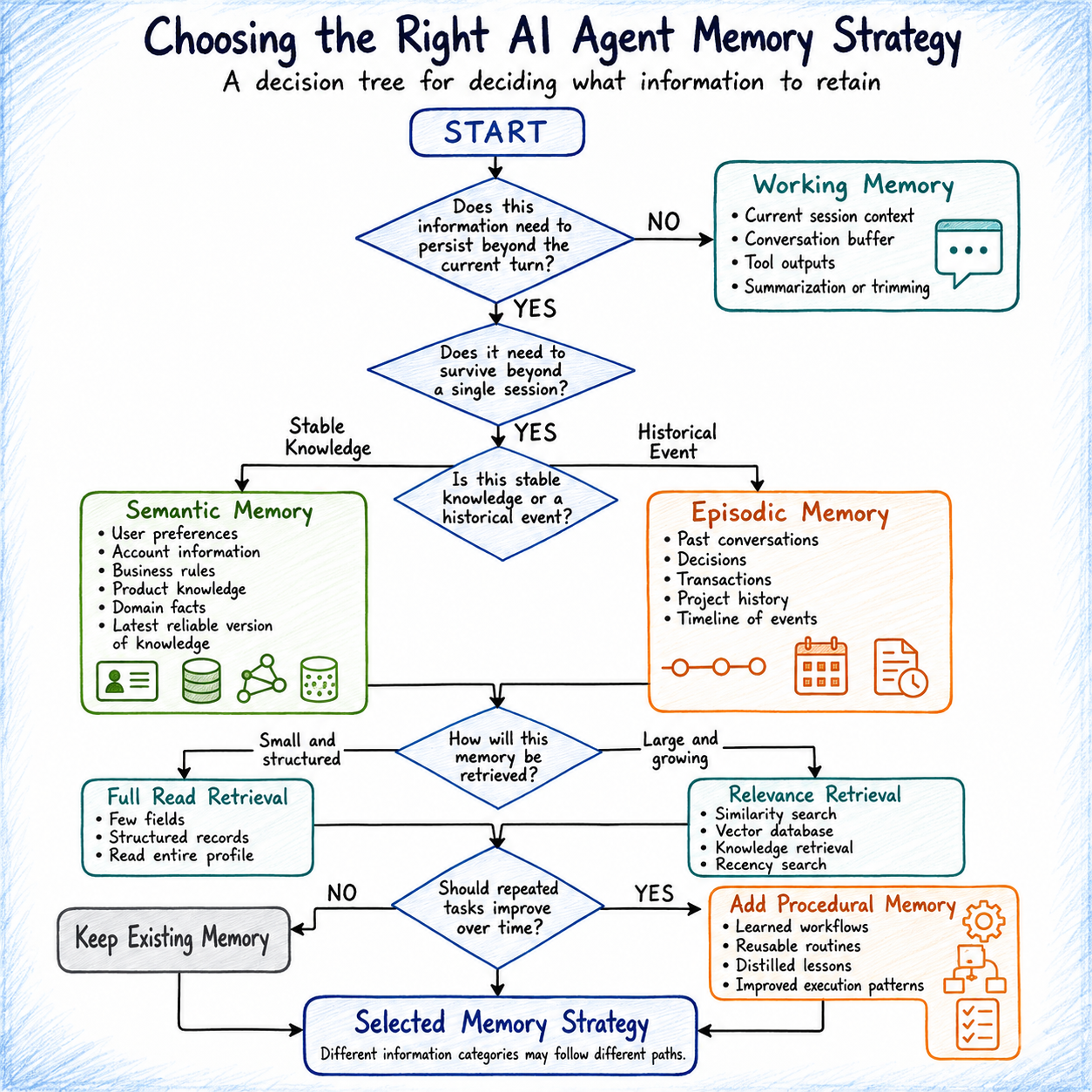
To navigate the complexities of AI memory design, a structured decision tree provides a clear path, evaluating information categories one at a time. This approach ensures that each distinct type of data is assigned the most appropriate memory layer, rather than attempting a one-size-fits-all solution for the entire agent. Consider an AI agent managing project workflows: "current task details," "user profile information," and "past project logs" represent three distinct categories, each potentially requiring a different memory strategy.
Question 1: Does This Information Need to Persist Beyond the Current Turn?
This initial question acts as a filter, distinguishing truly "memory-dependent" information from transient data. Many interactions involve self-contained requests where all necessary context is present within the current input and output.
- If no: The information is entirely self-contained within the current interaction turn. For example, a single query to translate a sentence or perform a quick calculation. The context window of the underlying LLM or the immediate processing buffer is sufficient. No dedicated memory layer is required.
- If yes: The information must be retained for subsequent turns within the same interaction, or even across different sessions. This signals a need for some form of memory, prompting a move to Question 2.
This step helps optimize resource usage. Storing transient information in persistent memory layers introduces unnecessary overhead and can pollute the memory store with irrelevant data, slowing down retrieval for genuinely important information.
Question 2: Does It Need to Survive Beyond a Single Session?
This question refines the need for persistence, differentiating between short-term conversational memory and long-term durable knowledge. A "session" could be defined by user inactivity, a specific task completion, or a deliberate reset.
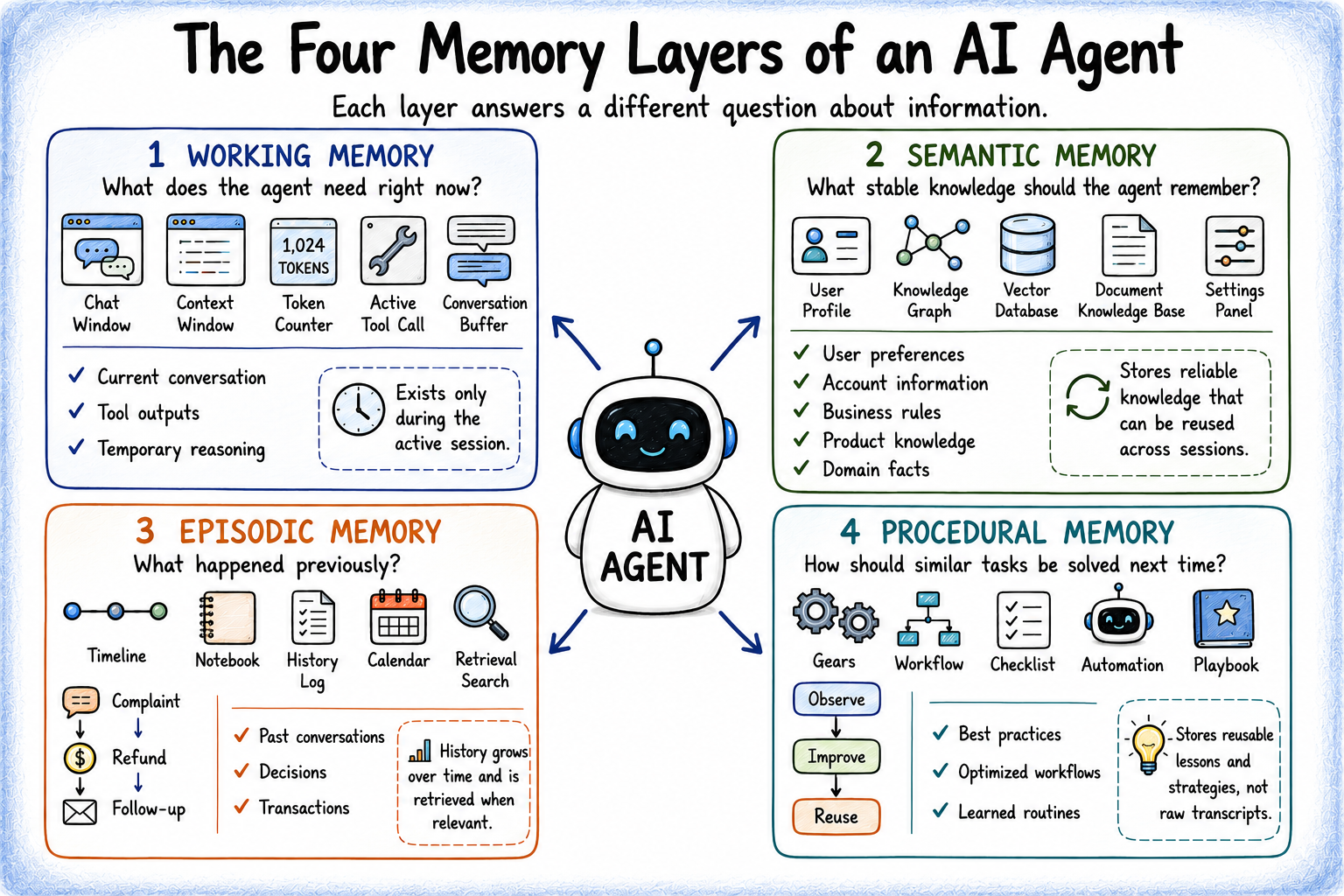
- If only within-session continuity matters: Working memory is the appropriate choice. This is typically implemented using conversation buffers that retain a window of recent interactions. Techniques like aggressive trimming or summarization are often employed to manage the size of this buffer and ensure only the most relevant context is kept. For example, in a booking agent, the user’s current flight preferences (origin, destination, dates) might reside in working memory until the booking is confirmed or abandoned.
- If it needs to outlive the session: The information requires more durable storage, leading to Question 3. A common design pitfall here is mismatching the information’s lifespan. Building complex persistent memory infrastructure for data that only needs to last a few minutes or hours is inefficient, while relying solely on working memory for critical user preferences that should carry over to future interactions will lead to a frustrating experience.
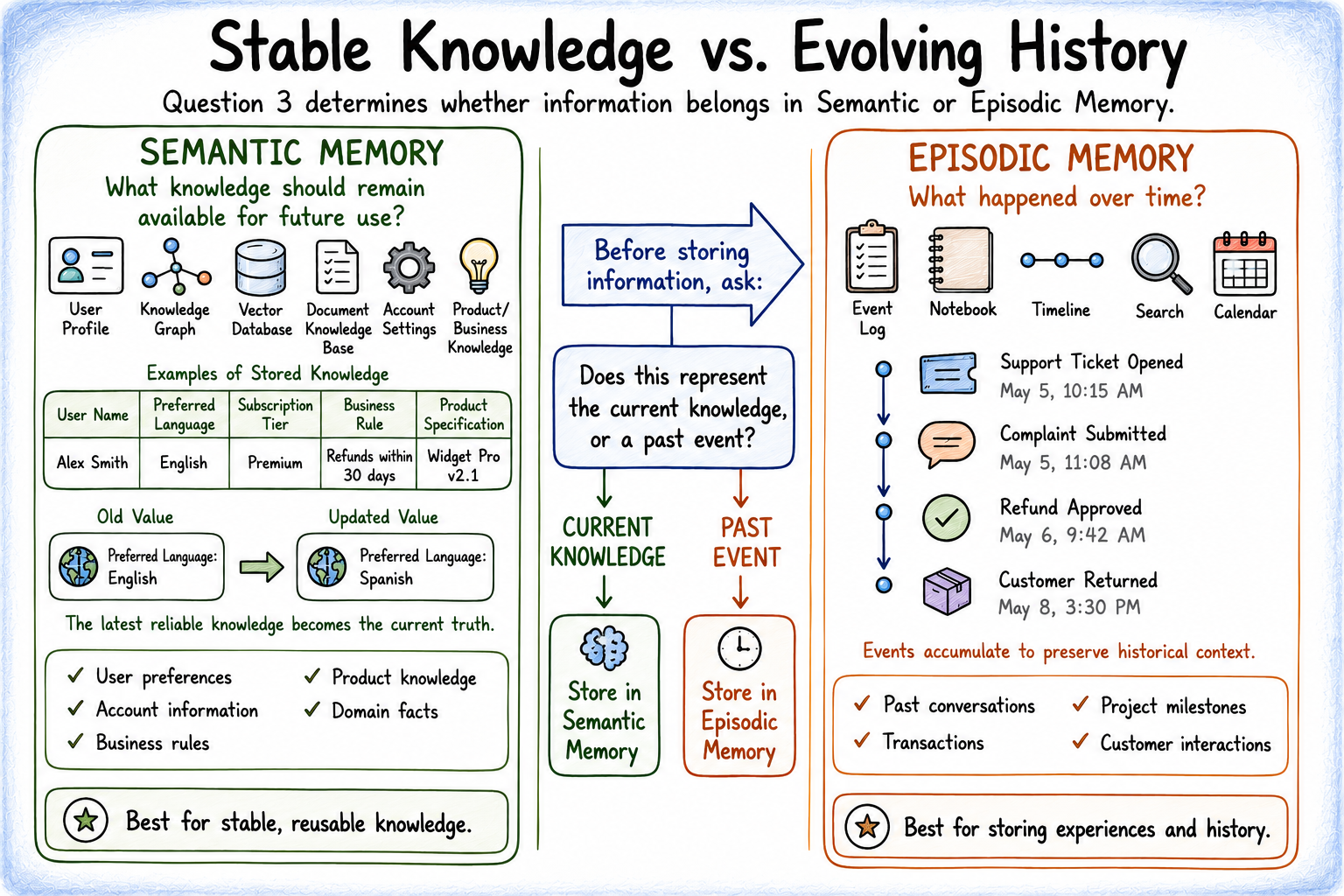
Question 3: Is This a Stable Fact or an Evolving Event?
This critical distinction separates static knowledge from dynamic history. Cognitive science models of human memory make a similar separation, recognizing that facts are stored and retrieved differently from experiences.
- If it’s a stable fact or generalized knowledge: This information is relatively static, unlikely to change frequently, or represents foundational domain knowledge. Examples include user’s subscription tier, product specifications, company policies, or geographical data. This category belongs in Semantic Memory. Implementations often include structured databases (for user profiles), knowledge graphs (for complex relationships), or vector databases (for semantically searchable domain knowledge like documentation). For instance, a medical diagnostic agent would store stable facts about diseases and treatments in semantic memory.
- If it’s an evolving event or interaction history: This information represents a sequence of occurrences, conversations, or actions that accumulate over time. Examples include a user’s purchase history, past complaints, or a log of previous agent interactions. This category belongs in Episodic Memory. These are typically stored as growing logs or temporal sequences, where entries accumulate. Older entries might require summarization or pruning to manage scale, but their temporal context is often crucial. For example, a financial advisor agent would track a client’s transaction history in episodic memory.
Advanced memory architectures, such as those employing temporal knowledge graphs (e.g., Zep), integrate time directly into the data structure, allowing facts to have validity windows. This prevents stale information from silently contradicting newer data, a significant advantage over simple, undifferentiated stores.
Question 4: How Will This Memory Be Retrieved?
Retrieval strategy must be tailored to the size, structure, and growth rate of the memory store. A single retrieval mechanism is rarely optimal for all memory types.
- For Semantic Memory (Stable Facts):
- Small, structured stores (e.g., user profiles): Often retrieved via direct lookup, key-value access, or full-read operations. For example, fetching a user’s name from a profile database.
- Larger knowledge bases (e.g., product documentation, domain knowledge): Typically require semantic search using vector databases, where queries are matched based on conceptual similarity rather than exact keywords. This allows agents to find relevant information even if the exact phrasing isn’t present.
- For Episodic Memory (Evolving Events):
- Logs of past interactions: Retrieval often prioritizes recency (the most recent events are usually most relevant) or relevance search (finding events similar to the current context), which might also leverage vector embeddings for conceptual similarity. Efficient indexing and temporal filters are crucial here.
It’s common for an agent to employ both direct lookup for small, stable facts and similarity search for larger, dynamic stores. The choice impacts both the speed and accuracy of retrieval, directly influencing the agent’s responsiveness and quality of output.
Question 5: Does the Agent Need to Learn Reusable Procedures?
This question addresses the agent’s capacity for operational learning and improvement, introducing the concept of procedural memory. This layer typically augments, rather than replaces, existing semantic and episodic stores.
- If the agent needs to improve its task execution over time: Procedural Memory is necessary. This involves storing distilled lessons, successful sequences of actions, or reusable workflows derived from past experiences. For example, a coding agent might learn an efficient "test-and-debug" workflow from repeated successful attempts.
- If the agent primarily executes predefined tasks without self-improvement: Procedural memory might not be a primary requirement.
Procedural memory differs from episodic memory in that it focuses on how to do things efficiently, rather than just what happened. While episodic memory logs raw past runs, procedural memory extracts and stores the distilled strategies that can be directly applied to future, similar tasks. This is foundational for agents aiming for higher levels of autonomy and self-optimization.
Combining Memory Layers for Robust AI Architectures
Running this decision tree for each distinct category of information an AI agent handles results in a comprehensive "memory profile" rather than a single memory solution. This profile then dictates the agent’s overall memory architecture, which typically involves a combination of several layers working in concert.
Consider a complex AI agent designed for scientific research. It might use:
- Working Memory: To hold the parameters and intermediate results of the current experiment being run.
- Semantic Memory: To store established scientific theories, known experimental protocols, and published research papers (potentially in a vector database for semantic search).
- Episodic Memory: To log the history of all experiments conducted, including their inputs, outputs, and any unexpected observations, allowing for retrospective analysis.
- Procedural Memory: To store optimized data analysis workflows or hypothesis generation strategies that have proven effective in past research cycles.
In contrast, a simple FAQ chatbot might only require working memory (a conversation buffer) because its information is static, self-contained, and doesn’t need to persist or evolve beyond the immediate interaction. Both scenarios are valid outcomes of the decision tree; the difference lies in the inherent complexity and requirements of the information each agent manages. Industry best practices, as evidenced by leading AI platforms, increasingly advocate for such a layered approach, moving away from monolithic memory solutions.
| Layer | What It Is For | Typical Implementation |
|---|---|---|
| No Persistence | Self-contained information with no carry-forward. | Rely on the context window alone; no dedicated memory layer. |
| Working Memory | Continuity within a single session. | Conversation buffer with trimming or summarization; often managed within the agent’s immediate state. |
| Semantic Memory | Stable facts and generalized knowledge that persist across sessions. | Stored in structured profiles (e.g., relational databases), knowledge graphs, or vector databases for semantic retrieval; retrieved through direct lookups for small stores or similarity search for larger knowledge bases. |
| Episodic Memory | Evolving history (specific events, interactions) that persists across sessions. | Growing log (e.g., event store, document database), retrieved by recency, temporal filters, or relevance search at scale (often using vector embeddings for contextual similarity). |
| Procedural Memory | Recurring task patterns or workflows that should improve with repetition. | Distilled, reusable routines, action sequences, or learned policies, often layered on top of an existing semantic or episodic store, or integrated into a planning module. Implemented through symbolic representations or learned policies (e.g., reinforcement learning models). |
Common AI Agent Memory Pitfalls and Solutions
Even with a well-designed memory architecture, implementations can encounter issues. Recognizing common pitfalls and their corresponding fixes is crucial for maintaining agent performance and reliability.
| Issue | Likely Cause | Fix |
|---|---|---|
| Agent re-asks for information already given this session. | Working memory trimmed too aggressively, or summarization drops relevant detail. | Widen the retained context window for working memory, or improve the summarization logic to ensure critical details are preserved. Avoid adding a long-term memory layer if the information’s scope is purely session-based, as this introduces unnecessary complexity. |
| Retrieval returns irrelevant or contradictory results. | Stable facts and evolving events mixed into one undifferentiated store, or poor indexing. | Split memory types: Use a small, structured store (semantic) for stable facts and a separate, chronological log (episodic) for events. Implement robust indexing and retrieval strategies (e.g., semantic search for knowledge, temporal filtering for history) tailored to each store’s content. |
| Semantic memory gets overwritten with bad or unverified information. | No validation, versioning, or review process at write time for critical facts. | Implement a confirmation or validation step before a new fact replaces an existing one. Introduce versioning for critical semantic data, allowing rollback. For high-stakes information, consider a human-in-the-loop review process before updates are committed. |
| Procedural memory never seems to improve agent performance. | The store holds raw replays of past runs rather than distilled lessons or generalized strategies. | Focus on extracting and writing the digested lesson learned or the optimized workflow steps, not merely a transcript of the attempt. This requires a learning mechanism that can generalize from specific experiences to reusable procedures. |
| One memory system is handling facts, history, and session state. | Every category of information was forced through the same store instead of being classified separately. | Re-evaluate with the decision tree: Run the decision tree for each distinct category of information. Allow each category to land on the specific memory layer it truly needs, leading to a multi-layered, specialized memory architecture. This is the most fundamental fix for an overloaded memory system. |
| Retrieval is slow or computationally expensive. | Inefficient indexing, searching overly large or undifferentiated stores, or redundant data. | Optimize indexing for each memory layer. For large episodic or semantic stores, leverage vector databases with efficient similarity search algorithms. Implement intelligent pruning or summarization strategies for episodic memory to keep its size manageable and focused on relevance. |
| Agent hallucinates or misinterprets context. | Insufficient context in working memory, or retrieval surfaces irrelevant/conflicting information. | Ensure working memory adequately captures immediate context. Improve retrieval algorithms to prioritize highly relevant and coherent information, potentially using ranking functions that consider recency, frequency, and semantic similarity. Implement confidence scores for retrieved information. |
Broader Impact and Future Outlook
The deliberate design of AI agent memory is not merely a technical optimization; it has profound implications for the broader adoption and capabilities of artificial intelligence. By enabling agents to remember, learn, and adapt more effectively, we move closer to developing AI systems that are genuinely intelligent, reliable, and capable of sustained, complex interactions. This impacts various sectors:
- Customer Service: Agents can provide personalized, informed support by remembering past interactions and preferences.
- Healthcare: AI diagnostic tools can recall patient histories, learned treatment protocols, and medical knowledge, leading to more accurate recommendations.
- Finance: Agents can offer tailored financial advice, remembering client portfolios, market trends, and regulatory changes.
- Education: Personalized learning agents can adapt curricula based on student progress, past struggles, and learning styles.
As AI research progresses, memory systems are expected to become even more sophisticated, potentially incorporating advanced mechanisms for forgetting (to prevent information overload), consolidation (to integrate new knowledge), and even introspective memory (where agents reflect on their own memory contents). The pursuit of Artificial General Intelligence (AGI) is inextricably linked to the development of memory systems that can robustly manage, learn from, and apply diverse forms of knowledge and experience.
Conclusion and Next Steps
The decision tree approach transforms AI memory design from an ambiguous challenge into a series of clear, actionable choices. It compels developers to ask fundamental questions about information persistence, type (fact vs. event), retrieval mechanism, and the potential for procedural learning. By moving away from the default assumption that all agent information is the same, practitioners can construct more efficient, effective, and intelligent AI agents.
The next crucial step for organizations and developers is to explore the burgeoning ecosystem of AI agent memory frameworks and tools. The market is rapidly evolving, offering a range of solutions from simple conversation buffers to sophisticated knowledge graphs and vector databases. In forthcoming analyses, we will delve into evaluating these frameworks, providing guidance on how to select the right tools to implement the memory architectures derived from this decision-tree methodology, ensuring that the chosen technologies align perfectly with an application’s specific requirements and the strategic memory profile of its AI agents.
