
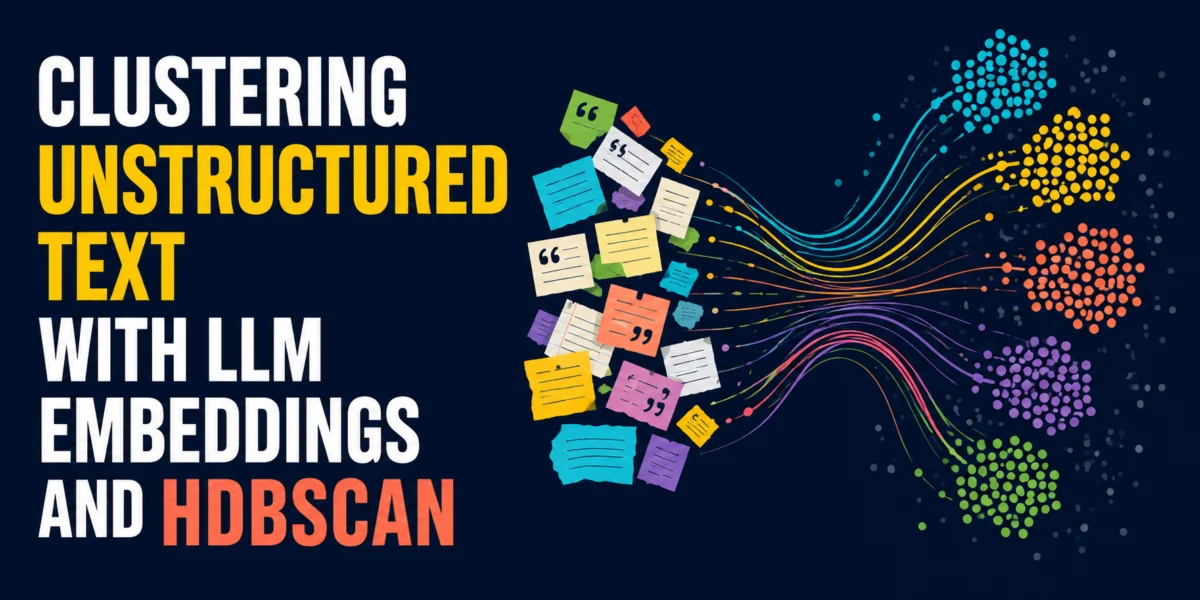

In an increasingly data-rich world, the ability to automatically discover hidden patterns and themes within vast repositories of unlabeled text has become a critical capability for businesses and researchers alike. This article delves into a robust methodology for achieving this, combining the semantic power of Large Language Model (LLM) embeddings with the sophisticated density-based clustering capabilities of HDBSCAN. This pipeline offers an elegant solution for transforming raw, unstructured textual data into semantically rich, organized insights, circumventing the arduous and often subjective process of manual labeling.
The Rise of Generative AI and Semantic Text Understanding
The current discourse surrounding Generative AI often gravitates towards its conversational interfaces and prompt-based interactions. However, the true breadth of Large Language Models (LLMs) extends far beyond these front-facing applications. A pivotal, yet often understated, downstream capability of LLMs is their capacity to distill complex, unstructured human language into high-dimensional numerical representations known as embeddings. These embeddings are not merely numerical codes; they are mathematical vectors designed to capture the semantic meaning, contextual nuances, and relationships between words, phrases, and entire documents. This intrinsic ability to encode semantic richness marks a significant paradigm shift in how machines understand and process human language, laying the groundwork for advanced machine learning applications that were previously challenging to implement with traditional Natural Language Processing (NLP) techniques.
Before the advent of powerful LLM embeddings, text clustering often relied on methods like Term Frequency-Inverse Document Frequency (TF-IDF), Latent Semantic Analysis (LSA), or Latent Dirichlet Allocation (LDA). While effective to a degree, these techniques often struggled with polysemy (words with multiple meanings) and synonymy (different words with the same meaning), leading to less accurate and contextually shallow clusters. They primarily focused on lexical similarity rather than true semantic proximity. LLM embeddings, by contrast, offer a continuous, dense vector space where semantically similar texts are positioned closer together, regardless of their exact word overlap. This allows for a much finer-grained understanding and grouping of text data.
HDBSCAN: A New Frontier in Density-Based Clustering
Complementing the semantic power of LLM embeddings is HDBSCAN (Hierarchical Density-Based Spatial Clustering of Applications with Noise), an advanced clustering algorithm that stands out for its ability to discover clusters of varying densities and shapes within a dataset, without requiring the user to pre-specify the number of clusters. This is a significant advantage over algorithms like K-Means, which demand a predefined k (number of clusters) and are often limited to identifying spherical clusters of similar sizes. Furthermore, HDBSCAN inherently identifies "noise" points – data instances that do not belong to any discernible cluster – by assigning them a special label (-1). This feature is particularly valuable in real-world datasets, where a substantial portion of data might indeed be anomalous or fall outside core topics.
The combination of LLM embeddings and HDBSCAN creates a synergistic pipeline: the embeddings provide a semantically robust foundation, ensuring that texts are represented accurately based on their meaning, while HDBSCAN leverages this rich representation to identify natural groupings and outliers, adapting to the inherent structure of the data rather than imposing rigid assumptions. This method is particularly adept at uncovering hidden topics, patterns, or categories in large text corpora without any prior labeling, making it an invaluable tool for exploratory data analysis, content organization, and trend identification.
Constructing the Text Clustering Pipeline: A Chronological Overview
The construction of this text-based clustering pipeline involves a series of carefully orchestrated steps, beginning with data acquisition and progressing through embedding generation, dimensionality reduction, and finally, the clustering itself. This systematic approach ensures that each stage contributes optimally to the overall goal of accurate topic discovery.
The initial phase of this pipeline involves setting up the computational environment by installing essential Python libraries. Key among these are sentence-transformers for generating LLM embeddings, umap-learn for efficient dimensionality reduction, and hdbscan for the clustering algorithm. Standard data manipulation libraries like pandas and scikit-learn are also foundational for data handling and accessing datasets.
Following library installation, the next crucial step is data acquisition. For illustrative purposes, a subset of the widely used 20 Newsgroups dataset is often employed. This dataset comprises news articles categorized into various topics. Crucially, even though the original dataset contains labels, these are deliberately omitted during the clustering process to simulate a real-world scenario where text data is unlabeled. A representative sample, typically around 150-200 documents, is sufficient to demonstrate the pipeline’s effectiveness without incurring excessive computational overhead. This selective sampling ensures that the example remains illustrative while maintaining tractability.
From Raw Text to Semantic Vectors: The Embedding Generation Phase
Once the textual data is prepared, the core of the semantic transformation begins: generating embeddings. This is achieved using an open-source LLM specifically trained for embedding generation. A popular choice is all-MiniLM-L6-v2 from Hugging Face’s sentence-transformers library. This model strikes an excellent balance between efficiency and effectiveness, producing high-quality embeddings rapidly. Each text document is fed into this model, which outputs a dense vector of fixed dimensions (e.g., 384 or 768 dimensions). This transformation converts qualitative text into quantitative numerical arrays, where the distance between vectors in the embedding space corresponds to the semantic similarity of the original texts.
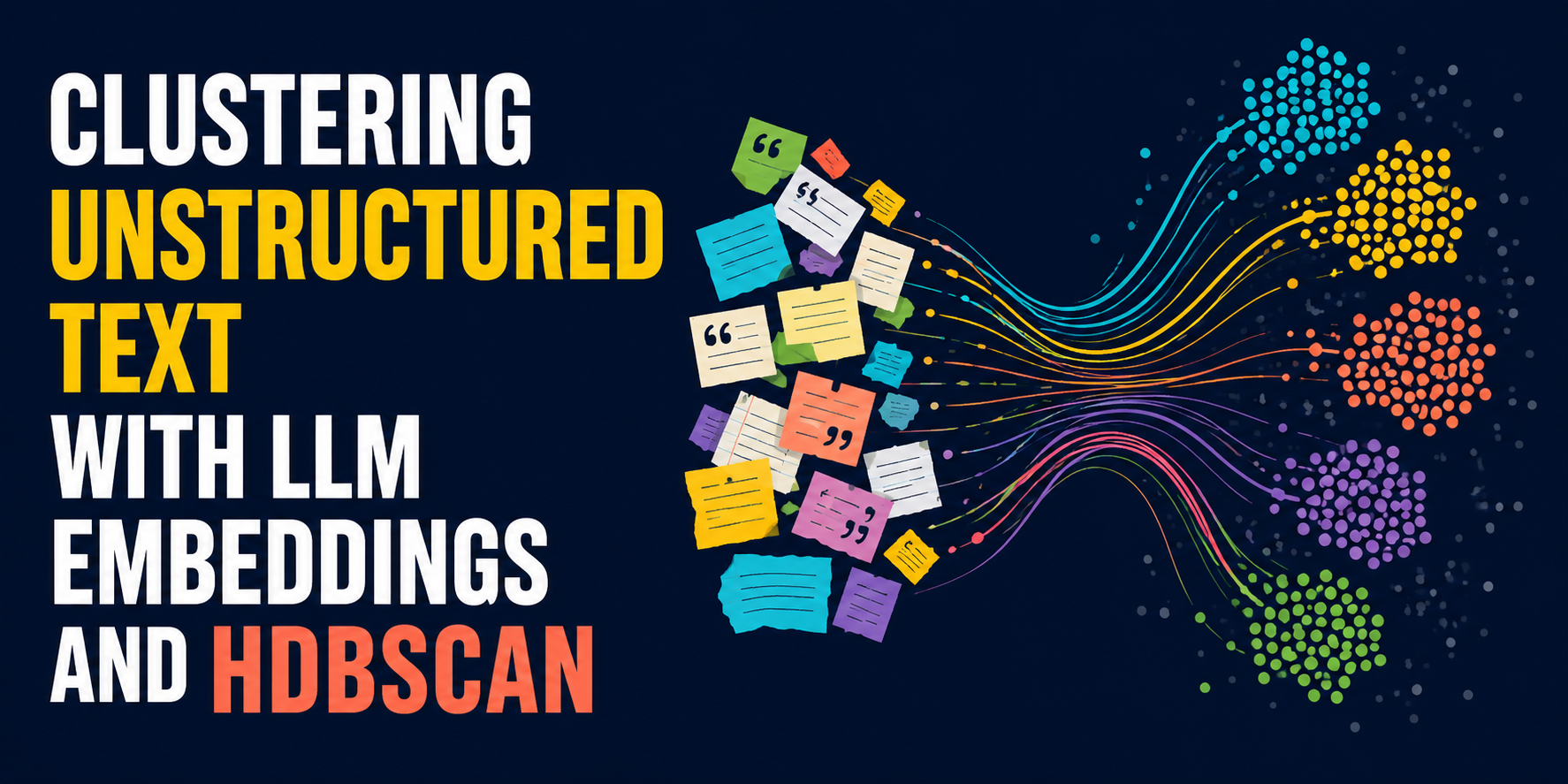
The immediate challenge after embedding generation is the high dimensionality of these vectors. While rich in information, high-dimensional spaces can pose computational challenges for clustering algorithms and make visualization difficult. This phenomenon, often referred to as the "curse of dimensionality," necessitates a dimensionality reduction step. Uniform Manifold Approximation and Projection (UMAP) is the preferred algorithm for this task. UMAP is a non-linear dimensionality reduction technique known for its ability to preserve both local and global data structures, making it highly effective at creating a lower-dimensional representation (e.g., 5 dimensions) that still retains sufficient density information for clustering. This reduction significantly improves the efficiency and often the accuracy of the subsequent clustering process.
Identifying Hidden Structures: The HDBSCAN Clustering Phase
With the embeddings now reduced to a manageable yet semantically rich dimensionality, the HDBSCAN algorithm is applied. HDBSCAN’s parameters, such as min_cluster_size and min_samples, are critical in shaping the clustering outcome. For instance, setting min_cluster_size=8 specifies that a valid cluster must contain at least eight documents, while min_samples=3 influences the density estimation. These hyperparameters allow for fine-tuning the sensitivity of the algorithm to detect smaller or larger clusters and manage noise. The algorithm then processes the reduced embeddings, assigning each document to a cluster or marking it as noise.
Key Findings and Interpretative Insights
In a typical demonstration using the 20 Newsgroups subset, HDBSCAN often identifies distinct clusters, reflecting the underlying topics within the dataset. For instance, if the dataset comprises articles from "sci.space," "sci.med," and "rec.autos," the clustering might naturally separate documents related to vehicles into one cluster and scientific articles into another, possibly further subdividing the scientific articles if enough distinct density regions exist. The output of the clustering process reveals the distribution of documents across these identified clusters, including the count of documents assigned to each. Importantly, HDBSCAN’s capacity to identify noise points (labeled as -1) provides valuable insight into the data’s inherent structure, indicating documents that are too sparse or anomalous to fit into any coherent group.
Analyzing sample texts from each discovered cluster is crucial for interpreting their thematic content. By reviewing a few representative documents from each cluster, human analysts can infer the latent topic that HDBSCAN has identified. For example, one cluster might reveal texts predominantly discussing automotive features, while another might contain discussions on medical research or space exploration. This qualitative assessment validates the effectiveness of the pipeline in semantically grouping related documents.
To further aid in understanding the clustering results, visualizations play a vital role. While the reduced embeddings might be in five dimensions, pairwise scatterplots of these dimensions can offer a visual representation of the cluster separation. Using libraries like matplotlib and seaborn, scatterplots can display data points colored by their assigned cluster, allowing for a visual confirmation of distinct groupings. These plots often reveal clear boundaries between clusters in various dimensional planes, underscoring the efficacy of UMAP in creating a separable representation and HDBSCAN in identifying these separations. Experimentation with HDBSCAN’s hyperparameters, such as min_cluster_size and min_samples, is highly encouraged, as different configurations can lead to the discovery of a varying number of clusters, reflecting different levels of granularity in topic discovery.
Broader Impact and Implications for Various Sectors
The ability to automatically cluster unstructured text with high semantic fidelity has profound implications across numerous industries and research domains.
- Customer Feedback Analysis: Companies can process millions of customer reviews, support tickets, or social media comments to automatically identify emerging issues, common complaints, product features requests, or sentiment trends, allowing for proactive responses and informed product development.
- Scientific Research and Literature Review: Researchers can quickly categorize vast collections of academic papers, patents, or clinical trial reports, identifying novel research areas, interdisciplinary connections, or key thematic shifts over time, thereby accelerating discovery.
- News and Media Monitoring: Media organizations can track news narratives, public opinion, and trending topics across various sources, providing competitive intelligence and aiding in content curation.
- Legal and Compliance: Law firms and regulatory bodies can rapidly categorize legal documents, contracts, or regulatory filings, identifying relevant clauses, potential risks, or compliance issues, significantly reducing manual review time.
- Healthcare: Analysis of electronic health records (EHRs), medical notes, and patient forums can uncover disease patterns, treatment efficacy insights, or patient concerns that might otherwise remain hidden.
- Recommendation Systems: By understanding the implicit topics within user-generated content or product descriptions, more accurate and contextually relevant recommendations can be generated for e-commerce, content platforms, or advertising.
- Cybersecurity: Security analysts can cluster log files, incident reports, or threat intelligence feeds to identify patterns indicative of malicious activity or emerging threats, enhancing threat detection capabilities.
This methodology not only automates a historically labor-intensive task but also brings a level of objectivity and depth to text analysis that was previously unattainable. The capacity to handle unlabeled data is particularly transformative, as it eliminates the bottleneck of costly and time-consuming manual annotation, democratizing advanced text analytics for organizations with limited resources for labeling.
Conclusion: A Paradigm Shift in Unsupervised Text Analysis
The synergy between Large Language Model embeddings and HDBSCAN represents a significant leap forward in unsupervised text analysis. LLM embeddings, particularly from efficient models like all-MiniLM-L6-v2, excel at capturing the intricate semantic and linguistic nuances of text, providing a robust foundation for analysis. HDBSCAN, with its ability to automatically detect clusters of varying densities and effectively manage noise, then leverages this rich representation to reveal inherent thematic structures within the data.
This powerful combination offers a robust, scalable, and highly adaptable pipeline for discovering topics in vast, unlabeled text datasets. Its key advantages include the preservation of true semantic meaning, automatic determination of the optimal number of clusters, and the effective identification of outliers. As the volume of unstructured text data continues to grow exponentially, methodologies like this will become increasingly indispensable, empowering organizations and researchers to extract actionable intelligence and profound insights from the deluge of information. The era of truly intelligent, automated text understanding is not just dawning; it is rapidly becoming a practical reality, driven by such innovative integrations of cutting-edge AI techniques.
