
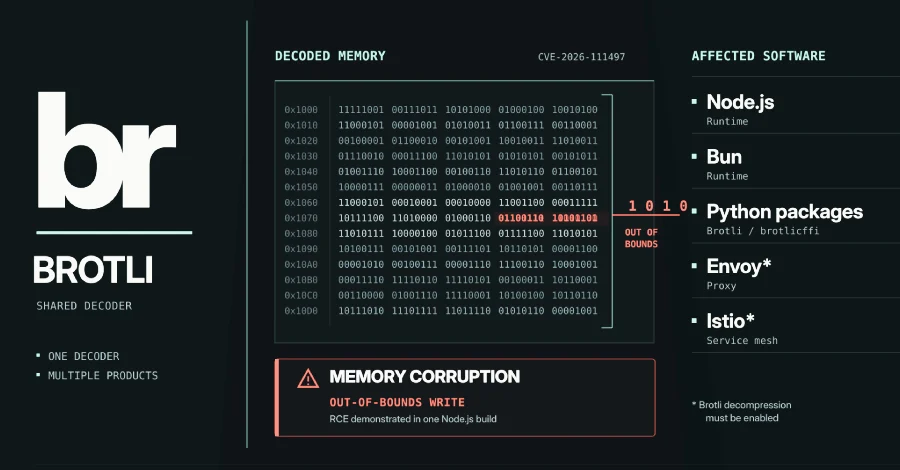

A critical memory-corruption vulnerability, cataloged as CVE-2026-111497, has sent shockwaves through the software development community, affecting a wide array of high-traffic tools and runtimes that utilize Google’s Brotli compression library. The flaw, which allows for potential remote code execution (RCE) via specially crafted Brotli-compressed data, represents a significant supply-chain security challenge because the vulnerable code is embedded within diverse software packages, each requiring independent remediation.
The vulnerability stems from an error in the C-based decoder responsible for unpacking Brotli streams. By sending malicious, malformed compressed data to an affected endpoint, an attacker could trigger a buffer overflow, leading to memory corruption. This corruption can manifest in several ways: system crashes, memory leaks, or, most critically, the execution of arbitrary code under the privileges of the application process.
The Scope of the Vulnerability
The ubiquity of Brotli as a compression standard—used to shrink web pages, API responses, and file transfers—means the attack surface is expansive. Because the vulnerable logic is contained within the C library itself, developers who statically link or include the library in their runtimes inadvertently inherit the flaw.
Software affected by this vulnerability includes, but is not limited to, the Node.js runtime (specifically versions 22.x, 24.x, and 26.x), the Bun JavaScript runtime (versions 1.4.3 and earlier), and the Envoy proxy, a cornerstone of modern cloud-native networking. Additionally, Python developers are at risk through the Brotli and brotlicffi packages. Even specialized tools such as cdxgen, used for software composition analysis, have been flagged as vulnerable in specific configurations.
The severity of the risk is highly dependent on how an application handles incoming data. For server-side runtimes like Node.js or Bun, the risk is realized when the application uses built-in fetch functionality to process responses or when it parses incoming request bodies—such as those processed by Express or body-parser—that are encoded using the Brotli algorithm. In the Python ecosystem, the danger is even more insidious; the mere installation of vulnerable packages can lead to automatic decompression of Brotli-encoded responses by standard HTTP clients like requests, urllib3, or httpx, potentially exposing an application to an RCE attack without the developer ever explicitly invoking the Brotli library.
A Chronology of Discovery and Disclosure
The timeline of CVE-2026-111497 is marked by a peculiar paradox: the technical fix for the vulnerability was actually introduced into the Brotli source code as early as February 27, 2026. However, at the time of that commit, the security implications of the bug were not fully understood, and no formal release was issued to package the patch.

It was not until October 21, 2026, that the issue was formally disclosed and addressed following an investigation by the OpenAI Codex Security team. Researchers Khai Tran and Sylvie Mayer are credited with identifying the vulnerability and reporting it to the relevant maintainers. The disclosure sparked a coordinated, though necessarily decentralized, response. Because the Brotli decoder is bundled with various projects, there is no "master switch" to patch the flaw. Instead, every individual software vendor—from the Node.js foundation to the maintainers of Istio and Envoy—was required to pull the updated Brotli source code and issue their own security releases.
On the day of the disclosure, major industry players scrambled to provide guidance. Vercel, for instance, implemented web application firewall (WAF) rules to mitigate potential exploitation. However, the company noted a critical limitation: while these rules could block malicious requests reaching their infrastructure, they could not protect serverless functions that fetch data from external, untrusted third-party servers.
Technical Implications and the "Node2Shell" Proof-of-Concept
The most alarming aspect of CVE-2026-111497 is the potential for Remote Code Execution. Imperva’s security researchers demonstrated the feasibility of this attack, dubbed "Node2Shell," by successfully executing unauthorized code on an unpatched Node.js 24.22.0 build running on an ARM64 Linux architecture.
The proof-of-concept confirmed that an attacker could trigger the flaw both as a malicious server responding to a client’s request and as a malicious client sending a payload to a vulnerable server. This bidirectional threat model is particularly dangerous for microservices architectures, where internal service-to-service communication is often treated as "trusted" and thus inadequately inspected.
Despite the demonstration by Imperva, there have been no confirmed reports of the vulnerability being exploited in the wild as of late October 2026. The Cybersecurity and Infrastructure Security Agency (CISA) has assessed the situation and currently reports no automated exploitation activity. Red Hat has similarly noted that while the potential for RCE is clear in a lab environment, creating a reliable, weaponized exploit that functions across varying system configurations remains a significant hurdle.
Discrepancies in Severity Scoring
The industry has struggled to reach a consensus on the exact severity of the flaw, reflecting the complexity of measuring risks in shared library dependencies. Google, as the original developer of the Brotli format, assigned the vulnerability a CVSS 4.0 score of 9.2, placing it in the "Critical" category. Conversely, Red Hat has categorized the risk as "Important" with a score of 8.1, and the Node.js project has generally labeled the threat as "High."
These variations arise from differing assessments of "exploitability." A score of 9.2 assumes a high level of accessibility and potential for widespread, automated impact. A score of 8.1 suggests that while the impact is severe, the environmental requirements—such as specific library versions, system architectures, and application logic—make the vulnerability harder to weaponize reliably across all target environments.

Mitigation Strategies and Best Practices
For organizations currently running any of the affected software, the primary recommendation is an immediate update to the latest patched versions. Following the update, security teams must ensure that all service instances are restarted and that container images are rebuilt from scratch to purge the vulnerable code from the runtime environment.
Where immediate patching is not possible, organizations are advised to take a defensive posture by restricting the processing of Brotli-compressed data. OpenAI and other security researchers have suggested that if an application does not strictly require Brotli support, it should be disabled entirely.
However, administrators must be wary: simply removing "br" from the Accept-Encoding header of an HTTP request is often insufficient. Many servers are configured to ignore the client’s preferences or are forced to process Brotli data if the server sends it proactively. Therefore, the only robust mitigation is to either patch the underlying libraries or implement rigorous input validation and sandboxing for any component that handles external data decompression.
The Broader Security Challenge
The discovery of CVE-2026-111497 highlights a systemic vulnerability in the modern software supply chain: the reliance on shared, low-level C libraries. When a foundational component like a compression algorithm is shared across dozens of runtimes, proxies, and language packages, a single oversight can ripple through the entire internet.
Furthermore, the lag between the initial patch in February and the October disclosure illustrates a "visibility gap" in open-source security. Vulnerabilities that are patched silently—without being identified as security-critical—remain dormant and uncommunicated to the downstream users who are most at risk. This incident serves as a call to action for the developer community to adopt more rigorous vulnerability disclosure practices, ensuring that security-relevant commits are properly flagged, audited, and disseminated.
As organizations continue to assess their exposure, the incident also underscores the importance of Software Bill of Materials (SBOM) management. Without clear, automated visibility into which packages and libraries are running in a production environment, security teams are left guessing as to whether their infrastructure is vulnerable to the latest "critical" threat. In the wake of this event, many enterprises are expected to accelerate the adoption of automated dependency scanning and more robust patch-management workflows to ensure that they are not caught off guard by the next hidden flaw in their shared library stack.
