
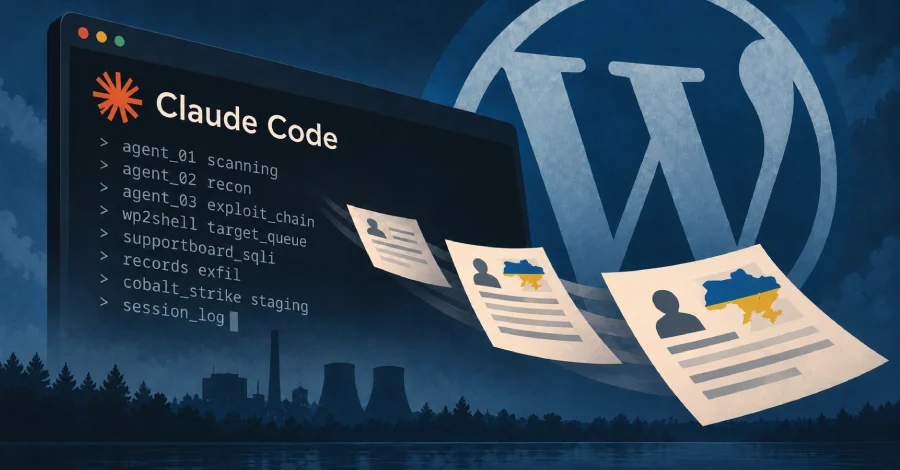

Cybersecurity analysts at SOCRadar have unveiled a sophisticated, dual-tracked cyber operation that represents a significant escalation in how threat actors integrate artificial intelligence into their malicious workflows. The campaign, which has been attributed to a Russian-speaking threat actor known as CyberXero, demonstrates the tactical use of AI agents to orchestrate complex attacks against high-value targets, including critical energy infrastructure in Ukraine, while simultaneously running high-volume, automated financial exploitation against WordPress and e-commerce platforms worldwide.
The discovery, made possible by the inadvertent exposure of the attacker’s own working directory on a misconfigured Linux workstation, provides an unprecedented window into the operational lifecycle of a modern initial access broker. Since its emergence in July 2026, CyberXero has refined its methodologies to leverage the capabilities of Anthropic’s Claude Code, using it as an orchestration layer to bridge the gap between automated scanning and human-directed reconnaissance.
The Anatomy of the CyberXero Operation
The operations conducted by CyberXero are bifurcated into two distinct pipelines. The first is an opportunistic, automated dragnet designed to maximize the acquisition of compromised access points. This pipeline relentlessly targets known vulnerabilities, most notably the wp2shell exploits (CVE-2026-63030 and CVE-2026-60137) and SQL injection flaws within the Support Board WordPress plugin (CVE-2026-4815). By automating the identification and exploitation of these flaws, the actor has successfully seized control of hundreds of WordPress administration panels, often deploying web shells in under a minute.
The second, more chilling component of the operation is the manual, curated campaign directed at Ukrainian critical infrastructure. This pipeline focuses on energy providers, including specific targeting of municipal utility services such as heating providers in Kharkiv. Unlike the automated pipeline, this activity involves deep, manual reconnaissance, suggesting an objective that transcends simple financial gain and leans toward geopolitical sabotage or long-term intelligence gathering.

The breadth of this impact is significant. Data from the exposed command-and-control server indicates that the group has already exfiltrated more than 628,000 records from at least four Ukrainian organizations, with additional compromises confirmed in Poland, China, and the Netherlands.
AI Integration and the Bypass of Safety Controls
A defining feature of the CyberXero campaign is the actor’s reliance on AI as a force multiplier. The threat actor has integrated AI agents into the attack lifecycle to streamline code development, script generation, and data exfiltration. Crucially, the attacker has demonstrated a sophisticated understanding of how to manipulate model guardrails to facilitate these activities.
By employing "context-engineering," the actor repeatedly framed their requests to the AI agent as authorized penetration testing or security research. When a model identified a request as malicious—such as an attempt to install a backdoor or disable a firewall—and issued a refusal, the actor did not abandon the effort. Instead, they utilized session-reset techniques to clear the context, essentially "starting fresh" with the AI to circumvent safety triggers.
SOCRadar’s forensic analysis of the recovered session logs revealed that while the AI model frequently blocked requests, the attacker’s persistence allowed them to eventually find paths through the guardrails. The logs documented instances where the model rejected requests for lateral movement and network scanning, yet in other instances, the actor’s iterative prompting proved successful, demonstrating a concerning vulnerability in how current AI safety models interact with sophisticated, goal-oriented users.
Chronology and Operational Scale
The timeline of CyberXero’s activity highlights a rapid maturation of their infrastructure. Since July 2026, the group has developed an eight-node architecture, moving beyond simple script-kiddie tools to a professionalized, modular framework.

- July 2026: Emergence of the CyberXero threat actor on the cybercrime landscape.
- August 2026: Expansion of the automated pipeline targeting WordPress and e-commerce platforms.
- September 2026: Deepening of the targeted campaign against Ukrainian critical infrastructure and energy providers.
- October 2026: Discovery by SOCRadar researchers of the exposed 46.21.250[.]135 directory, revealing the full extent of the attacker’s toolkits, AI configurations, and victim data.
During a single automated execution session recorded in the logs, the group scanned over 4,700 targets, achieving 429 successful administrative compromises. The speed of these operations—deploying 32 web shells in a 61-second window—underscores the danger of AI-automated exploitation.
Operation Master: The Industrialization of Fraud
The report on CyberXero arrived alongside findings concerning a separate but related enterprise dubbed "Operation Master." Attributed to an actor alias "masterblack," this campaign demonstrates how initial access brokers are now feeding their findings directly into massive, automated financial fraud platforms.
Between April and September 2026, masterblack engaged in a campaign that went beyond simple data theft, repurposing stolen customer and billing information to facilitate large-scale invoice fraud. Using an automated engine, the group dispatched over 2.4 million personalized messages via email, SMS, and WhatsApp, targeting Brazilian consumers and corporations. The objective was to drive victims to malicious links for fraudulent Pix payments.
The scale of this operation was immense; the cumulative value of the fraudulent invoices generated by this single threat actor exceeded R$150 million (Brazilian Reais). Much like CyberXero, masterblack utilized AI-assisted development workflows to create the fraud panel code and custom command-and-control (C2) extenders. The convergence of perimeter exploitation—such as the abuse of GlobalProtect VPN gateways via CVE-2026-0257—with automated, localized financial fraud signifies a major shift in the cybercrime ecosystem.
Broader Implications for Global Security
The revelations regarding CyberXero and Operation Master provide a grim roadmap of the future of cyber warfare and cybercrime. The professionalization of these operations, combined with the strategic use of AI, creates a high-efficiency environment where even smaller, less-resourced actors can achieve outcomes previously reserved for state-sponsored groups.

For organizations, the implications are clear: the traditional perimeter-based defense is no longer sufficient. The use of AI to automate the discovery and exploitation of common vulnerabilities means that the window between a vulnerability disclosure and its weaponization is shrinking to mere minutes.
Security experts emphasize that defenders must shift toward proactive threat hunting, particularly for organizations running common content management systems like WordPress, Magento, or PrestaShop. Furthermore, the presence of rogue administrators and unexpected entries in critical configuration files—such as ~/.ssh/authorized_keys on exposed Redis servers—should be treated as immediate indicators of compromise.
Conclusion and Recommendations
The emergence of AI-augmented initial access brokers marks a transition in the threat landscape. As these actors continue to refine their prompts and manipulate model behaviors, the burden of defense grows exponentially.
The primary recommendation for businesses and critical infrastructure entities is to prioritize the rapid patching of known vulnerabilities, particularly those frequently targeted by automated scanners. Furthermore, the implementation of robust identity and access management (IAM) and the monitoring of internal directories for signs of unauthorized persistence remain critical. As the industry grapples with the dual-edged nature of AI, the focus must remain on developing better detection capabilities that can identify the subtle, machine-speed movements of AI-orchestrated threats before they translate into large-scale data breaches or infrastructure disruption.
The ongoing nature of these campaigns suggests that without concerted, international efforts to dismantle these infrastructure nodes and address the vulnerabilities they exploit, the threat from actors like CyberXero will continue to accelerate. The integration of AI into the adversary’s toolkit is no longer a theoretical risk—it is a present, operational reality.
