

Understanding the foundational architecture of digital systems requires looking past abstract concepts like cloud computing and data storage to recognize that every piece of software, application, and website ultimately relies on tangible hardware. The ongoing debate within enterprise IT circles regarding physical versus virtual servers is not merely a philosophical discussion about digital existence; it is a critical operational choice that dictates cost efficiency, security postures, and performance scaling for organizations worldwide. As global data creation accelerates—with projections estimating that the total volume of data generated globally will exceed 180 zettabytes—the mechanisms used to store, process, and manage this information have evolved dramatically. To understand how modern infrastructure supports everything from personal mobile applications to high-frequency financial trading networks, one must examine the distinct characteristics, historical evolution, and strategic implications of both physical and virtual server environments.
The Evolution of Enterprise Compute: A Historical Chronology
The trajectory of enterprise computing over the past three decades illustrates a fundamental shift in how organizations allocate resources and manage IT infrastructure. In the early 2000s, the landscape was overwhelmingly dominated by physical infrastructure.
During the dot-com boom and the subsequent enterprise digitization wave of the early 2000s, companies operated on a dedicated hardware model. Organizations purchased individual physical servers—frequently referred to as bare metal servers—housing them in on-premises server rooms or co-location facilities. Each physical machine ran a single operating system and dedicated applications. While this model offered straightforward ownership and robust isolation, it introduced significant inefficiencies. Industry data from that era frequently highlighted that average physical server utilization rates hovered between 10% and 15%, leaving vast amounts of computing power, electricity, and cooling capacity wasted.
The mid-2000s marked a pivotal turning point with the mainstream commercialization of server virtualization. Pioneers in hypervisor technology enabled a single physical machine to be partitioned into multiple isolated virtual environments, each acting as an independent computer. This breakthrough allowed organizations to consolidate dozens of underutilized physical servers onto a single piece of hardware, drastically reducing capital expenditure, floor space, and power consumption.
By the 2010s, the advent of hyperscale cloud computing shifted the paradigm further. Companies like Amazon Web Services, Microsoft Azure, and Google Cloud Platform built massive data centers filled with physical servers, slicing them into millions of virtual instances available on-demand. Today, virtual machines (VMs) handle the vast majority of global server workloads, enabling startups and Fortune 500 enterprises alike to scale computing resources dynamically without managing physical hardware. Despite this dominance, physical servers have retained a vital, specialized niche in modern IT architectures, continuing to power workloads that demand uncompromising performance and security.
Anatomy of a Physical Server: Bare Metal Infrastructure
A physical server, technically designated as a bare metal server, is a tangible computing machine equipped with a physical chassis, central processing units (CPUs), graphics processing units (GPUs), random-access memory (RAM), storage drives (HDDs or SSDs), power supply units, and network interface cards. Unlike standard desktop computers, physical servers are engineered for continuous, heavy-duty operation, running 24 hours a day, 7 days a week, to serve other computers across a network.
Key Architectural Features and Exclusive Resource Allocation
The defining characteristic of a physical server is absolute resource exclusivity. When an application runs on a bare metal server, it has unrestricted, direct access to 100% of the machine’s hardware capabilities. There is no intervening software layer—such as a hypervisor—abstracting the hardware from the operating system. This direct connection eliminates the "noisy neighbor" effect, a phenomenon in shared environments where resource contention from one workload degrades the performance of another. Consequently, physical servers deliver predictable, high-speed performance and eliminate virtualization overhead.
Strategic Use Cases and Industry Adoption
Given their high initial cost and maintenance requirements, physical servers are typically deployed for specialized, mission-critical workloads. Key applications include:
- High-Performance Computing (HPC) simulations in scientific research and engineering.
- Massive, enterprise-grade database management systems that require sustained, ultra-low latency input/output operations.
- Single-tenant hosting environments governed by strict compliance mandates.
- Legacy applications that are structurally incompatible with virtualized architectures.
Industries such as financial services, healthcare, government defense, aerospace, and logistics heavily rely on physical servers. These sectors cite uncompromising security, hardware ownership, physical isolation, and predictable regulatory compliance as primary drivers for maintaining bare metal infrastructure alongside their cloud deployments.
The Rise of the Virtual Server: Virtualization and Cloud Scale
A virtual server is a software-based digital replica of a physical server. Created through a process called hardware virtualization, a hypervisor—such as VMware ESXi, Microsoft Hyper-V, or KVM—partitions the physical resources of a bare metal host into multiple isolated virtual machines. Each VM operates with its own assigned slice of CPU, memory, and storage, running its own operating system and applications independently of its neighbors.
To understand the mechanics, consider a scenario where an enterprise owns a state-of-the-art rack-mounted server with immense processing power and storage capacity. Instead of dedicating this entire machine to a single web application, the IT administrator deploys a hypervisor. This allows three separate clients or internal departments to rent or utilize slices of the same physical hardware simultaneously. Each virtual server functions as a distinct entity, completely unaware of the other workloads running concurrently on the shared physical host.
Key Architectural Features of Virtual Environments
Virtual servers have revolutionized IT infrastructure management by introducing capabilities that are physically impossible with bare metal machines. Key features include:
- Rapid Provisioning: Virtual servers can be deployed, scaled, or decommissioned via management consoles in a matter of minutes, contrasting sharply with the weeks required to procure, ship, and install physical hardware.
- Snapshotting and Cloning: Administrators can capture the exact state of a virtual machine at any given moment, enabling instant backups, rollback capabilities, and rapid replication.
- Resource Flexibility: CPU allocations, RAM capacity, and storage volumes can be dynamically adjusted upward or downward without requiring physical hardware modifications.
Ubiquitous Use Cases Across Sectors
Virtual servers underpin the vast majority of modern digital operations. From powering enterprise resource planning (ERP) software and customer relationship management (CRM) platforms to hosting corporate websites and mobile application backends, VMs provide the agile infrastructure required by modern organizations. Furthermore, virtual servers serve as the foundational building block for advanced IT frameworks, including virtual desktop infrastructure (VDI), containerization platforms like Kubernetes, and global cloud computing ecosystems.
Comparative Analysis: Physical Versus Virtual Infrastructure
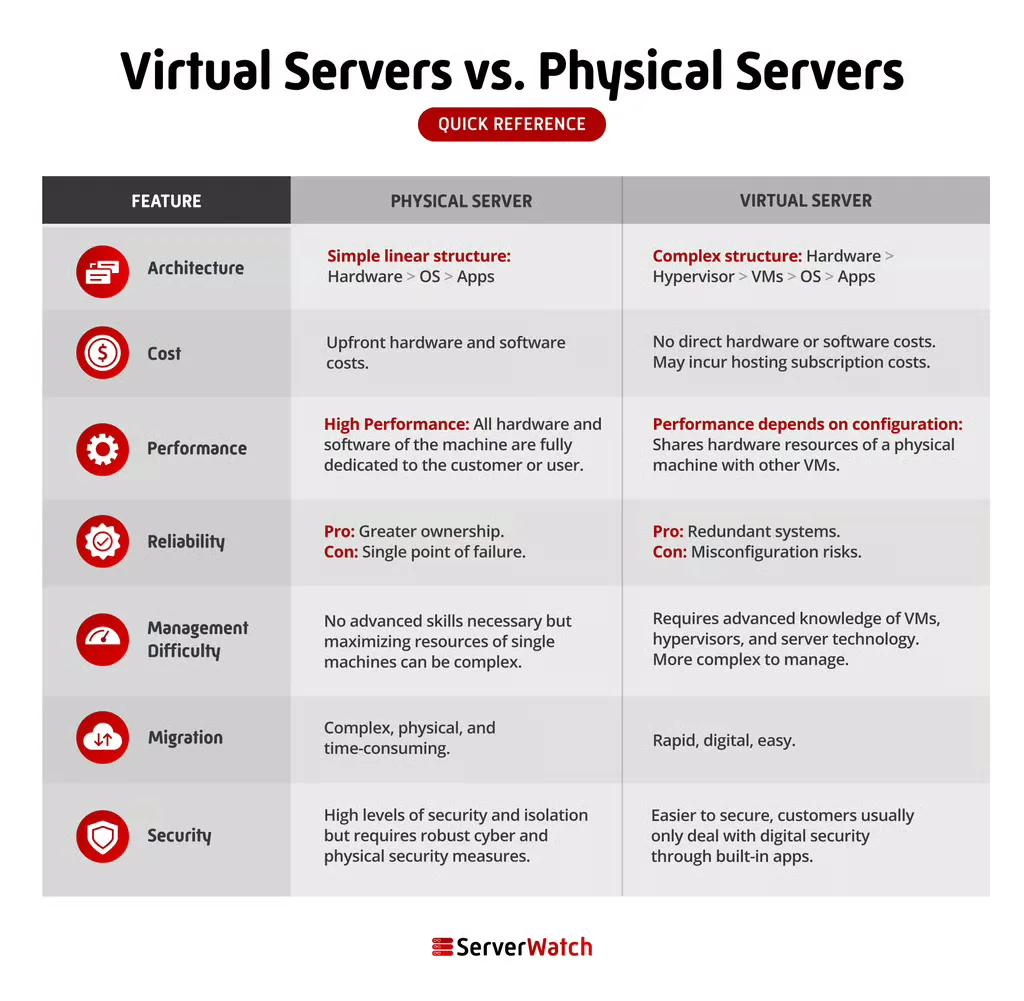
Evaluating whether to deploy workloads on physical or virtual servers requires a balanced assessment across several operational dimensions, including architecture, cost, performance, reliability, management complexity, migration capability, and security.

Architecture and Resource Distribution
The architectural divergence is fundamental. Physical servers maintain a direct, unmediated relationship between the operating system and the hardware components. Virtual servers interject a hypervisor layer, which introduces a microscopic amount of overhead in exchange for unprecedented resource multiplexing. While physical architecture is rigid and bound by the physical boundaries of the chassis, virtual architecture is fluid, abstracting workloads away from the underlying silicon.
Financial Implications and Total Cost of Ownership
From a financial perspective, the comparison hinges on scale and operational model. Physical servers require a substantial upfront capital expenditure (CapEx) for hardware procurement, alongside ongoing operational expenditures (OpEx) for power, cooling, physical space, and manual maintenance. Furthermore, if a physical component fails, internal staff or contracted technicians must manually replace the faulty part.
Conversely, virtual servers—particularly those hosted by third-party cloud providers—typically operate on a subscription-based operational expenditure model. Organizations pay only for the compute and storage resources they consume. Hardware maintenance, physical security, environmental controls, and component replacements are entirely outsourced to the cloud vendor. For growing organizations, virtualization significantly lowers the barrier to entry and optimizes the total cost of ownership by eliminating idle hardware capacity.
Performance Dynamics
Performance outcomes in the physical versus virtual debate are nuanced. Historically, physical servers held a definitive performance advantage because they lacked virtualization overhead. However, modern hypervisors have optimized resource allocation to the extent that virtualization overhead is often negligible—frequently measuring under 2% to 3% in optimized environments.
Nevertheless, physical servers retain the performance crown for workloads requiring sustained, maximum input/output operations per second (IOPS) and direct hardware acceleration, such as specialized GPU rendering or massive transactional databases. Virtual servers, conversely, may experience performance variability if the underlying physical host is over-provisioned or impacted by neighboring resource-intensive VMs.
Reliability and Fault Tolerance
Both system types can achieve high levels of reliability, but through different mechanisms. A physical server’s reliability depends entirely on the quality of its components and the implementation of redundant power supplies, RAID storage arrays, and network interfaces. If a physical server experiences a catastrophic hardware failure, the workload remains offline until repaired or failed over to a secondary machine.
Virtual servers offer superior inherent resilience through features like high availability and automated live migration. If a physical host running multiple virtual machines encounters hardware distress, the hypervisor can automatically migrate active VMs to a healthy physical node in the cluster with zero perceptible downtime for end users.
Management Complexity and Migration Agility
Managing physical infrastructure requires specialized on-site or remote hands-on technical expertise to handle hardware configurations, firmware updates, and physical repairs. Virtual servers centralize management through software dashboards, allowing administrators to oversee thousands of servers from a single interface.
When it comes to migration, virtual servers possess an overwhelming advantage. A virtual machine is essentially a collection of files; it can be copied, exported, and migrated from one physical host to another across a network with a few mouse clicks. Physical server migration, by contrast, requires manual data backups, hardware disassembly, physical transport, re-installation, and extensive reconfiguration.
Security and Isolation Paradigms
Both physical and virtual environments can achieve robust security postures, but their risk profiles differ. Physical servers offer a clear security boundary: bare metal isolation ensures that no other organization’s software resides on the machine, minimizing the risk of multi-tenant vulnerabilities or hypervisor escape exploits.
Virtual servers, while isolated from one another via hypervisor security controls, share the same physical motherboard, CPU caches, and memory buses. This shared-hardware paradigm has occasionally introduced complex security considerations, such as side-channel attacks. Consequently, organizations handling highly classified government data or ultra-sensitive financial assets frequently mandate physical isolation to mitigate these theoretical cross-tenant vectors.
Strategic Implications and Industry Outlook
The ongoing coexistence of physical and virtual servers underscores a pragmatic reality in enterprise IT architecture: no single computing model fits every use case. The strategic decision between deploying a workload on bare metal or within a virtualized instance depends entirely on an organization’s specific performance thresholds, regulatory requirements, budgetary constraints, and scalability objectives.
For the vast majority of modern businesses, virtual servers represent the optimal choice due to their economic efficiency, rapid scalability, simplified management, and built-in disaster recovery capabilities. They provide the agility required to compete in fast-paced digital markets without the burdensome capital outlays associated with procuring and housing physical hardware.
Simultaneously, physical servers remain an indispensable asset for a dedicated tier of enterprise applications. Organizations requiring absolute ownership, zero virtualization overhead, and airtight physical isolation will continue to rely on bare metal infrastructure for their most demanding, mission-critical workloads.
As emerging technologies such as edge computing, artificial intelligence workloads, and containerized microservices continue to expand the boundaries of enterprise computing, the synergy between physical and virtual infrastructure will remain the bedrock upon which the global digital economy is built. IT leaders must continue to evaluate their workload portfolios critically, leveraging virtualization for agility and scale while preserving bare metal infrastructure where raw, uncompromised performance is paramount.
