

The enterprise software market is undergoing a structural transformation as organizations rapidly transition from traditional code-based infrastructures to complex, autonomous artificial intelligence architectures. This paradigm shift has exposed critical vulnerabilities in legacy operational tooling, driving a wedge between infrastructure-level performance monitoring and the dynamic behavior of large language models (LLMs) and autonomous AI agents. Addressing this urgent technological gap, software intelligence leader Dynatrace has officially finalized its high-profile acquisition of AI observability pioneer Arize for $915 million, a strategic maneuver first announced in mid-August.
The multi-million-dollar transaction bridges two distinct yet increasingly interdependent disciplines: traditional full-stack application performance monitoring and specialized machine learning evaluation and debugging. By integrating Arize’s advanced tracing capabilities directly into its unified ecosystem, Dynatrace aims to provide enterprise engineering teams with a single source of truth for inspecting both the underlying digital infrastructure and the erratic, reasoning-driven outputs of modern AI systems. Industry analysts note that this consolidation reflects a broader realization across the software sector: as generative and agentic AI takes on critical production workloads, enterprises require an entirely new class of observability that transcends basic CPU utilization and error rates to evaluate the cognitive decisions of autonomous applications.
The Evolution of Observability in the Age of Autonomous AI
To comprehend the significance of the Dynatrace-Arize amalgamation, one must examine the historical trajectory of enterprise observability. Traditional Application Performance Monitoring (APM) emerged decades ago to help system administrators track response times, database queries, and server uptimes. Dynatrace, founded in Austria in 2005, evolved from these roots into a powerhouse of full-stack observability and digital experience management. Following a series of corporate transitions—including a buyout by Compuware in 2011, acquisition by private equity titan Thoma Bravo in 2014, and an initial public offering on the New York Stock Exchange in 2019—Dynatrace cemented its position as a staple for site reliability engineers (SREs) and platform engineering teams.
Over the past decade, Dynatrace aggressively embedded artificial intelligence into its product lifecycle. In 2017, the company launched Davis, an AI-powered assistant designed to automate root-cause analysis. Over subsequent years, Davis evolved into a hypermodal AI engine capable of combining predictive, causal, and generative artificial intelligence. More recently, the company pioneered agentic AI capabilities, introducing autonomous SRE agents capable of independently diagnosing and resolving operational incidents.
Despite these advanced automation features, a fundamental blind spot persisted. An enterprise application can function perfectly from a traditional infrastructure perspective—with optimal memory allocation, zero network latency, and nominal server loads—while an LLM or autonomous agent operating on top of that infrastructure fails catastrophically. The agent might hallucinate incorrect data, invoke the wrong software tools, or drift completely away from its assigned task objectives.
This exact vulnerability drove the market emergence of Arize in 2020. Founded by former industry executives, Arize set out to solve the unique troubleshooting challenges associated with machine learning models and production AI workloads. As generative AI exploded across the enterprise landscape, Arize expanded its portfolio to provide deep tracing, evaluation, and root-cause analysis specifically tailored for LLM applications and autonomous agent behavior.
A Chronology of Strategic Consolidation and Industry Convergence
The convergence of Dynatrace and Arize did not happen in a vacuum. Although the two entities operated independently prior to the transaction, their respective client bases frequently overlapped. Enterprise technology buyers increasingly voiced frustration at having to toggle between disconnected dashboards—using APM tools like Dynatrace to monitor APIs and cloud services, while relying on specialized point solutions like Arize to evaluate prompt responses, retrieval-augmented generation (RAG) pipelines, and agent reasoning loops.
The timeline leading to the formal closure of the $915 million acquisition highlights the swift pace of consolidation within the enterprise AI tooling sector:
- 2005: Dynatrace is established in Austria, laying the groundwork for modern application performance monitoring.
- 2019: Dynatrace successfully completes its IPO on the New York Stock Exchange under the backing of Thoma Bravo.
- 2020: Arize emerges from stealth to commercialize machine learning and AI observability solutions.
- 2023–2024: The rapid enterprise adoption of generative AI accelerates the demand for LLM tracing, evaluation frameworks, and agentic workflows.
- Mid-August: Dynatrace publicly announces its definitive agreement to acquire Arize for $915 million.
- Current Date: The transaction officially closes, combining product ecosystems and establishing a unified framework for software and AI observability.
According to Steve Tack, Chief Product Officer at Dynatrace, the acquisition was not merely an opportunistic financial investment, but a strategic necessity dictated by the market. Tack, who has spent over a decade guiding Dynatrace’s product vision, notes that the integration aligns seamlessly with the company’s foundational emphasis on AI-driven operations. Simultaneously, Aparna Dhinakaran, co-founder and Chief Product Officer of Arize, emphasizes that modern software failures rarely respect the boundary between traditional code and machine learning logic.
"We used to have one side of the coin—the ability to debug all the harness and LLM-related issues—but if it came to a software issue, we had to then go look at our software traces to figure out the root cause," Dhinakaran explains. "Now, we can put up way more improvements, because we have both sides of the coin to be able to debug."

Bridging the Gap: Software Stacks Meet Model Evaluation
The synergy between Dynatrace and Arize is anchored in complementary technological assets. On one hand, Dynatrace brings comprehensive visibility into cloud-native infrastructure, Kubernetes clusters, microservices, and traditional APIs. On the other hand, Arize brings sophisticated AI-centric tooling, including Phoenix—a widely adopted open-source platform for evaluating and debugging LLM applications—and OpenInference, an observability framework built on top of OpenTelemetry that standardizes the capture of LLM calls, tool usage, and retrieval mechanics.
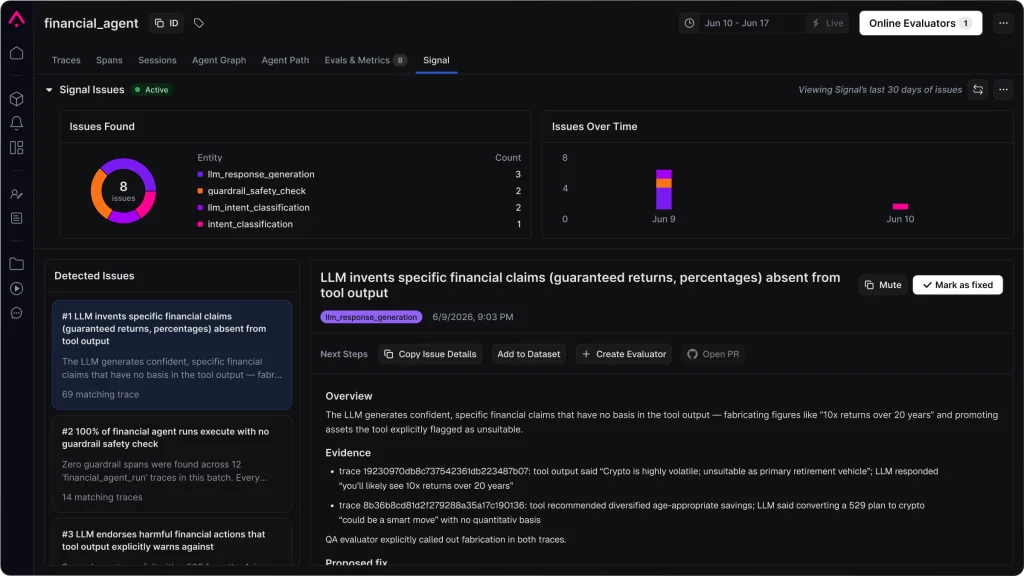
Furthermore, Arize developed advanced proprietary agents such as Signal, an automated utility designed to review production traces, identify recurring failure patterns, and suggest corrective actions. By combining these capabilities, enterprise teams can trace an error from an agent’s faulty semantic reasoning down through the specific API call, database query, and cloud infrastructure component that contributed to the breakdown.
Industry analysts have validated the strategic necessity of this integration. Stephen Elliot, Group Vice President for Software Development and IT Operations at IDC, observed in a recent market statement that uniting evaluation and observability closes the crucial loop between building AI applications and operating them reliably at enterprise scale. Elliot emphasized that as autonomous agents proliferate across business workflows, organizations require synchronized visibility to catch behavioral anomalies earlier and accelerate remediation cycles.
The Shift Toward Actionable, Agentic Observability
Beyond mere data collection and visualization, leadership from both Dynatrace and Arize emphasize that the ultimate evolution of observability lies in autonomous execution. As modern enterprise applications generate billions of telemetry events daily, manual inspection by human engineers has become entirely unsustainable.
"No human wants to go look at billions of traces," Dhinakaran states bluntly. "Nobody’s going to go do that. And so how do you have agents go read your telemetry data?"
This realization points toward a future where autonomous agents act as the primary consumers of observability telemetry. Rather than alerting a human operator to a dashboard anomaly, modern observability systems leverage AI agents to analyze data streams, identify root causes, and autonomously generate remediation code.
Arize has already begun pioneering this workflow through tools like Alyx, an embedded assistant that interacts with Signal to detect recurring root causes and automatically open pull requests for software patches. According to company metrics, a significant majority of these automated pull requests are successfully accepted and merged by engineering teams, effectively transforming human developers from trace-combers into code reviewers. This iterative feedback loop gestures toward the realization of self-sustaining, self-maintaining, and self-improving software ecosystems.
Market Implications and the Buy-Versus-Build Calculus
The $915 million price tag underscores the immense commercial value placed on AI-native infrastructure assets. For Dynatrace, the decision to acquire Arize rather than attempt an internal build reflects the prohibitive engineering costs and time-to-market constraints associated with developing world-class LLM evaluation frameworks from scratch. Core components like OpenInference and Phoenix represent years of specialized community development and technical refinement that cannot be easily replicated through organic R&D timelines.
Moving forward, both companies have confirmed that Arize will continue to operate as a standalone product offering, ensuring that existing customers who do not utilize Dynatrace can still access its evaluation and tracing platforms. Simultaneously, deep technical integrations will be rolled out incrementally across the unified product roadmap, bridging the gap between development-time model evaluation and production-time infrastructure monitoring.
As enterprises accelerate their deployment of autonomous agents into mission-critical environments, the boundary between application code and artificial intelligence will continue to dissolve. By uniting Dynatrace’s enterprise-grade infrastructure monitoring with Arize’s specialized AI evaluation engine, the newly expanded organization aims to establish the definitive operational standard for the next generation of software engineering.
