
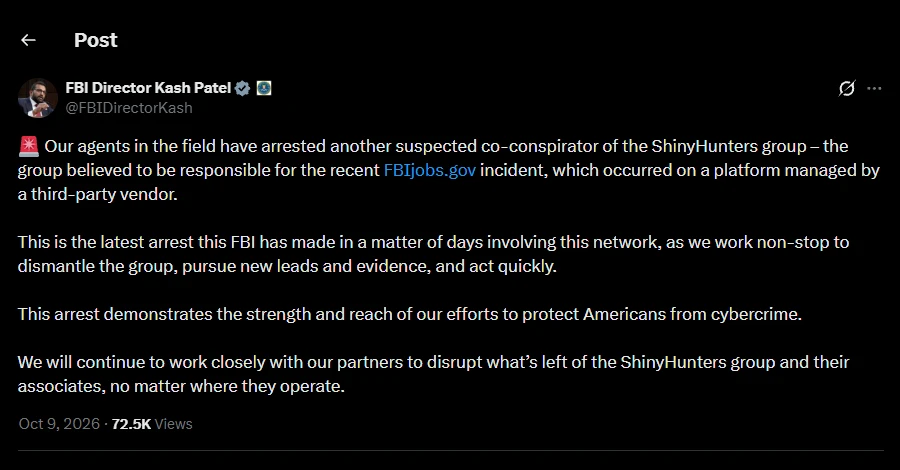

The Federal Bureau of Investigation (FBI) has confirmed the arrest of a new suspect linked to the high-profile cyberattack orchestrated by the extortion syndicate known as ShinyHunters. FBI Director Kash Patel announced the development on October 9, 2026, via social media, signaling a significant escalation in the agency’s multi-national campaign to dismantle the criminal collective. The suspect, identified by multiple media outlets as a Canadian national, was taken into custody in Pennsylvania. This latest apprehension marks the third public arrest in the wake of a sophisticated breach of the FBI’s job application portal, an incident that resulted in the exfiltration of sensitive records pertaining to bureau personnel and prospective applicants.
While the FBI has remained tight-lipped regarding the specific identity of the Canadian individual, citing ongoing investigative protocols, the arrest underscores the aggressive posture adopted by federal law enforcement in response to what many cybersecurity experts consider one of the most audacious data breaches against a U.S. government entity in recent history. The breach, which first came to light in late September 2026, exposed a vast array of personal identifiable information (PII), including psychiatric and medical histories of individuals seeking employment with the agency.
A Chronology of the ShinyHunters Investigation
The investigation into ShinyHunters has spanned continents, characterized by a complex web of international cooperation between the FBI and foreign law enforcement agencies. The timeline of the enforcement actions provides insight into the breadth of the investigation:
- September 15, 2026: In an early success, Dutch authorities, supported by the FBI, apprehended a 24-year-old Amsterdam resident. Identified in reports as Pepijn van der Stap, the suspect is alleged to be a key figure within the ShinyHunters hierarchy.
- September 22, 2026: ShinyHunters publicly claimed responsibility for the breach of the FBI’s recruitment website, leaking a sample of the stolen data to substantiate their claims.
- September 29, 2026: Reports surfaced indicating the detention of a second suspect, Saif al-Din Khader, in Jordan. Sources close to the investigation suggest that Khader has been cooperating with American authorities.
- October 3, 2026: The FBI formally acknowledged that it had been working with international partners to detain multiple subjects associated with the breach.
- October 9, 2026: FBI Director Kash Patel confirmed the arrest of a third individual in Pennsylvania, marking the first such arrest on U.S. soil related to this specific investigation.
Security Failure: The Human and Technical Factor
The breach was not the result of a direct penetration of the FBI’s primary, highly secured internal network. Instead, an internal forensic analysis revealed that the intrusion originated from a third-party platform managed by an external contractor. According to Brett Leatherman, assistant director of the FBI’s Cyber Division, the vulnerability was exploited after a contractor failed to implement a critical security patch specifically issued to fortify the platform.
While the FBI has refrained from publicly identifying the specific vendor involved, industry reporting and sources familiar with the matter have pointed to the involvement of PeopleSoft—an enterprise human resources software suite—and the global professional services firm Accenture. The incident has prompted the FBI to sever ties with the responsible contractor, reflecting the bureau’s zero-tolerance policy regarding the maintenance of federal security standards.

This specific failure highlights a systemic vulnerability in modern government operations: the reliance on expansive supply chains and third-party vendors. Even when an agency maintains a robust internal cybersecurity posture, the interconnected nature of modern digital infrastructure means that a single missed update by a service provider can provide a gateway for sophisticated threat actors to bypass perimeter defenses.
ShinyHunters: A History of Extortion
ShinyHunters is not a newcomer to the landscape of cybercrime. Prior to the FBI breach, the group had established a notorious reputation for executing large-scale data thefts, often targeting large corporations and government institutions. The FBI estimates that since 2025, the group has been responsible for compromising at least 140 organizations, successfully extracting over $70 million in extortion payments.
The group’s motivation for targeting the FBI, as stated in their own communications, appears to be retaliatory. They cited an FBI Public Service Announcement (PSA) released in May 2026 as the catalyst for the attack. That advisory characterized ShinyHunters as a purely criminal enterprise, a designation the group claims was inaccurate and damaging. By attacking the bureau, the group seemingly intended to assert its capabilities and challenge the authority of the very agency tasked with its neutralization.
Broader Implications for National Security
The theft of data from an FBI recruitment portal carries profound implications. The compromised files reportedly contained not only standard contact information but also sensitive background investigation materials. For the individuals whose data was stolen, the breach poses a long-term risk of identity theft, blackmail, and potential targeting by foreign intelligence services who may seek to identify or compromise future federal employees.
Furthermore, the incident has reignited the debate regarding the security of third-party software in federal environments. "The reality of this breach is that it was entirely preventable," says one cybersecurity analyst who requested anonymity. "When you integrate external software with federal human resources, that software becomes a part of the agency’s attack surface. If you don’t manage the patch cycle of your contractors with the same rigor you apply to your own servers, you are essentially leaving the front door unlocked."
The arrest of three individuals in three different countries demonstrates that the FBI is capable of conducting successful extraterritorial operations, but it also highlights the resilience of decentralized cyber-syndicates. ShinyHunters operates as a fluid organization, often utilizing a network of associates across various jurisdictions to minimize risk and evade capture.

Moving Forward: The Path to Prosecution
As the investigation continues, the focus will likely shift from identification to prosecution. The cooperation of suspects like Khader in Jordan could prove instrumental in mapping the internal command structure of ShinyHunters and identifying additional nodes within their network.
FBI Director Patel’s commitment to "disrupt what’s left of the ShinyHunters group" suggests that more arrests are likely on the horizon. For the bureau, the goal is twofold: to hold the perpetrators of the recruitment breach accountable and to send a deterrent message to other cyber-extortionists that an attack on U.S. federal infrastructure will be met with a sustained, global response.
The legal proceedings for the suspects currently in custody will likely take place in multiple venues. Those detained abroad may face extradition requests, while the suspect arrested in Pennsylvania will likely face federal charges in U.S. courts. The complexity of these legal battles, combined with the technical forensics required to secure a conviction, suggests that the aftermath of the ShinyHunters breach will be a subject of intense focus for the Department of Justice for the foreseeable future.
As the digital landscape continues to evolve, the incident at the FBI serves as a stark reminder of the persistent threat posed by organized cybercrime. The bureau’s transition toward stricter vendor management and enhanced threat intelligence is indicative of a broader shift in federal policy, aiming to ensure that the security of sensitive government data is not compromised by the weakest link in the supply chain. While the immediate danger posed by this specific group may be diminishing, the challenge of securing the digital perimeter against globalized threats remains one of the most pressing national security issues of the decade.
