

When the MACH Alliance was established six years ago, its founding mission felt like a radical departure from conventional enterprise software deployment. Advocating for an API-centric, composable software stack built from headless microservices, the organization positioned itself as a direct challenger to monolithic enterprise resource planning and digital commerce suites. In an industry historically dominated by single-vendor monoliths that locked enterprises into proprietary ecosystems, the promise of MACH—Microservices-based, API-first, Cloud-native SaaS, and Headless—was viewed by legacy players as a disruptive, niche movement.
Today, that once-rebellious architecture has become the undisputed mainstream paradigm. As global enterprises race to adapt to the realities of artificial intelligence, every major software vendor is rapidly opening up its application programming interfaces (APIs) simply to remain competitive. The concept of headless architecture, once treated with skepticism by risk-averse chief information officers concerned about a loss of centralized control, is now viewed as an operational necessity. In the modern commercial landscape, a software vendor survives not by locking customers into a closed loop, but by making its core capabilities discoverable and actionable by autonomous digital agents.
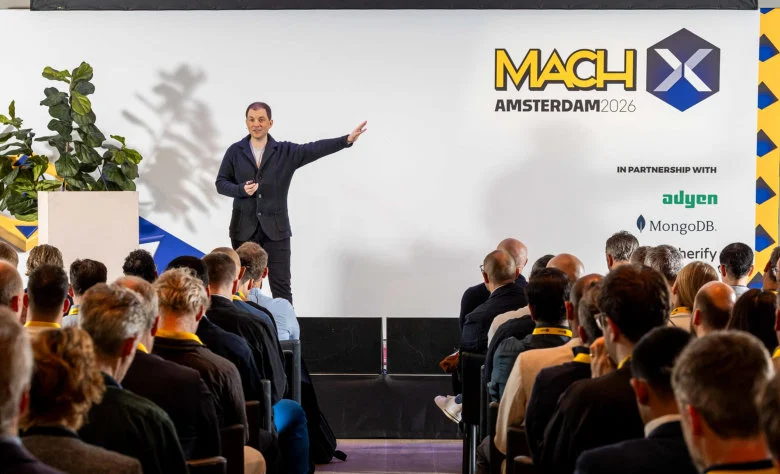
This seismic shift in the technological landscape was a central theme at the fifth annual MACH X conference, held last week in Amsterdam. The event drew hundreds of enterprise architects, technology executives, and digital transformation leaders from around the globe to discuss the practical realities of building modular, high-performance digital commerce ecosystems. It also marked the one-year anniversary of Jason Cottrell stepping into his role as President of the MACH Alliance, following a career as the CEO of commerce consultancy Orium. Under Cottrell’s leadership, the organization has accelerated its strategic pivot away from fighting a guerrilla war against monolithic legacy suites toward shepherding the industry through the nascent era of agentic artificial intelligence.
The Evolution of an Acronym and the Shift in Market Maturity
The transition of the MACH Alliance from a rebellious upstart to a foundational industry standard has been swift. Just three years ago, during its third annual conference, organization leadership recognized that its confrontational messaging risked alienating risk-averse enterprise buyers. Consequently, the Alliance began toning down its anti-monolith rhetoric to court mainstream enterprise membership, successfully bringing large global brands and traditional software providers into its fold.
By last year, however, the rapid acceleration of generative AI and foundational language models forced another strategic realignment. Organization leadership realized that the underlying principles of MACH—flexibility, cloud-native scalability, and decoupled architectures—were no longer novel differentiators, but rather the baseline operational requirements needed to support autonomous enterprise software agents.
This evolution culminated in a definitive decision made earlier this year: the acronym MACH will no longer be strictly tied to its original component definitions of Microservices, API-first, Cloud-native, and Headless. Speaking at MACH X in Amsterdam, Cottrell explained that feedback from members, ambassadors, and the broader developer community indicated that these technical attributes have largely become table stakes in modern platform engineering.
"What we heard really coming back from our membership, coming from our ambassadors and community, was actually what MACH stood for, for most of them, was about speed, agility, performance," Cottrell stated during the conference. "What I would recognize is that the M, the A, the C, the H, where the organization started, is increasingly table stakes in many platforms, right? It’s not always solved well, but it’s increasingly solved enough. I think the Alliance actually should deserve a lot of credit for what it did to date, in pushing that faster than otherwise would have happened. But what we recognize is the next tier. We want to keep educating on what is the baseline. We want to make sure, from a certification perspective, still there’s a trust in what good looks like, if somebody is a member of the Alliance. But that’s just the foundation for what’s next."
Preparing Enterprise Infrastructure for the Agentic Wave
With foundational composability largely accepted across the enterprise software market, the MACH Alliance is shifting its institutional focus toward preparing digital commerce and customer experience infrastructures for the impending explosion of autonomous software agents.
During the initial hype cycle surrounding generative AI models like ChatGPT and Google Gemini, many enterprise technology leaders operated under the assumption that they would eventually purchase a single, monolithic agentic platform designed to manage all internal operations and customer interactions. However, market maturity has yielded a more nuanced reality. Organizations now recognize that enterprise deployment will involve not one omnipotent agent, but hundreds, thousands, or even tens of thousands of specialized, decentralized agents operating concurrently across various business units.
"One year ago, everybody really kind of had in their mindset, ‘Oh, I’m going to buy an agent, and the agent’s going to do everything for me,’" Cottrell noted. "I think that was a natural extension from, we were using ChatGPT or Gemini or similar. But I think what we’re understanding now is how we’re going to deploy these at work is hundreds, thousands, tens of thousands, and while that may seem daunting, I don’t think it seems impossible anymore. So a year later, we’re approaching that I think with a different market awareness, a different understanding of what we’re going to be facing."
To prevent this proliferation of autonomous software agents from devolving into an unmanageable administrative and technical nightmare, the Alliance is positioning its network as the definitive ecosystem for agentic commerce, customer data management, and digital experience. The organization’s near-term mandate involves expanding its scope to encourage unified standards, pre-built integrations, and cross-functional interoperability. Without these foundational guardrails, the promised efficiency gains of agentic AI risk being neutralized by integration gridlock.
Interoperability in Practice: The Multi-Vendor Reality
A core tenet of the original MACH philosophy was the freedom to select best-of-breed components rather than relying on a single vendor’s all-in-one suite. In the agentic era, this multi-vendor requirement becomes even more pronounced. Enterprise agents cannot operate effectively if they are confined within proprietary data silos; they must be capable of querying, executing tasks, and sharing context across a disparate array of enterprise software systems.
Cottrell pointed to MACH Alliance member and event sponsor Voucherify as a prime example of how modern composable vendors are approaching this multi-vendor reality. Voucherify developed an autonomous agent named Vincent, specifically designed to navigate the promotions and loyalty management space. Rather than assuming a closed-loop environment, the platform’s architecture assumes that an enterprise client will utilize a customer data platform (CDP) such as Bloomreach or Segment, while executing underlying transactional operations through commerce platforms like commercetools or BigCommerce.
By building Vincent to function seamlessly across a diverse, multi-vendor enterprise stack—and conversely, enabling third-party developers to build integrations directly into the agent—Voucherify illustrates the exact type of collaborative, composable interoperability the MACH Alliance aims to champion on a global scale.
Expanding Certification, Standards, and Governance
As enterprise adoption of artificial intelligence accelerates, issues of security, data privacy, and architectural reliability have taken center stage. To maintain trust and guide buyers through an increasingly complex vendor landscape, the MACH Alliance plans to incrementally expand its formal certification framework over the coming years.
This expanded certification process will incorporate emerging architectural standards and implementation best practices specifically tailored for the agentic era. The organization intends to provide clear guidance regarding Model Context Protocols (MCP) and other communication frameworks, helping enterprises differentiate between baseline, advanced, and optimal implementations.
"We’ll be expanding incrementally our certification over the next couple of years to make sure that it starts to encompass the standards and the implementation best practices that will be needed for the agentic era," Cottrell explained. "So things like MCP, starting with guidance on what good, better, best looks like, amongst other protocols and other ways of making this work. Over time we’ll start to raise the baseline of, actually to be a member, of what you must do. So I think it starts to move our collective network of vendors in a direction. I think it starts to educate buyers on what to look for. That we see as the next challenge."
Fostering Community and Cultivating Change Agents
Beyond technical standards and platform certification, the MACH Alliance continues to emphasize the value of peer networking, education, and community-driven knowledge sharing. While software vendors form a vital pillar of the membership base, practitioners, consultants, and enterprise architects remain equally critical to the organization’s long-term viability.
To address the practical realities of deploying artificial intelligence within legacy corporate structures, the Alliance has launched a specialized grouping known as the agentic transformation lab, operated under a broader initiative called Change Agents. This program is explicitly designed to support, train, and build a collaborative community for hands-on professionals tasked with redesigning operational workflows.
"It’s meant to deliberately train, support, and build community for those who are hands-on, saying, ‘Okay, I’m helping to rethink the processes in this function, thinking about how we recompose what are new agentic-first ways of working into marketing, into operations, into software engineering,’ and so the people actually getting some of that change done," Cottrell said. "We’ve been starting to build out more deliberate training for them, because a lot of them right now they’re coming into these job descriptions. They’re often the first at their company to ever have to tackle that mandate."
Economic and Operational Implications for Enterprise IT
Operating concurrently as the President of the MACH Alliance and the Chief Executive Officer of Orium provides Cottrell with a dual perspective on the operational challenges and opportunities facing enterprise technology departments. From the consulting front lines, the impact of autonomous agents on software engineering and application infrastructure is already visible in real-time budgets and project scopes.
According to industry analyses and observations from enterprise deployments, the integration of generative AI and autonomous agents is fundamentally altering the software development lifecycle. Organizations are experiencing a notable reduction in the marginal cost of writing standard application code, leading to an overall increase in software output. However, this productivity gain introduces new operational overhead, particularly in areas such as code security, governance, and infrastructural monitoring.
"Whole layers of application infrastructure will move from being static to agentic as companies try to compete," Cottrell noted. "I think we’re going to drive down the cost to write code. We’re going to write more software, but also we’re going to probably also have to offset some of that, spending more time securing it. We’ve got to keep in mind that generally, there’s a lot more that comes out positive on the far side, and so we’ve got to be spotting for what those opportunities are, so we can be on the leading edge of those new things our customers want."
Broader Industry Impact and Outlook
The journey of the MACH Alliance over the past six years reflects the broader maturation of modern enterprise software architecture. When the organization was first conceived, its early members shared a distinct sense of camaraderie forged through opposition to entrenched industry norms. Taking a common cause against the dominance of monolithic software suites created a tight-knit community united by a shared vision of modular, API-driven flexibility.
Today, that specific sense of being an underdog insurgent has naturally dissipated because the core tenets of composability have swept through the entire software industry. It is progressively more difficult for an organization to foster a rebellious identity when virtually every legacy vendor now markets itself as API-first and cloud-native.
Nevertheless, the fundamental need for cross-industry collaboration, shared operational learnings, and rigorous architectural standards remains as acute as ever. As enterprises transition from static digital commerce stacks to dynamic, agent-driven ecosystems, the architectural definitions established today will dictate commercial competitiveness for the next decade. By evolving its mission to govern and guide the agentic era, the MACH Alliance has positioned itself to remain a central architectural authority as enterprise technology enters its next major phase of evolution.
