
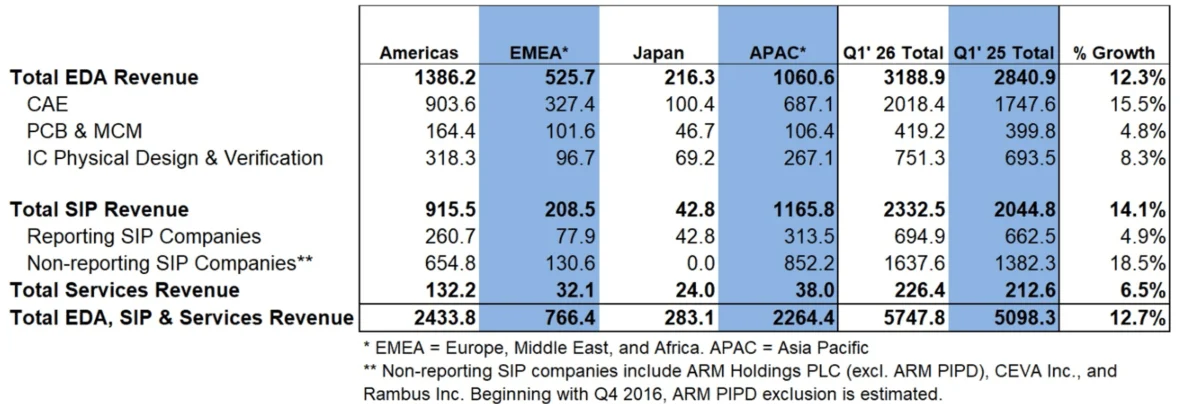

The global electronic design automation (EDA) and semiconductor intellectual property (SIP) market reached a significant milestone in the first quarter of 2026, signaling a robust era of expansion for the foundational technologies that underpin the modern electronics industry. According to the latest Electronic Design Market Data (EDMD) report, total revenue for the sector climbed to $5.748 billion during the first three months of the year. This represents a 12.7% increase compared to the $5.1 billion recorded in the first quarter of 2025, marking one of the strongest opening periods for the industry in recent history.
The sustained momentum is largely attributed to the insatiable global demand for high-performance computing (HPC) and specialized silicon tailored for artificial intelligence (AI) applications. As hyperscalers and enterprise data centers transition toward more efficient AI server architectures, the complexity of chip design has escalated, necessitating a more comprehensive suite of sophisticated software tools and pre-verified intellectual property blocks. This shift has pushed the industry’s annual run rate beyond the $22 billion threshold, a figure that Wally Rhines, Executive Sponsor of the SEMI EDMD report and CEO of Silvaco Group, noted is a dramatic departure from the historical norm of approximately $10 billion.
The AI Catalyst and the Surge in Computer-Aided Engineering
At the heart of this growth is the Computer-Aided Engineering (CAE) category, which saw its revenue jump 15.5% to $2.018 billion. CAE tools, which encompass simulation, synthesis, and verification software, are critical for managing the immense design complexity of next-generation AI accelerators and server processors. As chipmakers move toward advanced process nodes—specifically the 2nm and 1.4nm generations—the "verification gap" has widened. This gap refers to the disparity between the ability to manufacture billions of transistors and the ability to verify that the resulting design functions correctly without errors.
To bridge this gap, semiconductor firms are investing heavily in hardware-assisted verification, formal verification, and AI-driven design tools that can automate repetitive tasks. The rise of "System-on-Chip" (SoC) designs, which integrate CPU, GPU, and NPU (Neural Processing Unit) cores onto a single die, has made CAE indispensable. Furthermore, the industry-wide move toward "More than Moore" technologies, such as 3D-IC (three-dimensional integrated circuits) and chiplet-based architectures, requires new simulation environments to manage thermal dissipation, signal integrity, and power delivery across multiple stacked layers.
Regional Performance and the Relaxation of Export Restrictions
Geographically, the first quarter of 2026 showcased a landscape of varied but generally positive performance. A standout development was the significant recovery of the Chinese market. Following a period of stringent trade barriers, a targeted relaxation of certain export restrictions allowed for a 31% surge in Chinese EDA and SIP sales, reaching $508 million compared to $388 million in the first quarter of 2025. This resurgence suggests that Chinese domestic firms are aggressively catching up on design starts for legacy and mid-range nodes, while also seeking authorized tools for more advanced developments where permitted.

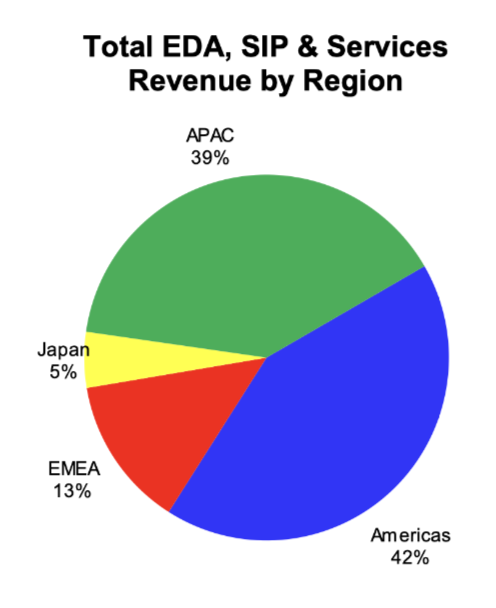
In the Americas, the largest market for EDA tools, revenue grew by 10.2% to reach $2.434 billion. This growth remains steady, supported by the ongoing domestic "onshoring" of semiconductor manufacturing and design, fueled in part by long-term government incentives and the presence of major cloud service providers developing proprietary silicon.
The Europe, Middle East, and Africa (EMEA) region recorded a stellar 17.6% growth rate, bringing its quarterly revenue to $766.4 million. Analysts point to the European automotive sector’s transition to software-defined vehicles and the region’s growing industrial AI base as primary drivers. The Asia/Pacific region (excluding Japan) grew by 17.7% to $2.264 billion, bolstered by the aforementioned rebound in China and continued design activity in Taiwan’s foundry ecosystem.
Japan stood as the sole outlier in the report, with revenue decreasing by 9.9% to $283.1 million. However, industry experts cautioned against interpreting this as a total market decline. Wally Rhines noted that while the headline figure was down, the contraction was almost entirely localized within the SIP segment. When SIP is excluded, Japan’s EDA tool sales showed double-digit growth, reflecting a shift in how Japanese firms are consuming technology—favoring internal tool development or specific software licenses over the acquisition of external IP blocks.

The Nuances of the South Korean and Indian Markets
While the broader Asia/Pacific region thrived, South Korea and India presented a more complex picture. Reported revenue in these regions remained relatively flat, a trend that has persisted over several quarters. In South Korea, the market is heavily influenced by the memory giants Samsung Electronics and SK hynix. While both companies reported increased DRAM and NAND flash revenue in early 2026 due to the AI-driven demand for High Bandwidth Memory (HBM), these financial gains do not always translate into immediate EDA sales. Memory design is typically less tool-intensive on a per-unit basis compared to logic design, and these firms often operate on long-term, multi-year licensing agreements that mask quarterly fluctuations.
In India, the flat growth figures are widely considered a reporting anomaly rather than a reflection of actual engineering activity. India has become a global hub for semiconductor design, with nearly every major multinational corporation (MNC) operating significant R&D centers in Bengaluru, Hyderabad, and Noida. However, because these MNCs often bill their EDA licenses through their corporate headquarters in the United States or Europe, the revenue is not credited to the Indian region in the EDMD reports. Consequently, the massive "brain trust" and design output of the Indian subcontinent are frequently underrepresented in regional financial data.
Workforce Expansion and the Talent Challenge
The growth in revenue has been accompanied by a corresponding expansion in the industry’s workforce. Total employment in the EDA and SIP sectors increased by 12.6% year-over-year, reaching 72,544 professionals in the first quarter of 2026. This represents a significant jump from the same period in 2025 and underscores the industry’s need for specialized talent to develop and support increasingly complex software.

Despite the increase in headcount, the semiconductor industry continues to grapple with a global talent shortage. The demand for engineers skilled in computational lithography, machine learning for EDA, and physical design has outpaced the supply of graduates. To address this, many EDA vendors are turning to AI themselves, integrating generative AI and reinforcement learning into their tools to improve the productivity of existing engineering teams—a trend often referred to as "AI for EDA."
Historical Context and the Four-Quarter Moving Average
To understand the significance of the Q1 2026 results, it is necessary to look at the industry’s long-term trajectory. The EDA and SIP market has historically been a steady, cyclical industry. However, the current data suggests a structural shift. The four-quarter moving average for the industry now stands at 10.3%, and the Q1 growth of 12.7% sits comfortably above this average.
The leap from a $10 billion annual run rate to over $22 billion within a few years highlights the "siliconization" of the global economy. In previous decades, EDA tools were primarily the province of specialized chip companies. Today, system companies—including automotive OEMs, aerospace firms, and consumer electronics giants like Apple and Google—are designing their own custom silicon to differentiate their products. This expansion of the customer base has fundamentally changed the scale of the EDA market.

Broader Implications and Future Outlook
The Q1 2026 data provides a clear indication that the semiconductor industry is not merely in a cyclical upturn but is undergoing a foundational expansion. The convergence of AI, 5G-Advanced, and autonomous systems is creating a "perfect storm" for design tool providers. As chip designs become more heterogenous, incorporating different types of processing cores and memory on a single package, the role of EDA software is shifting from a mere "utility" to a "strategic enabler."
Furthermore, the data suggests that the EDA industry is resilient to geopolitical tensions. Even with the complexities of international trade, the necessity of these tools for modern life ensures that demand remains high. The relaxation of export restrictions in China serves as a reminder of the interdependent nature of the global semiconductor supply chain; without access to world-class design tools, even the most advanced manufacturing facilities cannot produce functional silicon.
Looking ahead to the remainder of 2026, the industry is expected to maintain its double-digit growth trajectory. The anticipated rollout of more advanced AI models will require even more powerful hardware, which in turn will drive another wave of design starts. For the EDA and SIP providers, the challenge will be to keep pace with the rapid evolution of semiconductor physics while managing a global workforce and navigating a complex regulatory environment. If the first quarter is any indication, the industry is well-positioned to meet these challenges, cementing its role as the indispensable architect of the digital age.
