
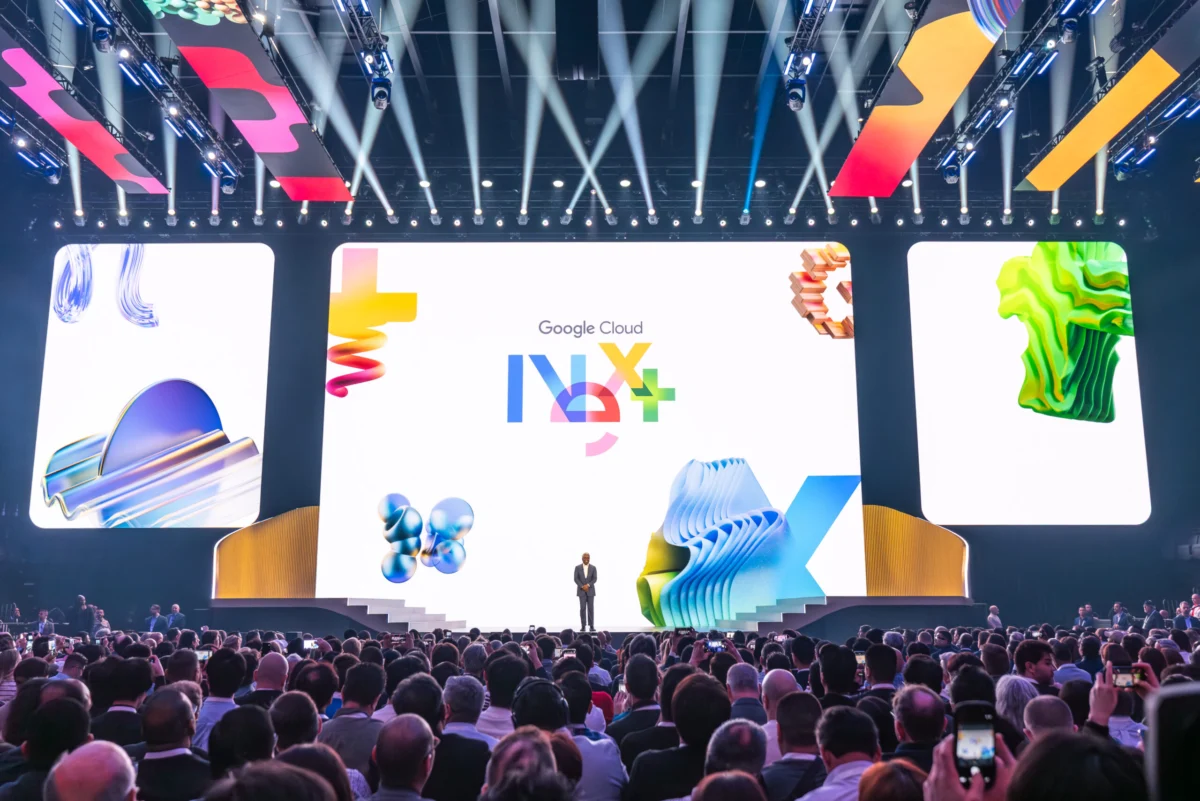

The competition for dominance in the enterprise artificial intelligence sector has entered a critical new phase as major technology providers vie to become the primary governance and management layer for autonomous agents. At the annual Google Cloud Next conference in Las Vegas, Google articulated a comprehensive strategy to position itself as the foundational operating system for the "agentic enterprise." This shift marks a transition from the experimental phase of generative AI toward a structured, production-ready environment where organizations manage thousands of autonomous entities performing complex business functions.
The strategic pivot comes at a time when the enterprise landscape is saturated with AI tools but remains fragmented in terms of execution and value realization. Google’s latest announcements, ranging from specialized hardware to unified software platforms, suggest a massive capital commitment and a fundamental change in how the company intends to interact with its corporate clients and its competitors.
The Shift from Experimentation to Production
Google Cloud CEO Thomas Kurian opened the event by addressing a primary pain point for Chief Information Officers (CIOs): the "pilot purgatory" where AI projects fail to reach meaningful scale. According to industry data shared during the keynote, while approximately 93 percent of organizations have integrated AI into their operations in some capacity, only 57 percent report a success rate of 50 percent or higher in their implementations. This gap represents the "bridge" that Google aims to build through its new suite of tools.
The centerpiece of this effort is the Gemini Enterprise Agent Platform. Kurian described this platform as the "Android of the agentic era," a reference to Google’s mobile operating system that succeeded by providing the connective tissue between disparate hardware, applications, and users. The ambition is to provide an end-to-end system that handles the orchestration, governance, and observability of AI agents, regardless of whether those agents were built using Google’s models or third-party frameworks.
Chronology of Strategy: From Open Orchestrator to Platform Owner
The current strategy represents a significant evolution from Google Cloud’s positioning just twelve months ago. In early 2023 and through the 2024 event cycle, Google’s narrative was centered on "openness" and the "Agent2Agent" protocol, which was designed as an interoperability standard supported by partners like Salesforce, ServiceNow, and Workday. At that time, Google sought to be a neutral broker in a multi-model world.
By late 2024 and into the current Next event, the tone has visibly hardened. While the language of composability remains, the structural moves indicate a desire for deeper platform lock-in. Vertex AI, previously a standalone developer-facing infrastructure service, is being absorbed into the Gemini Enterprise Agent Platform. This move signals that Google is moving away from selling raw infrastructure and toward owning the enterprise application and management layer.
The $185 Billion Infrastructure Bet
The scale of Google’s ambition is perhaps most evident in its financial commitments. Alphabet CEO Sundar Pichai revealed a staggering increase in capital expenditure (CapEx) to support the AI transition. In 2022, the company’s CapEx stood at $31 billion. For the current fiscal year, Google plans to invest between $175 billion and $185 billion—a nearly six-fold increase in just four years.
Approximately half of this investment is dedicated to machine learning compute specifically for the cloud business. This includes the rollout of new generations of Tensor Processing Units (TPUs) and a redesigned data architecture optimized for the high-throughput requirements of autonomous agents. This level of spending underscores Google’s belief that the "agentic layer" will be the most valuable territory in the technology stack for the next decade.
Technical Architecture: Identity, Registry, and Gateway
To manage the complexities of thousands of agents operating simultaneously, Google introduced three core pillars of governance:
- Agent Identity: Every autonomous agent is assigned a unique cryptographic ID. This allows organizations to track the "lineage" of actions taken by an AI, ensuring that every automated decision can be audited and attributed.
- Agent Registry: A central index that catalogs every agent and tool across an organization’s estate. This prevents the "shadow AI" problem, where departments deploy unauthorized agents that create security vulnerabilities.
- Agent Gateway: A centralized enforcement point for corporate policy. The Gateway monitors agent behavior in real-time, ensuring that an agent does not exceed its data access permissions or violate compliance protocols.
Furthermore, Google announced the "Agentic Data Cloud," anchored by a new Knowledge Catalog. This system acts as a universal context engine, pulling business data from across the enterprise. Notably, the Knowledge Catalog is designed to ingest data from competitors’ platforms, including Salesforce Data360, SAP, ServiceNow, and Workday, positioning these established platforms as subordinate data providers to Google’s reasoning engine.
The Governance Conflict: Local vs. Foreign Agents
A significant point of tension emerged during the event regarding the "ownership" of governance. Michael Gerstenhaber, Google Cloud’s VP of Product Management, articulated a scenario where a user’s agent (a "local agent") needs to interact with a data-owning agent from a provider like ServiceNow (a "foreign agent").
In Google’s vision, the Google Cloud administrator would monitor both sides of this transaction to ensure safety. However, this creates a potential political and technical conflict with other SaaS giants. Salesforce, for instance, has launched "Agentforce," its own governance layer designed specifically for customer-facing workflows. ServiceNow and SAP have similar ambitions to own the control plane for their respective domains (ITSM and ERP).
The industry is now facing a scenario where a single enterprise could have multiple, competing governance layers. A CIO may find themselves caught between Google, Microsoft, Salesforce, and ServiceNow, each claiming to be the authoritative source for audit logs, security traces, and performance metrics.
The Microsoft Interoperability Dynamic
Interestingly, Microsoft remains a unique outlier in Google’s "absorption" strategy. While platforms like SAP and Workday are being framed as data sources for Google’s Knowledge Catalog, the relationship with Microsoft is being handled with more strategic caution.
Google’s pitch regarding Microsoft focuses on compatibility—exporting documents into Office formats and connecting agents across Microsoft 365—rather than attempting to ingest the Microsoft data estate into its own reasoning engine. This likely reflects the reality of Microsoft’s entrenched position in the productivity layer and the high probability of a fierce defensive response should Google attempt to position Microsoft 365 as a subordinate context provider.
Security and the Wiz Integration
Security remains a primary barrier to agent adoption, a fact Google addressed by highlighting the formal arrival of Wiz into the Google Cloud security fold. By integrating advanced cloud security posture management (CSPM) with AI governance, Google aims to provide a "secure-by-default" environment. This is critical for "long-running agents"—autonomous entities that can operate for days or weeks without human intervention. These agents require constant monitoring to ensure they do not "drift" from their original intent or become compromised by external actors.
Implications for the Enterprise
For the broader market, Google’s strategy represents a double-edged sword. On one hand, the "full-stack" approach—where chips, models, data architecture, and governance are co-designed—offers a level of performance and cohesion that is difficult to achieve through fragmented, best-of-breed solutions. For organizations that are already "Google-native," this provides a clear and powerful path toward full automation.
On the other hand, most large enterprises operate in highly heterogeneous environments. They possess decades of investment in AWS or Azure infrastructure and deeply embedded workflows in Salesforce and ServiceNow. For these organizations, Google’s attempt to become the overarching governance layer may add a new level of complexity rather than reducing it.
To address this, Google has launched a $750 million partner fund aimed at system integrators (SIs). The goal is to place Google-trained engineers directly into customer environments to help bridge the gap between archaic legacy processes and modern agentic workflows. This "co-innovation" model suggests that Google recognizes that technology alone will not win the market; it requires the "boots on the ground" typically associated with firms like Accenture or Deloitte.
Conclusion: The Future of the Agentic Control Plane
The announcements at Google Cloud Next signal that the battle for the "control layer" of enterprise AI has officially begun. Google is no longer content to be a provider of models or compute; it is making a bid to own the administrative heart of the digital enterprise.
The success of this strategy will depend on two factors: the technical ability of the Gemini Enterprise Agent Platform to truly manage "foreign" agents from competitors, and the willingness of CIOs to grant Google authority over their entire data and agent estate. As Salesforce, ServiceNow, and Microsoft prepare their own counter-offensives, the enterprise technology landscape is set for a period of intense competition that will determine the "operating system" of the next decade.
