

Elon Musk’s AI venture, SpaceXAI, has officially launched Grok 4.5, marking its first public model release since the completion of the SpaceX-xAI merger in February and the ongoing $60 billion acquisition of AI coding assistant Cursor. This new iteration targets a broad spectrum of users, including coders, engineers, and what the company broadly defines as "knowledge workers"—a designation that appears to encompass professionals ranging from software developers crafting complex algorithms to legal experts meticulously reviewing contracts and finance teams building intricate Excel models. The strategic positioning of Grok 4.5 appears to be less about dethroning established AI leaders in terms of sheer capability, and more about carving out a significant niche through aggressive pricing and enhanced speed, particularly for Western AI models.
The pricing structure for Grok 4.5 presents a compelling proposition for budget-conscious enterprises. The model is priced at $2 per million input tokens and $6 per million output tokens. This stands in stark contrast to the premium offerings from its competitors. For instance, Anthropic’s flagship model, Claude Opus 4.8, commands $5 per million input tokens and a hefty $25 per million output tokens. Similarly, OpenAI’s newly unveiled top-tier model, GPT 5.6 Sol, launched on the same Wednesday, is priced at $5 for input tokens and $30 for output tokens. This deliberate pricing strategy suggests SpaceXAI is aiming to disrupt the market by offering a more accessible entry point for advanced AI capabilities.
Elon Musk himself took to the social media platform X (formerly Twitter) to provide further clarification on Grok 4.5’s performance relative to its competitors. He described the model as "roughly comparable to Opus 4.7, but much faster." It is important to note that Opus 4.7 was Anthropic’s previous flagship model, which has since been succeeded by Opus 4.8. Anthropic’s current leading model is Claude Fable 5. Musk framed this positioning as a calculated trade-off: prioritizing speed and cost-effectiveness over absolute peak performance. The purported real-world utility is validated, according to Musk, by the ongoing integration and use of the model by engineers within his other ventures, Tesla and SpaceX.
Benchmark Analysis: A Mixed Performance Landscape
Despite SpaceXAI’s strategic emphasis on cost and speed, an examination of the published benchmark results reveals a more nuanced picture of Grok 4.5’s capabilities. The company released four benchmark results at the time of its launch, and the data indicates a competitive but not leading performance across the board.
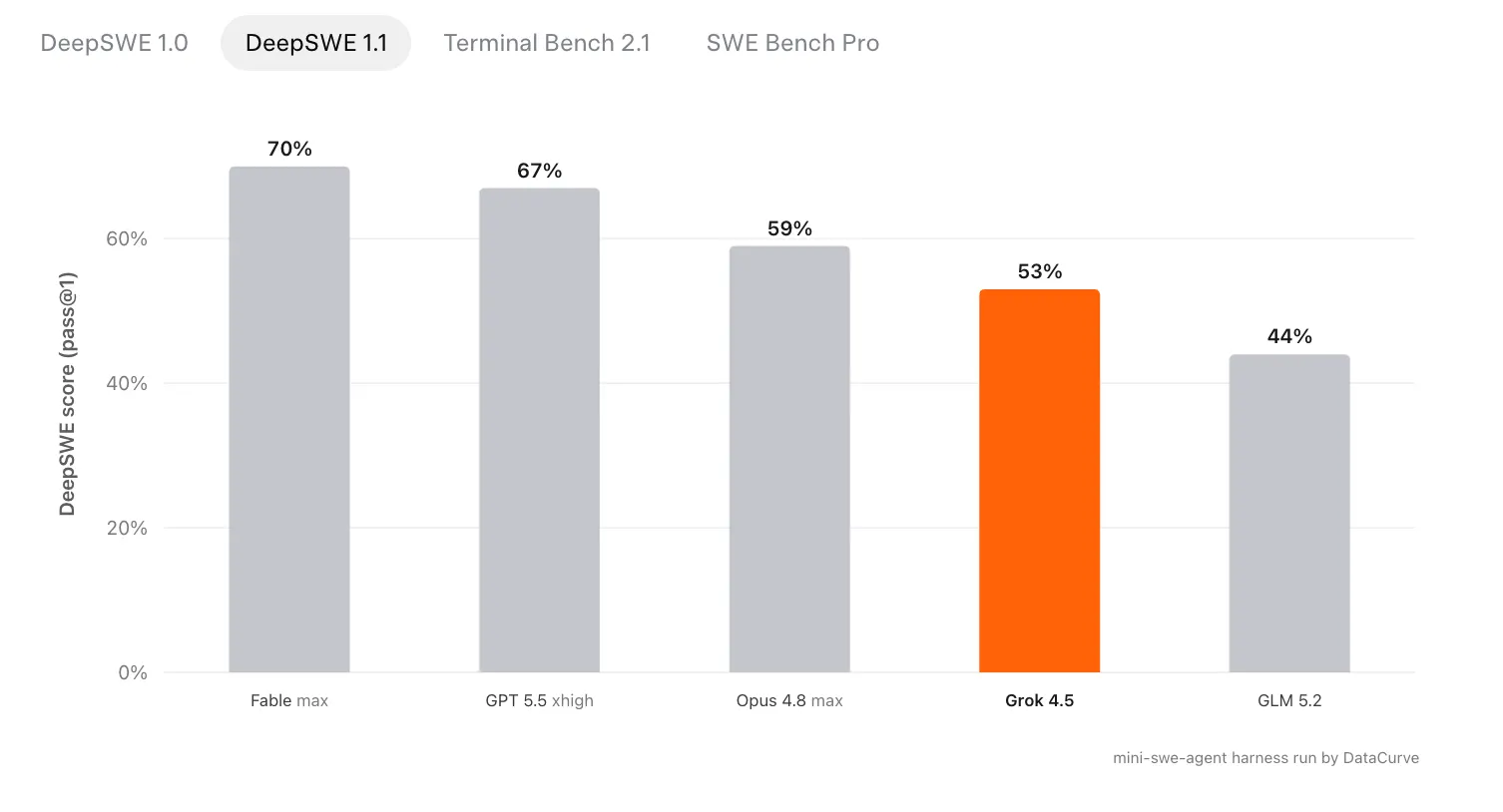
One of the key benchmarks presented is DeepSWE 1.1, which is designed to measure the reliability of AI models in fixing real-world software bugs submitted by developers. This benchmark utilizes a standardized testing setup to ensure fair comparisons, with scores calculated based on the percentage of issues successfully resolved. In this evaluation, Grok 4.5 achieved a score of 53%. This places it behind Anthropic’s Claude Opus 4.8, which scored 59%, and OpenAI’s GPT 5.5 (note: the benchmark predates the launch of GPT 5.6 Sol), which scored 67%. Topping the chart in this specific benchmark was Anthropic’s most advanced model, Claude Fable 5, with an impressive 70% success rate.

Another critical benchmark included in the release is SWE Bench Pro. This test assesses a collection of software engineering problems, with performance measured by the resolution rate. On SWE Bench Pro, Grok 4.5 posted a score of 64.7%. This performance was sufficient to outperform OpenAI’s GPT 5.5, which recorded 58.6% on this particular test. However, Anthropic’s Opus 4.8 maintained its lead in this category with a score of 69.2%, while Claude Fable 5 again demonstrated superior performance, achieving a remarkable 80.4%.
It is noteworthy that SpaceXAI chose to benchmark Grok 4.5 against GPT 5.5 rather than the newly released GPT 5.6 Sol. This decision appears to be a consequence of the timing of the releases; GPT 5.6 Sol was announced and made available just hours after Grok 4.5’s unveiling. This temporal proximity means that direct, head-to-head comparisons with OpenAI’s latest offering on these specific benchmarks are not yet available.
Computational Power and Training Data: The Engine Behind Grok
SpaceXAI’s development of Grok 4.5 was a significant undertaking, leveraging substantial computational resources. The model was trained in close collaboration with the recently acquired Cursor AI, utilizing tens of thousands of Nvidia GB300 GPUs. These powerful GPUs were housed within "Colossus," a formidable supercomputer located in Memphis, which boasts a total capacity exceeding 200,000 GPUs. This massive investment in hardware underscores the scale of SpaceXAI’s ambition.
Interestingly, the AI labs whose models currently outperform Grok 4.5 on these benchmarks do not possess hardware comparable in scale to Colossus. This raises questions about the efficiency of their training processes or the specific architectural choices made. Historically, SpaceXAI’s Grok models have consistently emerged with substantial compute power but have occupied a third-place position in benchmark rankings. The launch of Grok 4.5 appears to signal a shift in strategy, with a greater emphasis on refining pricing and leveraging new training signals.
The training data for Grok 4.5 is a key differentiator. Unlike previous iterations, which may have relied more heavily on static code repositories, Grok 4.5 was trained on extensive developer session data sourced from Cursor. This data includes detailed debugging traces and actual code modifications made by developers. This approach aims to imbue the model with a more practical and nuanced understanding of coding workflows, moving beyond theoretical knowledge to real-world application. As Musk has previously acknowledged in legal proceedings, xAI’s training practices have faced scrutiny in the past. However, the integration with Cursor, a platform that SpaceXAI is in the process of fully acquiring, suggests a more controlled and potentially less controversial training pipeline for this iteration.
The Value Proposition: Efficiency and Cost Savings
The true strength of Grok 4.5, according to SpaceXAI’s narrative, lies not in its absolute performance but in its remarkable efficiency and cost-effectiveness. This is particularly evident when analyzing its performance on the SWE Bench Pro tasks. Grok 4.5 required an average of just 15,954 output tokens to complete each job. In contrast, Anthropic’s Opus 4.8 consumed a significantly higher 67,020 tokens for the same tasks, representing a 4.2x difference in token usage.
For organizations that deploy AI models at a large scale, this efficiency translates directly into substantial cost savings. Even with a slightly lower performance score compared to its top-tier competitors, the combination of a lower per-token price and more efficient token utilization means that companies can run more iterations and experiments without incurring exorbitant expenses. This makes Grok 4.5 an attractive option for teams looking to optimize their AI budgets while still accessing advanced capabilities.
Furthermore, Grok 4.5 boasts an impressive inference speed of 80 tokens per second, placing it firmly in the category of fast-performing models. This speed is crucial for applications requiring real-time or near-real-time responses, such as interactive coding environments or rapid data analysis.
Broader Implications and Market Positioning
SpaceXAI’s strategy with Grok 4.5 appears to be a deliberate move to capture a segment of the AI market that prioritizes value and speed. For software engineers and development teams engaged in high-volume coding tasks, the proposition of achieving roughly Opus 4.7-level capability at a significantly reduced cost per input token (estimated at 60% less) is a compelling one. This could lead to increased adoption among smaller businesses or teams with tighter budgets who have previously found the cost of leading AI models prohibitive.
However, for organizations or researchers actively pursuing the absolute cutting edge of AI capabilities, Claude Fable 5 continues to hold the top position across all categories published by SpaceXAI. This suggests a clear segmentation of the market, with Grok 4.5 aiming for the practical, efficiency-driven user, while models like Claude Fable 5 cater to those demanding peak performance regardless of cost.
Initial independent testing of Grok 4.5 has yielded mixed results. A quick test on creative writing tasks, when building upon the Hermes platform, was described as "underwhelming." However, on a simple coding task, the model performed "acceptably." This suggests that while Grok 4.5 may excel in specific developer-centric applications, its general-purpose creative capabilities might still be in development or lag behind its more established counterparts.
The model is currently accessible via API, and its builds on the Hermes platform offer a substantial context window of half a million tokens, which translates to approximately 400,000 words. This large context window is beneficial for processing lengthy documents or complex codebases. Users in European Union countries will need to exercise patience, as SpaceXAI has indicated that Grok 4.5 is slated for release in the EU in mid-July. This phased rollout suggests a careful approach to market penetration and regulatory compliance in different regions. The competitive landscape of AI development is rapidly evolving, and SpaceXAI’s entry with Grok 4.5, characterized by its focus on affordability and speed, signifies a strategic attempt to redefine the value proposition in the artificial intelligence market.
