
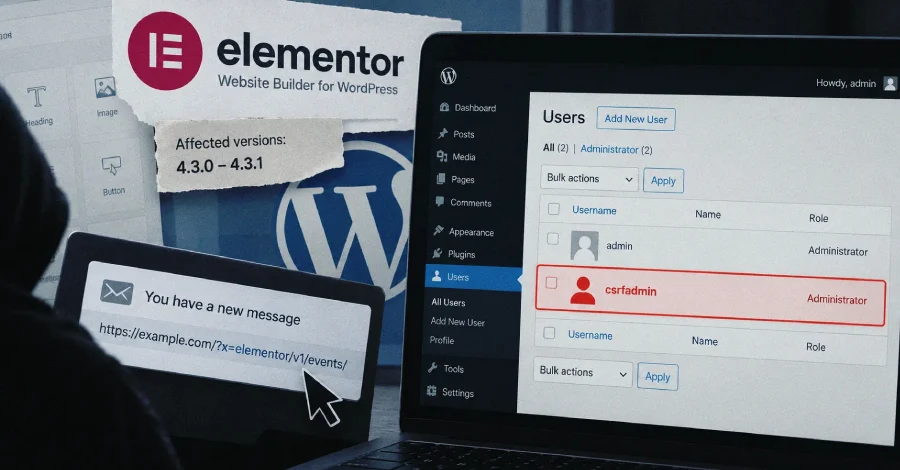

A critical security vulnerability identified in the widely used Elementor Website Builder plugin for WordPress has placed over two million websites at immediate risk of full administrative compromise. The flaw, which has been classified with a high-severity CVSS score of 8.8, allows unauthenticated attackers to perform unauthorized actions, including the creation of rogue administrator accounts, by tricking logged-in users into executing malicious requests. While the vulnerability has been patched, the sheer scale of the Elementor user base—which exceeds 10 million active installations—makes the event a significant point of concern for the global web development community.
The vulnerability resides specifically in versions 4.3.0 and 4.3.1 of the Elementor plugin. According to security researchers at Patchstack, the issue is a Cross-Site Request Forgery (CSRF) vulnerability, a type of exploit that forces a victim to perform actions on a web application in which they are currently authenticated. Because the plugin is a staple in the WordPress ecosystem, facilitating drag-and-drop page building for millions of businesses, e-commerce platforms, and personal blogs, the potential for widespread exploitation was exceptionally high before the release of the version 4.3.2 security update.
Technical Anatomy of the Vulnerability
The core of the issue lies within the plugin’s "Editor Events" module, which was introduced in version 4.3.0. Security analysts discovered that this module implemented an flawed security check. The module was designed to skip CSRF protection for specific REST API requests, provided the string "elementor/v1/events/" appeared anywhere in the request URI.
The technical failure stemmed from how the plugin handled request URI parsing. Because the code checked for the presence of the string rather than validating the full path, it created a bypass mechanism. An attacker could craft a malicious URL containing this specific string as a query parameter. When a site administrator or any logged-in user with sufficient privileges clicked a link containing this payload—even if it was disguised as a simple anchor tag in an email or a forum post—the browser would execute the request with the user’s authenticated session credentials.
Crucially, this bypass was not limited to Elementor-specific functions. It effectively disabled CSRF protection for the entire WordPress REST API on the target site. This means an attacker could manipulate core WordPress functions, including the creation of new users with administrative privileges, by simply appending the "elementor/v1/events/" string to a malicious request.
A Chronology of the Discovery and Disclosure
The discovery of the vulnerability is credited to a security researcher operating under the alias "Saggre." Following the standard protocol for responsible disclosure, the vulnerability was reported to the Elementor development team, allowing them to assess the risk and develop a remediation strategy before the details became public knowledge.
- Version 4.3.0 Release: Elementor introduced the vulnerable "Editor Events" module, unknowingly embedding the CSRF flaw into the plugin’s architecture.
- Discovery and Reporting: Independent researcher Saggre identified the vulnerability and initiated the responsible disclosure process.
- Remediation: Upon verification, the Elementor development team finalized a fix that corrected the URI validation logic within the Editor Events module.
- Version 4.3.2 Release: Elementor officially pushed version 4.3.2 to the WordPress repository, effectively neutralizing the flaw.
- Public Disclosure: Security firms, including Patchstack, released detailed advisories to ensure that site administrators were aware of the necessity to update their installations.
Supporting Data and Statistical Impact
The impact of this vulnerability is best understood through the lens of WordPress adoption statistics. Elementor is currently one of the most downloaded plugins in the official WordPress repository. As of late 2026, the plugin is active on over 10 million websites. While the vulnerability only affects versions 4.3.0 and 4.3.1, these versions were rapidly adopted due to the plugin’s frequent update cycles.
WordPress.org data indicates that more than 2 million sites were running the compromised versions at the time the security advisory was issued. This presents a massive attack surface. In the world of cybersecurity, a "window of vulnerability"—the time between the release of a patch and the widespread application of that patch by users—is often the most dangerous period. Even though a fix is available, many site administrators fail to perform routine maintenance or update plugins in a timely manner, leaving "zombie" installations that remain susceptible to exploitation long after a patch is available.

The Mechanism of Exploitation
The danger of this CSRF attack lies in its simplicity and the lack of prerequisites required for execution. Unlike complex exploits that require specific server configurations or the injection of malicious JavaScript, this CSRF attack is essentially a "drive-by" incident.
An attacker does not need to compromise the server’s infrastructure or exploit a vulnerability in the underlying operating system. They only need to lure a logged-in administrator to a link. Once the administrator interacts with that link, the browser automatically attaches the necessary authentication cookies, and the server processes the request as if it were a legitimate administrative command.
A representative exploit request might look like this:
https://example.com/wp-json/wp/v2/users?_method=POST&username=malicious_actor&[email protected]&password=securepassword123&roles[]=administrator&x=elementor/v1/events/
In this scenario, the x=elementor/v1/events/ parameter acts as the "key" that unlocks the door, bypassing the plugin’s CSRF protections and allowing the wp/v2/users endpoint to create a new user account with administrative privileges. Once the account is created, the attacker gains full control over the website, allowing them to install malicious plugins, exfiltrate user data, or deface the site.
Implications for Website Security and Plugin Ecosystems
The Elementor event serves as a sobering reminder of the inherent risks within the modern web development ecosystem. The reliance on modular, third-party code—while essential for the rapid deployment of modern websites—introduces supply chain vulnerabilities that can affect millions of users simultaneously.
- Complexity and Security Debt: As plugins become more complex, incorporating features like REST API proxies and real-time event listeners, the attack surface grows. Developers must prioritize "security by design," ensuring that features intended for convenience do not inadvertently disable critical security controls.
- The Persistence of CSRF: Despite being a well-understood vulnerability type, CSRF remains a pervasive threat. The industry’s continued struggle with CSRF highlights the difficulty of managing cross-origin requests in a web environment that relies heavily on stateful authentication.
- Administrator Responsibility: This incident underscores the importance of the "Shared Responsibility Model" in web hosting. While plugin developers are responsible for writing secure code, site owners are responsible for maintaining their installations. The gap between the release of version 4.3.2 and the actual update of 2 million sites represents a significant risk to the integrity of the WordPress ecosystem.
Official Responses and Recommendations
Elementor has been proactive in addressing the issue, ensuring that version 4.3.2 is available across all update channels. The primary recommendation from both the Elementor team and independent security researchers is for all site administrators to verify their plugin versions immediately.
For those managing large fleets of WordPress sites, the use of centralized management tools is highly recommended. These tools allow for the batch deployment of security patches, reducing the time that sites remain vulnerable. Furthermore, security professionals advise implementing a "defense-in-depth" strategy:
- Restrict REST API Access: Where possible, restrict access to sensitive REST API endpoints to known IP addresses or through additional authentication layers.
- Monitor User Accounts: Regularly audit the user list for unauthorized accounts. An unexpected administrator account is often the first indicator of a successful compromise.
- Web Application Firewalls (WAF): Deploying a WAF can help detect and block malicious requests that attempt to exploit known vulnerabilities like the one in the Editor Events module.
- Principle of Least Privilege: Ensure that users have only the minimum level of access required to perform their duties. An administrator account should not be used for daily tasks that do not require administrative privileges.
As the digital landscape continues to evolve, the security of the WordPress ecosystem remains a critical component of internet stability. The Elementor incident is a reminder that even the most reputable and widely used software components are subject to human error. Constant vigilance, combined with a commitment to rigorous update cycles, remains the most effective defense against the evolving tactics of threat actors. By responding quickly to the 4.3.2 update, the WordPress community has mitigated what could have been a catastrophic event, but the underlying lesson regarding software maintenance remains valid for all stakeholders in the digital age.
