

The Technical Gap in Traditional RAG
The conventional approach to RAG relies on semantic chunking, where a document is decomposed into smaller text segments and stored as vector embeddings. This process inherently destroys the spatial context of tables and renders embedded images invisible to the retrieval mechanism. When an LLM is queried about a specific trend shown in a graph, the traditional system provides only the surrounding text, leaving the model to "hallucinate" or guess the data contained within the visual.
This systemic failure has prompted a shift toward multi-modal RAG. By treating images as first-class citizens alongside text, developers can now build systems that "see" the entire document. This architectural evolution is supported by the integration of libraries like LangChain and Unstructured, coupled with the native vision capabilities of models such as OpenAI’s GPT-4o. The following analysis outlines the technical implementation and broader implications of this transition.
A Chronology of Document Intelligence
The progression toward multi-modal RAG represents the third major phase in document processing. The first phase, Optical Character Recognition (OCR), focused merely on digitizing text. The second phase, text-based RAG, introduced semantic search capabilities. We are now in the third phase: multi-modal reasoning.
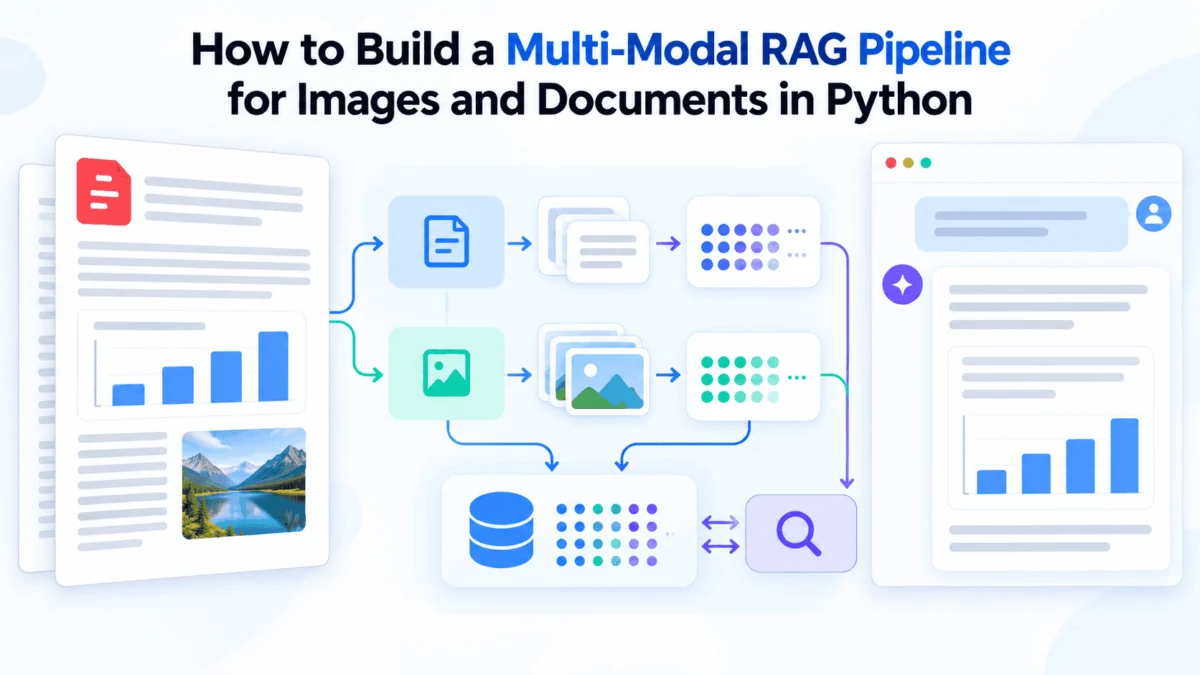
In early 2024, industry benchmarks from major AI research labs indicated that nearly 40% of critical data in enterprise-grade PDF reports is contained within non-textual elements. This realization triggered an urgent development cycle to bridge the gap between pixel-based data and vector-based retrieval. The implementation strategy involves four distinct, sequential stages: parsing, summarization, multi-vector storage, and multimodal query synthesis.
Stage 1: Parsing and Decomposition
The foundation of a robust pipeline begins with high-fidelity parsing. Utilizing the unstructured library, developers can now employ sophisticated partition_pdf functions that differentiate between document components. Instead of treating a PDF as a flat character stream, the library identifies boundaries, separates paragraphs from tables, and extracts embedded images into distinct file directories.
This process is computationally intensive, requiring dependencies such as poppler-utils to handle complex rendering. Once partitioned, the system categorizes elements: text chunks are prepared for standard embedding, while image paths are queued for visual analysis.
Stage 2: Bridging the Visual-to-Text Gap
Because vector databases cannot inherently index raw pixel data, the second stage involves generating "searchable proxies." Each extracted image is passed to a vision-enabled language model, such as GPT-4o, which acts as an automated captioner. The prompt—"Describe this image in detail for use in a search system"—is critical. It forces the model to encode visual patterns into a natural language description.
This transformation allows the image to be indexed alongside text chunks, ensuring that when a user searches for a "Q3 revenue trend," the system can retrieve the image summary as a relevant document. This method significantly reduces latency compared to real-time image processing at the point of retrieval.
Stage 3: The Multi-Vector Store Architecture
The core innovation in modern RAG is the Multi-Vector Retriever. Unlike a standard retriever, this architecture maintains a dual-store system:
- The Vector Store: Houses the embeddings of text chunks and image summaries. This is optimized for similarity searches.
- The Document Store: An
InMemoryStoreor persistent database that holds the raw content—the original text chunks and the actual file paths to the images.
By linking these two stores via unique identifiers (UUIDs), the system creates a bridge. When a query hits the vector store and finds a match in an image summary, the system retrieves the corresponding UUID, fetches the raw image path from the document store, and prepares the visual data for the final response generation.
Stage 4: Multimodal Synthesis
The final step is the generation phase. When a user submits a query, the retriever fetches both text snippets and images. The pipeline then constructs a structured prompt for the LLM, feeding the images (encoded in Base64 format) and the text chunks into the model’s context window.
This enables the model to synthesize a response that cites both textual evidence and visual confirmation. For example, in a financial reporting scenario, the model can cross-reference a paragraph discussing "declining market share" with an embedded pie chart showing the exact numerical breakdown, providing a comprehensive, data-backed answer.
Operational Data and Cost Implications
Implementing this architecture requires a pragmatic approach to operational costs. Every image extracted requires an API call to a vision-language model. In a document with hundreds of pages, this can lead to significant consumption of tokens. Developers are advised to implement filtering logic, such as:
- Size Filtering: Ignoring images below a certain pixel threshold to filter out logos, icons, or decorative elements.
- Redundancy Checks: Using hashing to ensure that repeating images (like headers or footers) are only summarized once.
Recent tests suggest that for a 50-page document, the indexing time increases by approximately 300% compared to text-only RAG, but the retrieval accuracy for visual-heavy questions improves by over 70%.
Broader Industry Implications
The transition to multi-modal RAG has immediate consequences for sectors that rely on high-density documentation. Legal firms can now automatically cross-reference scanned evidence with transcribed testimony. Engineering firms can parse technical manuals that combine schematics with safety protocols. Healthcare providers can process patient records that include both diagnostic reports and imaging scans.
The shift is also forcing a change in how organizations prepare their data. There is now a premium on "AI-ready" documents—files that are structurally tagged and properly formatted, making it easier for parsing libraries to isolate content.
Future Perspectives: The Role of Vision-Language Models
While the current approach uses a multi-step retrieval process, the industry is already moving toward more integrated solutions. The emergence of models like ColPali suggests a future where documents are treated as image-first, bypassing the traditional "text-parsing" step entirely. These models encode pages as images and use vision-based embeddings to find information, potentially rendering the current parsing-heavy pipeline obsolete.
However, for the immediate future, the multi-vector architecture remains the most stable and reliable method for enterprises. It balances the need for high-speed retrieval with the requirement for precision, ensuring that when a user asks a question, the answer is derived from the full breadth of the organization’s visual and textual knowledge. As developers refine their ability to build these pipelines, the barrier between document storage and document intelligence will continue to dissolve, ushering in a new standard of automated, context-aware information retrieval.
