
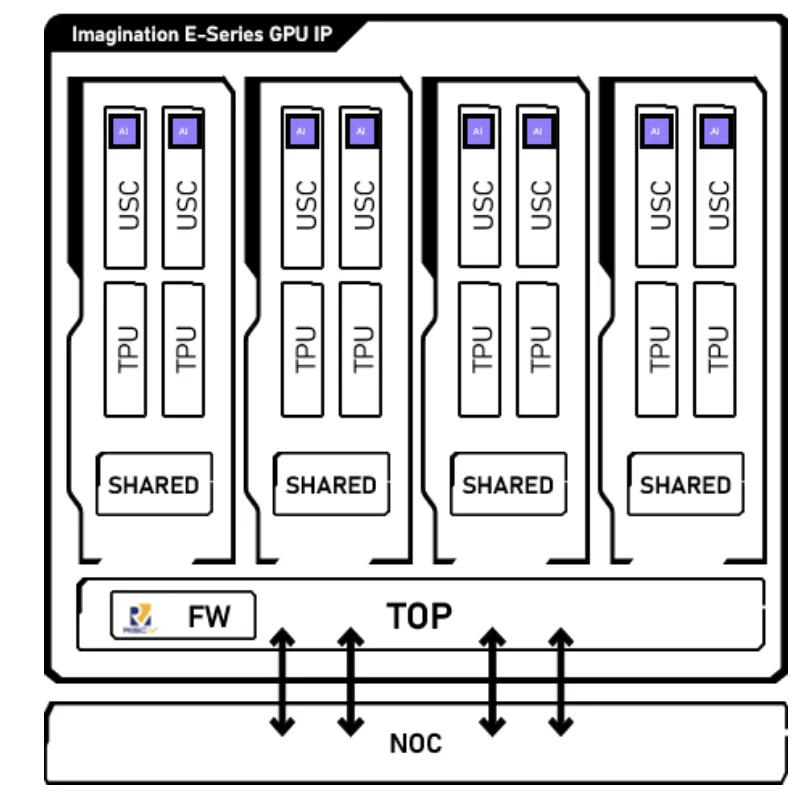

The rapid evolution of edge computing and the escalating demands of artificial intelligence have necessitated a fundamental rethinking of semiconductor architecture. Imagination Technologies, a leading provider of semiconductor IP, has positioned its newly unveiled E-Series GPU architecture as the cornerstone of this transition. By unifying graphics, general-purpose compute, and AI acceleration under a singular, flexible architecture supported by a unified programmable software stack, the E-Series promises to redefine how system designers approach the complexities of the intelligent edge.
The Evolution of Edge Architecture
The semiconductor landscape has long been defined by the separation of duties: GPUs handled pixel processing, CPUs managed general-purpose tasks, and NPUs were relegated to specific AI inference workloads. While this modular approach served the industry well during the initial rise of consumer electronics, it has become a bottleneck for modern edge devices that require real-time, multi-modal processing.
The E-Series, first announced by Imagination Technologies in 2025, represents a departure from this siloed methodology. With first silicon expected to arrive by the end of 2026, the architecture is specifically engineered to handle the "converged" workloads that define the current era of ambient intelligence. By enabling the concurrent execution of graphics and AI workloads, the E-Series addresses the inherent inefficiencies of traditional multi-chip or multi-core approaches, where memory bandwidth and data movement between discrete processing blocks often created significant latency.
Technical Specifications and Performance Benchmarks
At the heart of the E-Series is a commitment to raw throughput coupled with high efficiency. The architecture delivers up to 32 TOPS (Trillions of Operations Per Second) at Int8 precision per core when clocked at 1GHz. This represents a four-fold increase in raw compute performance compared to the company’s previous D-Series architecture.
This leap in performance is not merely an incremental upgrade; it is a structural redesign of how compute cores utilize local resources. By optimizing the data pipeline to handle disparate instruction sets—graphics rendering commands alongside neural network inference operations—the E-Series minimizes the overhead typically associated with context switching. This concurrency is critical for applications such as augmented reality (AR) headsets, industrial vision systems, and advanced automotive cockpit displays, where the device must simultaneously render a high-fidelity interface and interpret sensor data in real-time.

A Chronology of Imagination’s Strategic Shift
The trajectory toward the E-Series can be traced back to the industry-wide recognition that the "memory wall"—the limit of how quickly data can move between memory and processors—is the primary constraint on AI development.
- 2023–2024: Imagination Technologies began re-evaluating its IP roadmap in response to the generative AI boom. Market analysis suggested that edge device OEMs were struggling with the footprint and power consumption of discrete AI chips.
- Early 2025: The E-Series was officially unveiled, signaling a shift in corporate strategy toward "converged acceleration." The announcement generated significant interest among silicon vendors looking for ways to integrate AI capabilities without sacrificing graphics performance.
- 2026: The current year has been characterized by the transition from design to physical verification. The industry is currently awaiting the arrival of the first silicon, which will serve as the litmus test for the architectural claims made during the initial launch.
- Late 2026 and Beyond: Post-silicon validation and the subsequent integration into partner SoCs (System-on-Chips) are expected to drive the adoption of E-Series across automotive, IoT, and mobile sectors throughout 2027.
Implications for System Design
The integration of a programmable software stack alongside the E-Series hardware is arguably as important as the physical architecture itself. One of the greatest challenges for system designers is the "fragmentation of stacks"—the need to write code for a GPU, a different language for a CPU, and yet another for an NPU.
By unifying these under one programmable stack, Imagination Technologies aims to lower the barrier to entry for developers. This allows for a "write once, deploy anywhere" philosophy that is essential for the rapid iterative cycles required in modern AI development. For the system architect, this translates into a smaller silicon die size, reduced bill-of-materials (BOM) costs, and improved power efficiency, as the system no longer needs to power multiple disparate accelerators.
Industry Reactions and Market Analysis
While official public statements from third-party partners remain limited pending the release of the first silicon, industry analysts have noted that the E-Series addresses the "converged compute" narrative that has dominated recent semiconductor summits.
"The industry is moving toward a state where everything is an AI task," notes one semiconductor analyst familiar with the IP market. "Whether it is upscaling a video stream for a smoother display or analyzing a security feed for threat detection, the underlying math is the same. Imagination’s decision to move toward a single, high-performance architecture that treats graphics and AI as siblings, rather than distant cousins, is a pragmatic move that mirrors the direction the rest of the market is heading."
Furthermore, the focus on Int8 precision is a pragmatic choice. While training large language models requires high-precision floating-point arithmetic (FP16 or BF16), the vast majority of edge-based AI inference—the "doing" part of AI—is highly efficient at Int8 precision. By optimizing for this specific workload, the E-Series maximizes performance-per-watt, a metric that is non-negotiable for battery-operated devices.

Broader Impact on the Edge Computing Landscape
The introduction of the E-Series is likely to influence the next generation of SoCs in several key verticals:
- Automotive: In the cockpit, the E-Series can simultaneously handle the rendering of a 3D digital instrument cluster while running driver monitoring systems (DMS) and lane-keeping AI. The ability to handle these safely and concurrently without thermal throttling is a major competitive advantage.
- Industrial Robotics: Autonomous mobile robots (AMRs) require real-time SLAM (Simultaneous Localization and Mapping) alongside complex visual navigation. The E-Series architecture enables these robots to process visual data while simultaneously mapping the environment, significantly reducing the required hardware footprint.
- Smart Home/IoT: As smart appliances move from simple connectivity to advanced local intelligence, the E-Series provides the necessary horsepower to run LLMs locally, ensuring privacy by keeping data on the device rather than the cloud.
Conclusion: The Road Ahead
As the industry prepares for the first silicon of the E-Series by the end of 2026, the focus will shift from architectural theory to practical implementation. The success of this platform will depend on how effectively Imagination Technologies supports its partners in the silicon-bring-up phase and how well the software stack scales across different performance tiers.
The E-Series stands as a testament to the current era of hardware design—an era that prioritizes flexibility, concurrency, and power efficiency above all else. By bridging the divide between high-performance graphics and neural network inference, Imagination Technologies has provided a clear, albeit challenging, blueprint for the future of the edge. As the lines between graphics and intelligence continue to blur, architectures like the E-Series will not just be an option; they will likely become the standard for any device claiming to be truly intelligent.
For system designers and silicon vendors, the next year of validation will be critical. The industry remains watchful, as the E-Series represents one of the most significant attempts to consolidate the disparate worlds of visual rendering and machine learning into a single, cohesive, and highly efficient package. The result will ultimately be measured not just in TOPS, but in the seamlessness of the user experience in the next generation of intelligent devices.
