
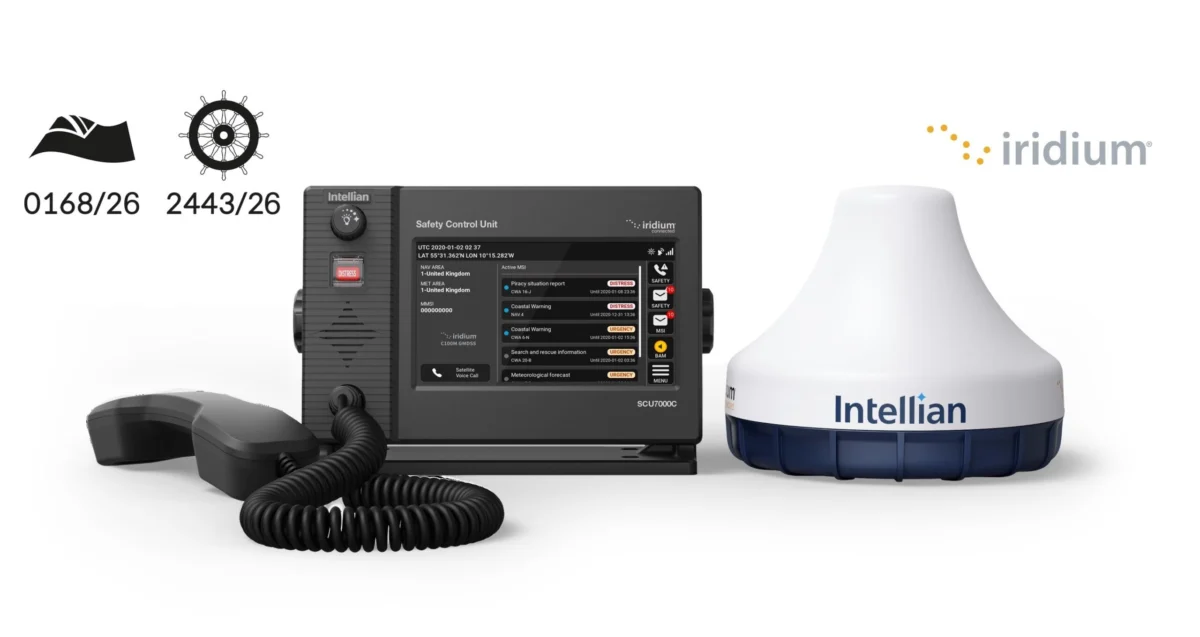

Intellian Technologies, a global leader in satellite communications and antenna systems, has officially announced the launch of the C100M GMDSS terminal, a specialized maritime safety system designed to operate on the Iridium Certus 100 service. This new terminal represents a significant milestone in the evolution of maritime safety, offering a modern, reliable, and compact alternative for vessels required to comply with the Global Maritime Distress and Safety System (GMDSS) standards. By integrating the C100M into its existing lineup, Intellian becomes the first and only manufacturer to provide a dedicated hardware solution for every tier of the Iridium Certus service, further solidifying its position as a primary partner in the satellite communications ecosystem.
The C100M GMDSS system is engineered to facilitate critical "safety of life" communications, ensuring that mariners can transmit and receive distress alerts and safety information regardless of their location on the globe. Utilizing Iridium’s unique Low Earth Orbit (LEO) cross-linked satellite constellation, the terminal provides truly global coverage, including the historically difficult-to-reach polar regions (Sea Area A4). The launch of the C100M is expected to accelerate the transition of the maritime industry away from legacy satellite safety systems toward more integrated, high-performance digital solutions.
The Evolution of GMDSS and the Role of Iridium
The Global Maritime Distress and Safety System (GMDSS) is an internationally recognized set of safety procedures, types of equipment, and communication protocols used to increase safety and make it easier to rescue distressed ships, boats, and aircraft. Established by the International Maritime Organization (IMO) through the SOLAS (Safety of Life at Sea) Convention, GMDSS has been the cornerstone of maritime safety since its full implementation in 1999.
For decades, the satellite component of GMDSS was served exclusively by a single provider. However, the maritime industry recognized the need for competition and technological redundancy to enhance safety and drive innovation. In 2018, the IMO’s Maritime Safety Committee (MSC) formally recognized Iridium as a provider of GMDSS services, breaking a long-standing monopoly. Iridium officially launched its commercial GMDSS service in December 2020, offering the first truly global alternative that included coverage for the Arctic and Antarctic circles.
The introduction of the Intellian C100M is a direct response to the growing demand for Iridium-based safety hardware. While Iridium provided the network, the hardware manufacturers—led by Intellian—have been tasked with creating the physical terminals that can withstand the harsh environments of the open sea while maintaining the stringent reliability standards required for emergency communications.
Technical Architecture and Feature Set of the C100M
The Intellian C100M GMDSS terminal is built upon the Iridium Certus 100 platform, which is optimized for small-form-factor antennas and mid-band data speeds. This makes the C100M particularly attractive for a wide range of vessels, from commercial shipping fleets and fishing vessels to high-end leisure yachts.
One of the most notable design innovations in the C100M is the integration of the Below Deck Unit (BDU) and the user terminal into a single, cohesive Safety Control Unit (SCU). This "all-in-one" approach significantly reduces the physical footprint of the equipment within the ship’s bridge or communications center. In the maritime world, where space is often at a premium, a compact and easy-to-install terminal provides a clear competitive advantage.
Key functionalities of the C100M include:
- Distress Alerting: A dedicated distress button that, when activated, sends a high-priority signal to a Rescue Coordination Center (RCC), providing the vessel’s identity and precise location.
- Safety Voice: High-quality voice communication dedicated to emergency and safety-related calls.
- Maritime Safety Information (MSI): The reception of vital broadcasts regarding weather warnings, navigational hazards, and other safety-related announcements.
- Ship Security Alert System (SSAS): A security measure that allows a ship to transmit a covert alert to shore-based authorities in the event of a pirate attack or other security breach.
- Long-Range Identification and Tracking (LRIT): A mandatory international system for the global identification and tracking of ships to enhance maritime security and environmental protection.
Furthermore, the C100M has been designed with retrofitting in mind. Intellian noted that the system is compatible with existing legacy GMDSS antenna cabling. For shipowners looking to upgrade their safety systems without the cost and downtime associated with complete rewiring, this "plug-and-play" capability represents a substantial cost saving.
Chronology of Maritime Connectivity Milestones
The launch of the C100M is the latest entry in a timeline defined by the rapid digitalization of the maritime sector.
- 2018: The International Maritime Organization (IMO) approves Iridium to provide GMDSS services, ending the decades-long monopoly of Inmarsat.
- January 2019: Iridium completes its $3 billion "Iridium NEXT" campaign, replacing its entire satellite constellation with 66 new cross-linked LEO satellites.
- 2020: Iridium formally commences GMDSS service operations, providing 100% global coverage, including Sea Area A4.
- 2021-2023: Intellian expands its Certus portfolio, launching terminals for the Certus 200 and Certus 700 tiers, catering to different bandwidth requirements for commercial and operational data.
- 2024: Intellian announces the C100M GMDSS, completing its suite of terminals and providing a dedicated safety solution for the Certus 100 tier.
This chronology highlights a shift toward L-band satellite services that offer high reliability in adverse weather conditions. Unlike higher-frequency bands (such as Ku or Ka), L-band signals are largely unaffected by "rain fade," a critical requirement for emergency systems that must function during the most severe storms.
Strategic Implications for the Maritime Industry
The release of the C100M has several implications for shipowners, regulatory bodies, and the broader satellite communications market.
First, the availability of a dedicated Certus 100 GMDSS terminal lowers the barrier to entry for smaller vessels. Previously, GMDSS equipment was often bulky and expensive, sometimes relegated to larger commercial ships. The compact nature of the C100M allows smaller commercial fishing boats and workboats to adopt a high-standard safety system that meets international requirements without overwhelming their physical or financial resources.
Second, the competitive landscape of maritime safety is reaching a new level of maturity. With Intellian providing hardware for every Iridium Certus tier, shipowners now have more choices regarding their service providers and hardware manufacturers. This competition is expected to drive down the total cost of ownership for safety systems while simultaneously improving the user interface and reliability of the technology.
Eric Sung, CEO of Intellian Technologies, emphasized the strategic importance of this launch, stating that the company now offers the industry’s most extensive portfolio of Iridium GMDSS systems. Sung noted that the tailored solutions for every vessel size ensure that vital connectivity is available when it matters most, providing a seamless upgrade path from legacy networks.
Safety and Operational Analysis
From a technical standpoint, the C100M utilizes the Iridium network’s LEO architecture to its advantage. In a distress scenario, latency—the delay in signal transmission—can be a factor. Because Iridium satellites are in a much lower orbit (approximately 780 km) than Geostationary (GEO) satellites (35,786 km), the signal travel time is significantly reduced. While the difference may be measured in milliseconds, in a life-or-death emergency, every second of connectivity and every successful packet of data counts.
Moreover, the cross-linked nature of the Iridium constellation means that a distress signal can be routed from satellite to satellite until it reaches a ground station, even if the vessel is in the middle of the ocean far from any terrestrial infrastructure. This redundancy is a core feature of the GMDSS philosophy, which mandates that safety systems must have no single point of failure.
The inclusion of LRIT and SSAS within the C100M also streamlines vessel operations. By consolidating safety, security, and tracking into a single terminal, fleet managers can reduce the complexity of their onboard electronics. This consolidation leads to fewer points of failure and simplified maintenance schedules.
Future Outlook: Digitalization and Polar Navigation
As global trade routes continue to expand, particularly with the opening of Arctic shipping lanes due to receding ice, the demand for reliable polar communication is surging. Traditional GEO-based safety systems often struggle at high latitudes because the satellites appear very low on the horizon, leading to signal blockage by terrain or even the ship’s own superstructure. The Iridium-powered C100M solves this by providing "overhead" coverage at the poles, making it an essential tool for the next generation of polar-bound commercial traffic.
The launch of the C100M also fits into the broader trend of "e-Navigation," an IMO-led initiative to harmonize the collection, integration, exchange, and presentation of maritime information. As GMDSS moves from basic voice and low-speed text toward more data-rich environments, terminals like the C100M will serve as the foundation for more sophisticated safety applications, including real-time medical teleconsultation and enhanced search-and-rescue (SAR) coordination.
In conclusion, the Intellian C100M GMDSS terminal represents more than just a new piece of hardware; it is a manifestation of the maritime industry’s commitment to modernizing safety through competition and technological advancement. By bridging the gap between legacy requirements and modern satellite capabilities, Intellian and Iridium are ensuring that the global maritime community remains connected, secure, and prepared for any emergency on the high seas.
