
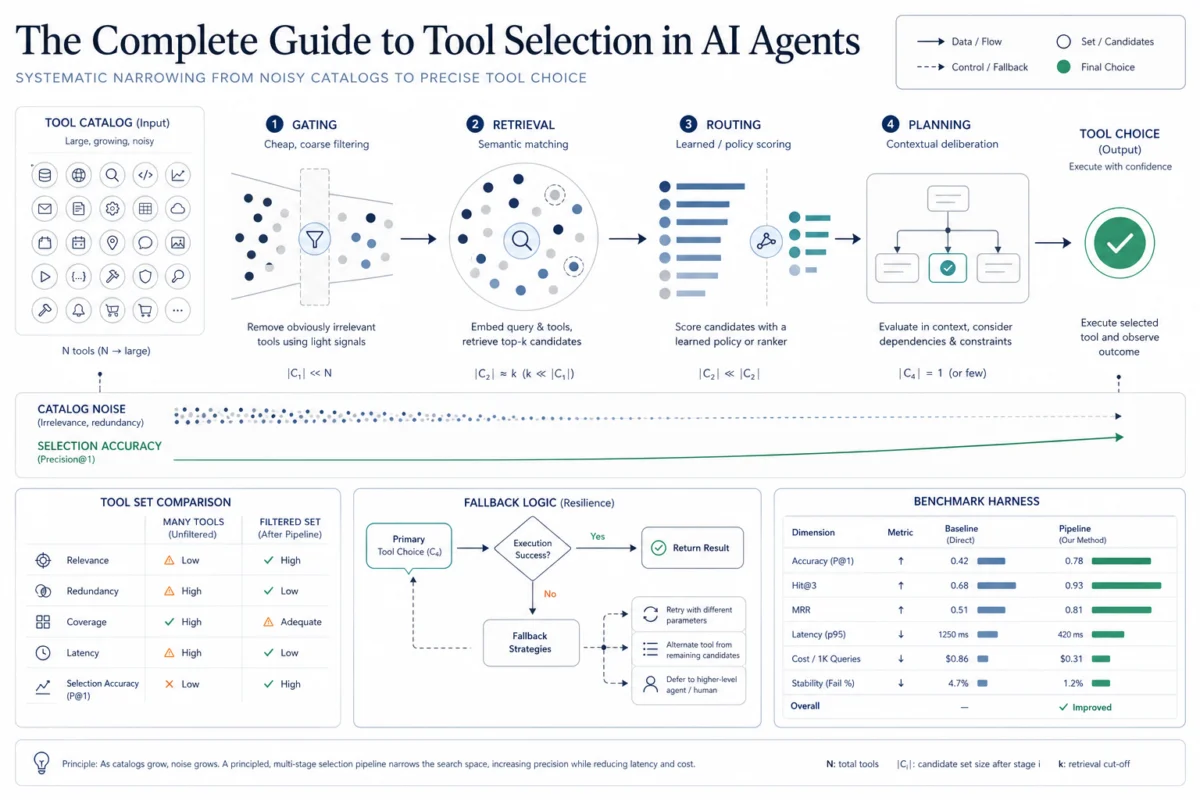

The burgeoning field of AI agents, once heralded for its ability to automate complex tasks, is confronting a critical scaling challenge: the degradation of agent accuracy as their tool catalogs expand. Initial demonstrations of AI agents performing flawlessly with a handful of tools often give way to erratic behavior, incorrect tool calls, and stalled workflows when confronted with real-world enterprise environments featuring dozens of integrated systems. This phenomenon, which industry experts now recognize as the default trajectory for growing agent deployments, underscores a fundamental architectural flaw in how many agents interact with their expanding capabilities. A new paradigm, focusing on intelligent tool selection rather than merely larger underlying language models, is emerging as the definitive solution, promising significant gains in accuracy and efficiency.
The Unseen Challenge: Agent Performance Degradation at Scale
The promise of AI agents lies in their ability to act autonomously, leveraging a suite of digital tools—from CRM systems and file operations to Slack integrations and diverse search APIs—to accomplish user-defined objectives. An agent designed to manage five tools might operate with near-perfect precision. However, as organizations integrate these agents into more complex ecosystems, the tool catalog can quickly balloon to 40, 50, or even 100+ distinct functionalities. This expansion, while seemingly beneficial, consistently leads to a measurable decline in agent reliability. Research analyzing various multi-capability agent (MCP) tool descriptions across the AI ecosystem has revealed that a significant number contain quality issues, and production benchmarks clearly indicate a noticeable drop in agent accuracy once the number of active tools surpasses approximately 10 to 15. This empirical observation highlights that the problem is not an edge case but an inherent scaling issue.
Anatomy of Failure: Why Large Language Models Struggle with Expanding Toolkits
The root causes of this degradation are multifaceted, stemming primarily from the inherent limitations of how Large Language Models (LLMs) process vast amounts of contextual information. Every tool definition—its name, comprehensive description, and detailed parameter schema—must be transmitted to the LLM with each request, irrespective of whether that specific tool is ultimately utilized. In environments with 50 or more tools, this can consume a substantial portion, often 5% to 7%, of the LLM’s finite context window before the user’s actual query even arrives. This crowding effect diminishes the space available for conversation history and the intricate reasoning required for complex tasks, leading to suboptimal decision-making.
A significant compounding factor is the "lost in the middle" effect. LLMs exhibit a well-documented tendency to recall information more reliably from the beginning and end of their context window, with information buried in the middle often overlooked. When dozens of functionally similar tool definitions are presented sequentially, the one truly appropriate tool for a given task can easily fall into this cognitive "dead zone." The model might not fail due to a lack of reasoning capacity, but rather because its attention is structurally misdirected.
Even more problematic is the phenomenon of "tool hallucination." As an LLM’s attention is spread thin across numerous, sometimes subtly distinct, tool descriptions, it can begin to invent tool names that do not exist or, more insidiously, call the correct tool but populate its arguments with parameters borrowed from a different, unrelated tool’s schema. Such failures are catastrophic; there is no "slightly wrong" way to execute a nonexistent function or a function with malformed inputs. OpenAI’s documentation acknowledges a theoretical hard ceiling of 128 tools per agent, but practical experience shows severe degradation manifesting long before this limit, typically around 15 to 20 tools in active rotation. The emerging consensus is clear: merely expanding the context window of an LLM is insufficient; the solution lies in intelligently controlling what the model sees in the first place.
A New Blueprint for AI Agents: Six Strategies for Precision Tool Selection
Responding to these challenges, a new architectural philosophy is gaining traction, emphasizing a modular and intelligent approach to tool selection. This paradigm shift moves beyond simply appending tools to an agent and instead treats the tool list itself as a meticulously designed component of the agent’s overall architecture. Developers are deploying a layered strategy, combining six practical techniques to maintain accurate and efficient tool selection at scale, without requiring ever-larger models.
1. Strategic Gating: The First Line of Defense
Before an agent embarks on the computationally intensive process of selecting a specific tool, a more fundamental and cost-effective question can be posed: does the current conversational turn require any tool at all? A substantial portion of agent interactions are purely conversational—acknowledgments ("thanks"), requests for clarification ("what do you mean by that?"), or simple greetings. Running the full tool retrieval and selection pipeline for such turns represents an unnecessary expenditure of computational resources and introduces latency.
Gating addresses this by employing a fast, lightweight classifier, often a small model call or simple pattern matching, to pre-filter conversational turns. By quickly identifying and short-circuiting these non-tool-requiring interactions, gating immediately reduces the overhead on the main agentic pipeline. Even if only 20-30% of interactions are conversational, the savings in token cost and latency can be significant, making it an indispensable first layer in any scalable agent architecture. This proactive filtering prevents the agent from engaging its more complex reasoning mechanisms when a direct, conversational response suffices.
2. Retrieval-Augmented Tool Selection: Leveraging Semantic Understanding
This technique, backed by robust academic research, represents a cornerstone of efficient tool management. Instead of presenting the entire tool catalog to the LLM for every request, tool descriptions are indexed within a vector store. When a user query arrives, it is embedded into a vector, and a semantic search retrieves only the top-K most relevant tools based on similarity. Only this filtered, significantly smaller subset of tools is then passed to the LLM.
The seminal RAG-MCP paper, published in May 2025, provided compelling quantitative evidence for this approach. Its framework, which leverages semantic retrieval to identify relevant MCP tools before the LLM sees the full catalog, demonstrated a remarkable improvement in performance. Tool selection accuracy more than tripled, soaring from a baseline of 13.62% with a full catalog exposure to 43.13% with retrieval-filtered selection. Concurrently, prompt tokens were cut by over 50% on identical benchmark tasks. This drastic reduction in context window load, combined with a focus on genuinely relevant candidates, allows the LLM to make more precise and efficient decisions, mitigating both the "lost in the middle" effect and tool hallucination.
3. Intelligent Routing: Organizing the Agent’s Arsenal
While retrieval excels at pinpointing specific tools within a flat list, semantic routing offers a complementary approach for scenarios where tools naturally cluster into broader categories (e.g., data manipulation, communication, scheduling). Rather than re-ranking the entire catalog, routing aims to identify the most relevant "toolbox" for a given query.
This strategy involves classifying incoming queries into predefined categories, each associated with a subset of tools. Once a category is identified, only the tools within that specific category are considered for selection. This hierarchical approach introduces a layer of modularity, making it easier to manage extremely large and diverse tool catalogs. It reduces the search space more drastically than simple top-K retrieval in some contexts, particularly when the initial intent can be broadly categorized. Crucially, a well-designed router incorporates confidence thresholds, ensuring that if a query doesn’t strongly align with any category, it can be routed to a "general" category or trigger a fallback mechanism, preventing arbitrary and low-confidence selections.
4. Proactive Planning: Orchestrating Complex Workflows
For multi-step tasks, which are common in enterprise automation, a single-turn tool selection approach is insufficient. Such tasks necessitate a structured sequence of tool calls, with each step scoped to only the tools it specifically requires. This is the essence of planner-based tool selection, an architecture designed to circumvent the "God Agent" anti-pattern. The "God Agent" anti-pattern describes a single, monolithic agent burdened with dozens of tools in its context, attempting to manage complex, multi-stage workflows without an explicit plan. A failure at any point in such an unsegmented process can corrupt the entire task.
The planner pattern involves asking the LLM to first output a structured plan: an ordered list of subtasks, each explicitly tagged with the required capability. Only after this plan is established are tools retrieved and executed for each individual step, ensuring that the selection process is narrowly scoped to the immediate needs of that particular step. This compartmentalization enhances robustness, makes debugging easier, and prevents errors in one part of a complex workflow from cascading uncontrollably. By breaking down tasks and dynamically loading only the necessary tools per step, planning applies the principle of context reduction at a finer granularity, leading to more reliable and efficient execution of intricate operations.
5. Robust Fallback Mechanisms: Ensuring Graceful Degradation
Even with advanced gating, retrieval, and routing, real-world queries can be ambiguous, underspecified, or fall outside the agent’s defined tool catalog. How an agent handles these uncertainties is paramount to its reliability and user trust. A robust fallback logic prevents the agent from making "confidently wrong" tool calls, which are often more detrimental than admitting uncertainty.
A typical fallback chain involves a three-tiered approach:
- High Confidence: If the initial tool selection (from retrieval or routing) yields a high-confidence match, the tool is directly invoked.
- Low Confidence / Retry: If confidence is low, the system attempts to reformulate the query. In a production environment, this might involve an LLM rephrasing the original query to better align with known tool descriptions or capabilities, effectively giving the retrieval system a second, more focused attempt.
- Escalation / Clarification: If even the reformulated query fails to yield a high-confidence match, the agent escalates. Instead of guessing, it issues an explicit clarification request to the user ("I’m not confident which tool fits your request. Could you clarify what you’d like me to do?"). This ensures that the agent never forces a tool call based on weak signals, maintaining user trust and allowing for a recoverable interaction. The ability to gracefully degrade by asking for clarification is a critical design choice often overlooked but essential for production-ready agents.
6. Empirical Validation: Benchmarking for Continuous Improvement
The efficacy of any of these techniques remains a hypothesis until rigorously measured. Benchmarking is the indispensable final layer, providing the empirical data needed to validate architectural choices and drive continuous improvement. The methodology involves creating a carefully labeled dataset of (query, correct tool) pairs that accurately reflect real-world usage patterns. This dataset is then used to evaluate the agent’s performance across key metrics.
The benchmark harness runs the tool selection pipeline against this dataset, measuring:
- Accuracy: The percentage of times the agent correctly identifies the appropriate tool.
- Token Cost: The average number of prompt tokens consumed per query, reflecting the efficiency of context management.
- Latency: The time taken for the tool selection process, impacting user experience.
By comparing a filtered pipeline (using one or more of the above techniques) against a naive baseline where the full tool catalog is presented every time, organizations can quantify the benefits. Benchmarks like MCPToolBench++, published in August 2025 and built from over 4,000 real MCP servers across diverse categories, exemplify the rigorous structure required for large-scale validation. This data-driven approach allows developers to confirm that their changes genuinely improve performance, rather than relying on anecdotal evidence or subjective assessments.
Industry Reactions and Future Outlook
The findings from research like RAG-MCP and the practical adoption of these architectural patterns are catalyzing a significant shift in the development philosophy for AI agents. Industry leaders and developers are increasingly recognizing that the path to robust, scalable, and reliable AI agents does not solely depend on the raw power or size of the underlying LLMs. Instead, it hinges on the sophistication of the surrounding architecture, particularly in how agents perceive and interact with their available tools.
"For too long, the default approach was to just throw more context at the model or wait for bigger models to solve the problem," states Dr. Anya Sharma, a lead researcher in AI systems at OmniCorp (a hypothetical leading AI development firm). "What we’re seeing now is a maturation of the field, where intelligent design principles are being applied to the agent’s perception layer. The RAG-MCP results, showing a tripling of accuracy with half the tokens, are a stark reminder that efficiency and precision are achieved through smarter engineering, not just brute computational force."
The implications for enterprise AI adoption are profound. By making agents more reliable and predictable, these techniques unlock the potential for automating more complex and mission-critical workflows, delivering a higher return on investment for AI initiatives. Developers can build more modular, maintainable, and debuggable agents, fostering a more sustainable development ecosystem. This paradigm shift will likely lead to the proliferation of standardized frameworks and libraries that embed these best practices, making it easier for a broader range of organizations to deploy high-performing AI agents.
Conclusion
The challenge of agent accuracy degrading with a growing tool catalog is a universal hurdle for organizations deploying AI agents. However, the emerging suite of architectural techniques—gating, retrieval, routing, planning, fallback logic, and rigorous benchmarking—offers a clear and effective pathway to overcoming this obstacle. These are not competing solutions but complementary layers that, when integrated thoughtfully, transform an agent from a monolithic, context-overloaded entity into a nimble, intelligent, and context-aware system. The data unequivocally supports this approach: a smarter view of what the model sees before it acts, rather than a bigger model or a longer context window, is the true determinant of an AI agent’s ability to survive and thrive in complex, tool-rich environments. The future of AI agents lies in elegant, efficient architectures that treat tool selection as a core design problem, not merely an afterthought.
