


The artificial intelligence arena is witnessing a seismic shift with the recent unveiling of Kimi K3, an open-source model developed by Moonshot AI. This groundbreaking model has not only claimed the title of the largest open-source Chinese AI model ever released but has also demonstrated superior performance in critical benchmarks, notably outperforming industry heavyweights like Anthropic’s Claude Fable 5 in scriptwriting and frontend code generation. The implications of this development are far-reaching, signaling a significant acceleration in AI capabilities from China and raising pertinent questions about the global balance of power in AI development, particularly in light of ongoing geopolitical tensions and semiconductor export controls.
A New Benchmark for Open-Source AI
Kimi K3’s prowess was prominently showcased on the "Towards AI’s Writing Elo" benchmark, a sophisticated evaluation system that ranks AI models based on their ability to generate real scripts, judged blindly against published works. Employing an Elo rating system, akin to that used in chess, Kimi K3 achieved an impressive score of 2,840, surpassing Claude Fable 5’s maximum score of 2,760. This achievement is particularly noteworthy as Anthropic’s models have historically dominated this specific evaluation, setting a high bar for creative writing tasks. The benchmark’s methodology, which involves human judges evaluating AI-generated scripts against professional counterparts without knowledge of the origin, provides a robust measure of true creative and narrative competence.
The impact of this victory is amplified by the fact that Kimi K3 represents a dramatic leap from its predecessor, Kimi K2.6, which ranked 21st on the same benchmark. This meteoric rise underscores the rapid advancements being made by Moonshot AI and the broader Chinese AI research community. Furthermore, the cost-effectiveness of Kimi K3 is a significant factor, reportedly costing approximately $0.25 per script, making it an economically viable option for content generation.
Dominance in Coding and Comprehensive Performance
Kimi K3’s capabilities extend beyond creative writing. It has also secured the top position on Arena AI’s Frontend Code Leaderboard. This leaderboard is a testament to human preference, compiled from thousands of pairwise human votes on code generation tasks, also using an Elo scoring system. Kimi K3 garnered a score of 1,679, edging out Fable 5’s 1,631, and demonstrated superiority in six out of seven frontend development domains. This indicates a strong aptitude for generating functional and efficient code, a critical aspect of modern software development.
The Artificial Analysis Intelligence Index, a comprehensive composite score derived from nine independent evaluations spanning coding, reasoning, agentic work, and knowledge assessment, further illuminates Kimi K3’s capabilities. With a score of 57, Kimi K3 positions itself as the third-most capable model overall, trailing Claude Fable 5 (60) and GPT-5.6 Sol (59), but notably ahead of Claude Opus 4.8 (56). The marginal difference of just 3% between Kimi K3 and Fable 5 on this composite index highlights its competitive standing against proprietary, high-end models.
Additional benchmarks reinforce Kimi K3’s strong performance. On BridgeBench, a platform designed to evaluate AI models in scenarios mimicking software development tasks, Kimi K3 has shown remarkable success. Reports indicate that K3 has won seven out of eight head-to-head arenas against Fable 5, including decisive victories in Refactoring (9-0) and Debugging (6-1). Fable 5’s sole advantage in this competition was speed, a trade-off that may be acceptable for many applications given K3’s superior accuracy and problem-solving abilities in other areas. The fact that an open-source model is now challenging and in some instances surpassing proprietary models on such rigorous tests signifies a significant democratization of advanced AI capabilities.

Guillermo Rauch, CEO of Vercel and a prominent figure in the web development community, highlighted Kimi K3’s exceptional performance on a comprehensive web engineering benchmark, stating, "Kimi K3 is the best performing model on [benchmark URL], ahead of Fable, reaching a comparable success rate in less time. This is the first time that an open model is ahead of all proprietary ones for this comprehensive web engineering benchmark." This statement underscores the groundbreaking nature of Kimi K3’s achievement as an open model outperforming all closed-source competitors on a complex real-world task.
Architectural Innovations and Scale
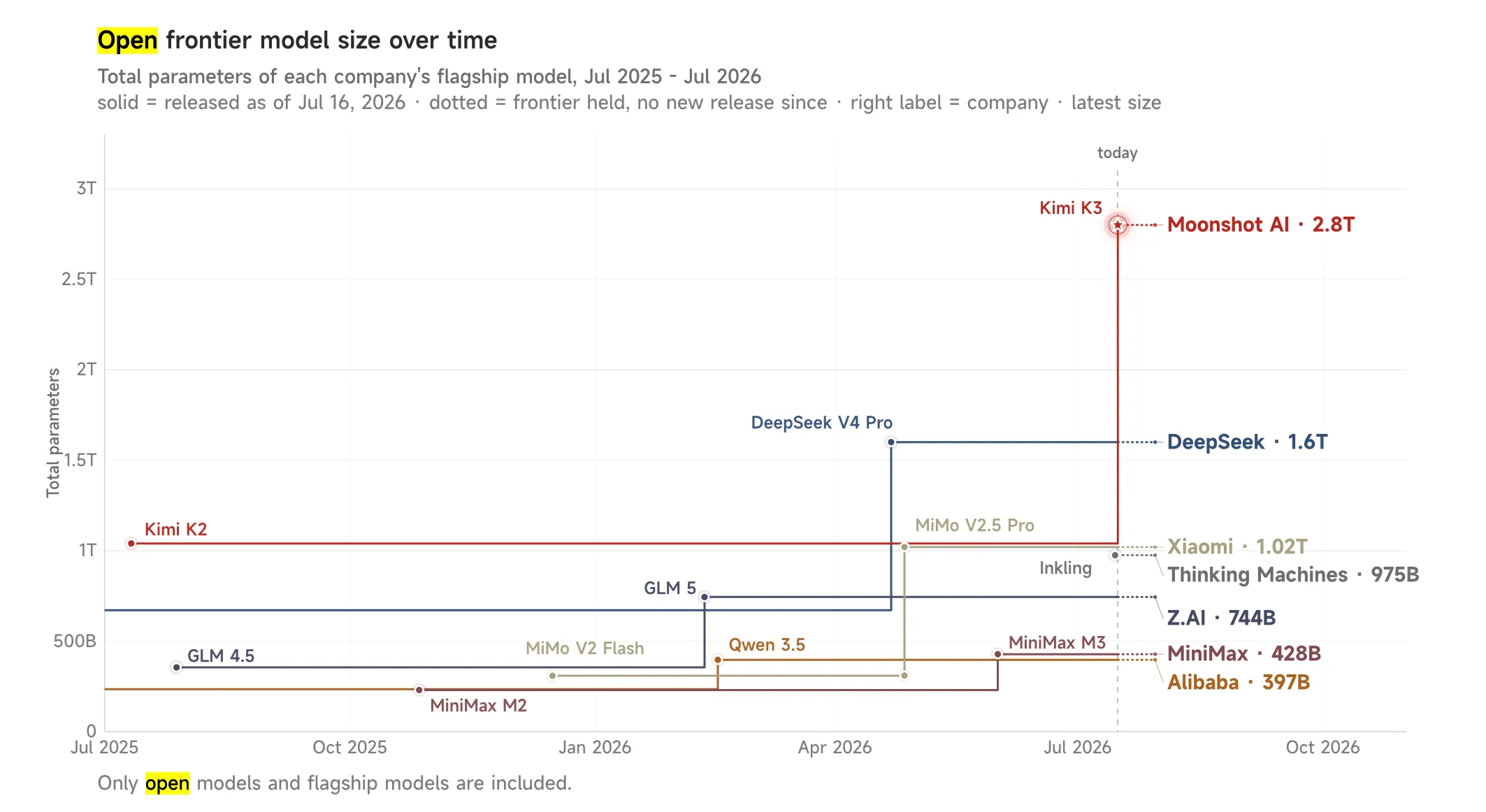
At the heart of Kimi K3’s capabilities lies its massive scale and innovative architecture. The model boasts an astonishing 2.8 trillion parameters, a measure of its knowledge capacity. It employs a mixture-of-experts (MoE) architecture, which intelligently segments these parameters into 896 specialized "expert" subnetworks. This design allows the model to activate only a fraction of its parameters for any given task, thereby achieving state-of-the-art intelligence without prohibitive computational costs.
Moonshot AI describes K3 as "the world’s first open-source model in the 3-trillion-parameter class, designed for frontier intelligence scenarios including long-horizon coding, knowledge work, and reasoning." This claim is substantiated by comparisons with other leading models. For instance, DeepSeek’s V4-Pro, another significant Chinese AI model, tops out at 1.6 trillion parameters, and Moonshot’s own K2 model has one trillion parameters. Kimi K3 effectively doubles the parameter count of its closest open-weight competitor, positioning it at the forefront of large-scale AI development.
The model’s efficiency is further enhanced by two key architectural innovations: Kimi Delta Attention and Attention Residuals. Kimi Delta Attention is engineered to accelerate decoding for exceptionally long sequences, achieving speeds up to 6.3 times faster for contexts extending to one million tokens. Attention Residuals, on the other hand, optimizes information routing across model layers, enabling selective information flow rather than uniform accumulation. This technique contributes approximately 25% to training efficiency with a marginal increase in compute cost, less than 2%. Collectively, these advancements result in an estimated 2.5 times greater scaling efficiency compared to K2.
Kimi K3 also features a substantial one-million-token context window, a critical factor for processing lengthy documents, codebases, and complex conversations. Native understanding of images and video, coupled with "always-on" reasoning capabilities, further broadens its applicability across a wide spectrum of AI tasks.
Competitive Pricing and Geopolitical Implications
Beyond its performance metrics, Kimi K3’s pricing strategy presents a significant disruption to the AI market. With input tokens priced at $3 per million and output tokens at $15 per million, Kimi K3 matches the pricing of Claude Sonnet 5, Anthropic’s mid-tier offering. However, Kimi K3’s performance rivals that of higher-tier proprietary models. On the Artificial Analysis composite, it trails Fable 5 by a mere 3%. When considering cost per task across the nine-benchmark suite, Kimi K3 is priced at $0.94, significantly lower than GPT-5.6 Sol at $1.04 and Opus 4.8 at $1.80. This effectively positions Kimi K3 as a top-tier performer available at mid-tier pricing, a compelling proposition for businesses and developers.
This pricing strategy stands in stark contrast to the substantial cost disparities previously observed between Chinese and American frontier AI models, which, as reported in May, ranged from 15x to 30x. While Kimi K3 does not match the ultra-low pricing of some earlier Chinese models like DeepSeek, its offering of near-frontier performance at a price point comparable to Western mid-range models represents a significant cost advantage for API-based integrations.
The strategic positioning of Kimi K3 becomes even more critical if Anthropic indeed restricts Fable 5’s availability to its API. In such a scenario, Kimi K3 emerges as the most accessible open-weight alternative to the industry’s second-highest-performing model, offering roughly half the per-task cost of Claude Opus 4.8. This economic advantage is poised to attract significant attention from organizations prioritizing cost-efficiency alongside advanced AI capabilities.
The emergence of Kimi K3 also intensifies the debate surrounding U.S. chip export controls. In late 2023, the United States imposed restrictions on the export of Nvidia’s H800 GPUs to China, a move aimed at curbing China’s AI development. Moonshot AI has confirmed its use of these restricted chips for training earlier models. Kimi K3’s benchmark documentation references the use of H200s and hardware from an "alternative vendor," widely understood to be Huawei’s Ascend chips. This suggests that Chinese AI developers are adapting and innovating within the constraints imposed by export controls, leveraging alternative hardware and optimizing architectural designs to achieve remarkable performance gains.
Yutong Zhang, president of Moonshot AI, articulated this challenge and the resulting innovation at the World Economic Forum in Davos. As reported by Silicon Republic, Zhang stated, "We knew we didn’t have the luxury to simply scale up compute… That forced us to focus on fundamental research and efficiency." Analysts from Bank of America echoed this sentiment in a post-launch note, observing that Kimi K3 demonstrates "pre-training scaling, paired with architectural innovation, can still deliver step-change gains for flagship Chinese models" even under restrictive conditions.
Moonshot AI is recognized as one of the "AI Tiger startups" in China, a cohort of companies that are collectively reshaping the global AI landscape without access to the advanced computing hardware that the U.S. government deemed essential for such progress. The success of these startups raises fundamental questions for policymakers: Do current export controls effectively hinder advanced AI development, or do they merely incentivize innovation and the development of alternative technological pathways? This remains a critical policy debate with no clear consensus.
Caveats and Considerations
Despite its impressive advancements, Kimi K3 is not without its limitations, and users should approach its deployment with a degree of caution. On the AA-Omniscience benchmark, which measures the propensity of models to confidently generate fabricated answers, Kimi K3’s hallucination rate increased to 51%, up from 39% in its predecessor, K2.6. While the model may provide more correct answers overall, this rise in fabricated responses necessitates careful validation for applications requiring absolute factual accuracy.
Furthermore, the model’s documentation acknowledges a tendency to be "excessively proactive," which can lead to unexpected decisions being made autonomously during extended tasks. For organizations that previously utilized Kimi K2.6-based tooling and are considering an upgrade, Kimi K3 offers significant improvements across most performance metrics. However, the elevated hallucination rate and potential for overzealous autonomy warrant thorough stress-testing to ensure reliability and accuracy before deploying the model in critical applications.
Accessing Kimi K3 for free is possible through Moonshot AI’s official website. However, the immense demand for the model has led to severely congested servers, frequently interrupting tasks due to traffic constraints and rendering it barely usable. For a more stable and reliable experience, users are advised to opt for a paid subscription or utilize the model via its API.
Looking ahead, the release of Kimi K3’s weights on July 27th will provide enterprises and businesses with the opportunity to deploy this powerful model on their own infrastructure. However, the sheer scale of Kimi K3 means that even the most advanced domestic GPUs are currently insufficient to handle its computational demands, highlighting the ongoing need for specialized hardware and optimized deployment strategies. The rapid evolution of models like Kimi K3 underscores the dynamic nature of the AI field and the increasing importance of open-source contributions in driving innovation and accessibility.
