

The rapid integration of artificial intelligence, particularly generative AI, into organizational workflows is fundamentally reshaping the technological landscape. At the forefront of this transformation is Kubernetes, the open-source container orchestration platform, which is increasingly being recognized not just as a tool for managing applications, but as the de facto operating system for AI. Recent findings indicate that a significant majority of organizations leveraging generative AI models are turning to Kubernetes for their inference needs, with an overwhelming 82% utilizing it for production deployments. This widespread adoption underscores Kubernetes’ pivotal role in enabling the scalable, resilient, and efficient deployment of complex AI systems.
The synergy between Kubernetes and AI is further amplified by complementary open-source projects like Kubeflow, a dedicated platform for machine learning on Kubernetes. Together, these technologies empower organizations to not only build and deploy AI models but also to manage their lifecycle, scale them effectively, and maintain ownership of their AI infrastructure. This community-driven innovation is a testament to the power of open source in fostering rapid advancement and widespread adoption of cutting-edge technologies.
This pivotal moment in the evolution of cloud-native technologies and AI was a central theme at KubeCon + CloudNativeCon, held in Amsterdam in March. This year’s event, touted as the largest yet, brought together a global community of cloud-native developers, now numbering an impressive 19.9 million. The conference provided a critical platform for discussing the latest trends, challenges, and solutions shaping the industry.
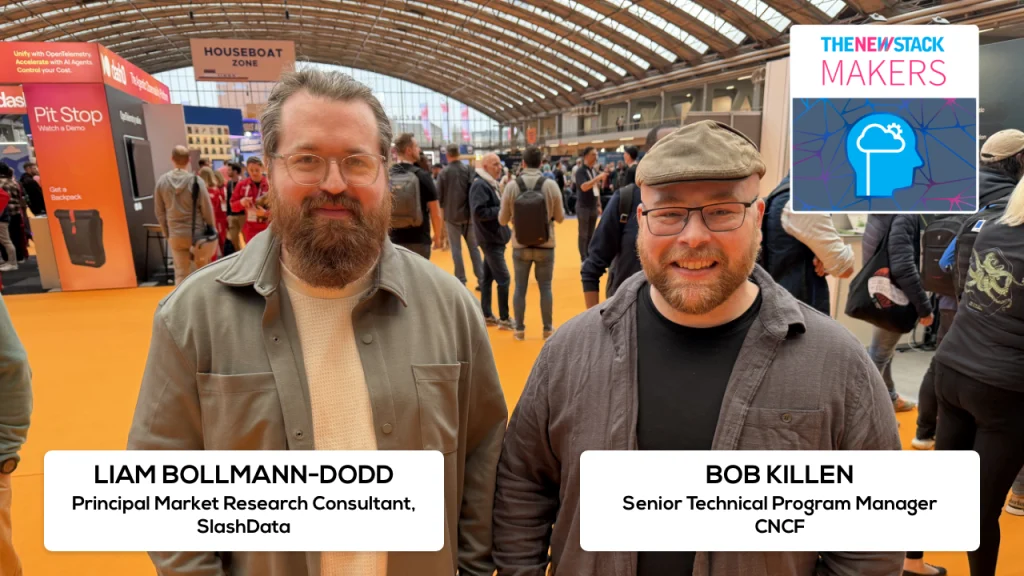
A deep dive into the burgeoning relationship between Kubernetes and AI was facilitated through discussions with key figures in the cloud-native ecosystem. Bob Killen, Senior Technical Program Manager at the Cloud Native Computing Foundation (CNCF), and Liam Bollmann-Dodd, Principal Market Research Consultant at SlashData, shared insights gleaned from recent research collaborations. Their discussions, conducted on the expo floor of KubeCon + CloudNativeCon, offered a comprehensive look at the current state and future trajectory of cloud-native development and its intersection with AI.
Q1 2026 CNCF-SlashData Research Highlights
The insights shared by Killen and Bollmann-Dodd were largely informed by two significant research collaborations between the CNCF and SlashData, released in Q1 2026. These reports provide a granular view of the cloud-native ecosystem, focusing on developer trends and technology adoption. The findings paint a clear picture of how organizations are navigating the complexities of integrating AI into their operations, with a strong emphasis on the foundational role of Kubernetes.
The research underscored a persistent truth in the realm of AI adoption: success and a tangible return on investment are inextricably linked to robust engineering best practices. These practices, in turn, are heavily influenced by the effectiveness of internal developer platforms (IDPs) and the overall developer experience. The interconnectedness of these elements is crucial; an optimized developer experience can significantly enhance the utility and adoption of an IDP, which then provides the structured environment necessary for efficient and secure AI development and deployment.
The AI Bottleneck: From Code Generation to Operational Challenges
While AI-generated code has the potential to accelerate development cycles, it has inadvertently exacerbated existing bottlenecks within DevOps, reliability, and security operations. The ease with which AI can generate code has shifted the focus from coding itself, which was previously considered a bottleneck, to the more complex and resource-intensive areas of ensuring operational stability, security, and reliability. This has led to a critical shortage of skilled personnel in these domains, amplifying the challenges faced by organizations.
Consequently, operator experience has emerged as a paramount concern for most organizations in 2026. The intricate nature of managing and securing AI-driven systems requires specialized expertise and robust tooling. The research suggests that to navigate this new landscape safely and effectively, organizations must implement stringent guardrails. These guardrails are essential for preventing unintended consequences and ensuring that the rapid pace of AI development does not compromise system integrity or security.
Liam Bollmann-Dodd elaborated on this duality, stating, "The kind of safety with AI is making things better and worse at the same time. One of the approaches you can take is if you can take the kind of developer platform or other internal tooling, where you can prevent people from being dangerous to themselves, you can control everything at your end. All security is handled by someone who actually understands how it works. All the pipelines are built by people who actually know how pipelines work." This highlights the strategic importance of centralized control and expertise in mitigating the risks associated with AI integration.
The Rise of "AI Developers" and Evolving Team Structures
The trend of onboarding non-human developers, or AI agents, is also on the rise. Intriguingly, the principles that benefit junior developers are proving equally valuable for AI agents. Bollmann-Dodd explained, "The AI developer, whether they are super competent, medium competent, like upskilled or downskilled, you can basically just say they cannot destroy in our systems, they are locked into what they do, and therefore you can let them be a bit more dangerous because they can’t actually break things." This refers to the concept of agentic AI developers, where their operational scope is precisely defined and constrained, allowing for greater experimentation without compromising system stability.
This shift has also prompted a re-evaluation of team structures, as noted by Bob Killen. He observed a notable transformation in DevOps and platform engineering teams. Historically, these functions were often handled by smaller, more generalized teams where individuals juggled development and operations tasks. However, the increasing complexity and scale of AI initiatives have led to a pivot towards larger, more specialized platform engineering teams. These teams are tasked with building and maintaining the internal infrastructure and services that empower development teams to operate more efficiently and securely. This aligns with the principles outlined in methodologies like Team Topologies, which advocate for the creation of platform teams to provide self-service capabilities to product teams.
The Cloud Native Landscape and the Future of Open Source
The exponential growth of AI is profoundly impacting the vast Cloud Native Landscape, a comprehensive catalog of cloud-native technologies maintained by the CNCF. This expansion brings with it an unprecedented level of complexity for the tech industry. Despite the technological advancements, the core tenets of open-source success remain consistent: a strong emphasis on people and processes, rather than solely on technology.
The future of the tech industry, and particularly the trajectory of AI, is deeply intertwined with the continued vitality and evolution of open source. The collaborative, community-driven nature of open-source projects like Kubernetes is instrumental in democratizing access to powerful technologies and fostering innovation at a global scale. As AI becomes more pervasive, the open-source model’s ability to facilitate shared development, transparent governance, and rapid iteration will be more critical than ever in shaping a secure, scalable, and equitable AI future.
The discussions at KubeCon + CloudNativeCon served as a powerful reminder that while the technology evolves at breakneck speed, the human element – collaboration, expertise, and well-defined processes – remains the bedrock of successful technological adoption and innovation. The continued growth and influence of the cloud-native community, powered by open source, is therefore a critical factor in how organizations will harness the transformative potential of artificial intelligence in the years to come. The ongoing evolution of Kubernetes as the foundational operating system for AI is a clear indicator of this trend, promising a future where complex AI systems are more accessible, scalable, and manageable than ever before.
