
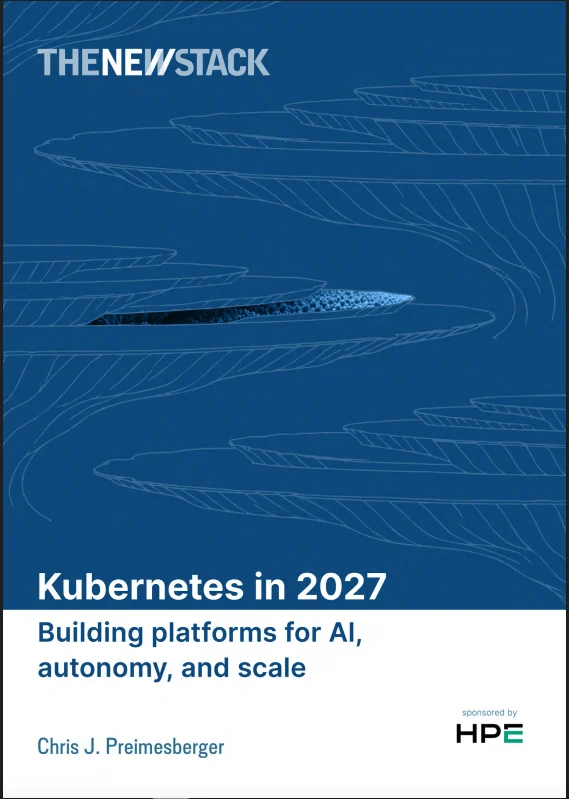

The rapid integration of artificial intelligence into enterprise software architectures is fundamentally reshaping the responsibilities of platform engineering and cloud-native operations teams. As organizations increasingly deploy complex AI workloads—including autonomous agents capable of interacting directly with production environments—traditional metrics for container management are proving insufficient. To address these evolving operational demands, The New Stack, in strategic partnership with Hewlett Packard Enterprise (HPE), has published a comprehensive new guide titled Kubernetes in 2027: Building Platforms for AI, Autonomy, and Scale, authored by technology journalist and analyst Chris J. Preimesberger.
The publication arrives at a critical juncture for enterprise IT. For years, Kubernetes orchestration has focused primarily on fundamental infrastructure health: monitoring whether container pods are running, tracking resource consumption, and ensuring basic high availability. However, the maturation of generative AI, large language models (LLMs), and autonomous agentic workflows has introduced an unprecedented layer of complexity. Platform teams are no longer tasked solely with traditional concerns such as software upgrades, cluster recovery, and baseline security. They must now contend with performance variables unique to artificial intelligence, spanning GPU allocation, model inference latency, and the probabilistic nature of AI-generated outputs.
Evolution of Enterprise Workloads and Operational Challenges
Historically, Kubernetes administrators evaluated platform performance through deterministic metrics. CPU utilization, memory thresholds, pod restart counts, and network input/output rates provided a clear picture of application health. The advent of AI inference pipelines shifted these baseline parameters, demanding visibility into metrics such as time-to-first-token and throughput scaling under high-concurrency requests.
With the emergence of agentic AI—systems designed to execute multi-step workflows, query external databases, and invoke system tools autonomously—the operational paradigm has expanded further. Granting an artificial intelligence agent administrative access to a Kubernetes cluster introduces significant risk, even when executing routine maintenance or deployment tasks. The new publication emphasizes that organizations must establish rigorous governance frameworks before deploying autonomous systems into production environments. These frameworks include defining clear operational ownership, enforcing narrow permission scopes, implementing mandatory human approval gates, and maintaining comprehensive audit trails that link every automated tool call directly to its initiating task.
Furthermore, the guide underscores that speed cannot supersede accuracy. In enterprise settings, a rapidly delivered inference result offers little operational value if the underlying data is factually incorrect or subject to hallucinations. Consequently, platform teams must incorporate evaluation frameworks that continuously assess AI output quality alongside traditional infrastructure metrics.

Comprehensive Infrastructure Checklists and Pre-Launch Protocols
Kubernetes in 2027: Building Platforms for AI, Autonomy, and Scale moves beyond high-level architectural theory by providing actionable checklists for pre-launch, active deployment, and post-deployment phases. The framework urges engineering organizations to stress-test model-serving infrastructure under realistic, high-volume operational loads rather than relying on synthetic benchmarks. Additionally, teams are encouraged to rehearse failure scenarios regularly, simulating infrastructure outages, network partitions, and hardware degradation to evaluate how automated systems and recovery protocols respond.
The guide addresses the tendency for modern organizations to hyper-focus on artificial intelligence while neglecting foundational platform hygiene. Effective container orchestration in the AI era still requires stringent policy enforcement across multi-cluster environments, robust visibility into dependencies operating outside the Kubernetes ecosystem, and disciplined operational ownership.
To bridge the gap between application developers and platform operators, the publication outlines specific diagnostic inquiries designed to resolve common organizational blind spots:
- Cluster Baseline Compliance: Can administrators instantly verify which clusters adhere to a standardized access control and network security baseline, and is there an auditable record of who authorized exceptions to these policies?
- Holistic Observability: When application latency increases, can engineering teams immediately correlate pod-level metrics with dependent external systems, including underlying databases, virtualized infrastructure, network fabrics, and third-party APIs?
- Upgrade Preparedness: Prior to executing cluster upgrades, have operators systematically scanned for deprecated or removed APIs, and have they successfully tested end-to-end restoration procedures for both cluster state and persistent application data?
- Lifecycle Management: Post-deployment, are administrative responsibilities clearly assigned for routine maintenance tasks such as renewing ingress certificates, authorizing capacity expansions, and auditing resource costs associated with developer self-service environments?
Industry Implications and Cross-Functional Collaboration
The release of this definitive guide reflects a broader transition within the enterprise technology sector. Platform engineering is evolving from a specialized subset of systems administration into a strategic discipline that bridges application developers, security specialists, and executive business leadership.
As enterprises scale their artificial intelligence initiatives toward 2027, the success of these deployments will rely heavily on structured collaboration. Security teams must adapt to the non-deterministic behavior of AI agents; application developers must understand the operational constraints of underlying container platforms; and business leaders must balance the financial costs of specialized hardware acceleration against tangible productivity gains.
By providing structured prompts, rigorous operational checklists, and forward-looking architectural guidance, Kubernetes in 2027: Building Platforms for AI, Autonomy, and Scale serves as a vital resource for organizations navigating the complexities of modern cloud-native infrastructure. The ebook is currently available for download through The New Stack, offering engineering leaders a practical framework to prepare their technical operations for the next wave of autonomous, AI-driven scale.
