

The telecommunications landscape in the Lao People’s Democratic Republic has undergone a profound transformation over the last decade, evolving from a nascent market into a competitive sector that recorded over 10 million mobile subscribers by the end of 2021. This milestone reflects a significant penetration rate in a nation of approximately 7.5 million people, suggesting a high degree of multi-SIM usage and a rapidly growing reliance on mobile connectivity for both social and economic activities. As Laos transitions from a land-locked to a "land-linked" nation through infrastructure projects like the Laos-China Railway, the digital infrastructure provided by the country’s four major mobile operators—Unitel, Lao Telecom (LaoTel), TPlus Laos, and ETL Laos—serves as the backbone for this modernization. This report provides a comprehensive analysis of the market dynamics, technological deployments, regulatory environment, and the future trajectory of the Lao mobile industry.
The Evolution of Telecommunications in Laos: A Chronological Perspective
The journey of the Lao telecommunications sector began in earnest in the mid-1990s as the government sought to modernize its communications infrastructure to support economic opening. In 1996, Lao Telecom was established as a joint venture between the Lao government and international investors, setting the stage for the first era of mobile connectivity. For over a decade, the market saw gradual growth, primarily centered in the capital, Vientiane, and major provincial hubs.
A pivotal shift occurred in 2008 with the entry of Unitel, a joint venture between the Lao Ministry of Defense and Vietnam’s Viettel Group. Unitel’s aggressive strategy focused on rural expansion, mirroring Viettel’s successful model in Vietnam. By 2009, the competitive landscape expanded further with the arrival of VimpelCom’s Beeline (now TPlus), which brought international branding and marketing expertise to the Lao market.
By the mid-2010s, the focus shifted from voice services to data. The Enterprise of Telecommunications Lao (ETL) underwent various restructuring phases, including a significant investment period involving Chinese capital, to remain competitive. By 2020, the Ministry of Post and Telecommunications (now integrated into the Ministry of Technology and Communications) reported a consolidated market where mobile data had become the primary driver of revenue, leading to the current four-player ecosystem that balances state interests with foreign technical expertise.

Market Share and Competitive Dynamics
The Lao mobile market is characterized by a strong duopoly at the top, with two major players commanding the vast majority of the subscriber base, while two smaller operators compete for niche segments and regional dominance.
Unitel: The Market Leader
As of the latest comprehensive data from the Ministry of Post and Telecommunications, Unitel maintains a commanding lead with approximately 51% of the market share. With a subscriber base exceeding 5 million, Unitel’s dominance is attributed to its "rural first" strategy. By installing thousands of base stations in mountainous and remote areas where other providers saw little immediate profit, Unitel secured a loyal customer base. The company’s integration with Viettel’s global supply chain has allowed it to offer diverse value-added services (VAS), including the U-Money mobile finance platform, which has become a critical tool for financial inclusion in rural Laos.
Lao Telecom (LaoTel): The Established Incumbent
Holding approximately 34% of the market, Lao Telecom remains the preferred choice for many government agencies, urban professionals, and established businesses. As the oldest operator, LaoTel has leveraged its extensive fixed-line and fiber-optic infrastructure to offer bundled services. In recent years, LaoTel has focused on digital transformation, launching the "M-Money" service to compete in the burgeoning fintech space and expanding its 4G and 4.5G footprint across all 18 provinces.
TPlus Laos and ETL: The Challenger Brands
TPlus Laos, formerly Beeline, holds roughly 10% of the market. Since its rebranding, TPlus has focused on the youth demographic, offering trendy marketing campaigns and flexible data packages. Meanwhile, ETL Laos, with a 5% market share, has positioned itself as a provider of reliable data services. Despite their smaller footprints, these operators play a crucial role in maintaining price competition, ensuring that mobile services remain affordable for the average citizen.
Technical Infrastructure and Network Coverage
The geography of Laos, characterized by dense forests and rugged mountain ranges, presents a formidable challenge for network deployment. Despite these hurdles, the country has seen a rapid rollout of high-speed mobile internet.
From GSM to 4G LTE
While the Global System for Mobile Communications (GSM) remains the legacy standard for voice calls, 4G LTE has become the standard for data. Unitel and LaoTel have achieved near-ubiquitous 4G coverage in provincial capitals and along major transport corridors. The deployment of 4G has been essential for supporting the government’s "Digital Laos" initiative, enabling e-government services and supporting the digital economy.
The 5G Frontier
Laos has demonstrated a surprising level of ambition regarding 5G technology. In late 2020 and 2021, both Lao Telecom and Unitel began 5G trials in Vientiane. These pilots focused on high-traffic areas and showcased speeds significantly faster than existing 4G networks. While full-scale commercial 5G deployment is still in the early stages, the government views 5G as a catalyst for Industry 4.0, particularly in the sectors of logistics, smart mining, and hydroelectric power management.
Service Portfolio and Pricing Analysis
The affordability of mobile services in Laos is a key factor in the high subscriber count. Compared to regional neighbors like Thailand or Cambodia, data pricing in Laos is highly competitive.
Data and Voice Pricing
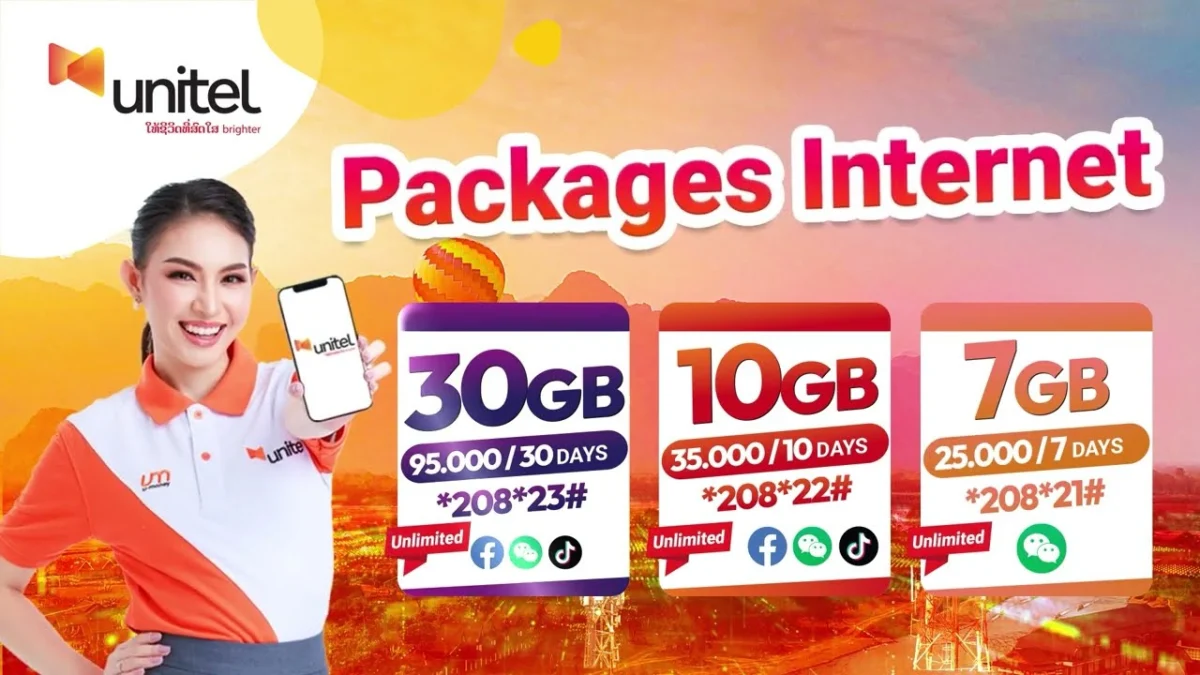
On average, mobile data in Laos costs between $2 and $5 per gigabyte, depending on the validity period and the size of the bundle. Operators frequently offer "night-time" data bonuses and social media-specific packages (e.g., unlimited access to Facebook or WhatsApp), which are popular among younger users. Voice call rates remain low, though the volume of traditional voice traffic is declining as users migrate to Over-the-Top (OTT) services like WeChat, WhatsApp, and Line.
Innovations in Tourism: The eSIM
A notable development in the service sector is the introduction of eSIM technology, specifically tailored for the tourism industry. As Laos reopens its borders to international travelers, providers have introduced digital SIM cards that can be activated via QR code. This allows tourists to maintain connectivity from the moment they arrive without needing to visit a physical kiosk. Platforms such as laosesim.com have become instrumental in facilitating this transition, offering pre-paid data plans that work seamlessly across the country’s major networks.

Regulatory Framework and Government Policy
The Lao mobile sector is governed by the Ministry of Technology and Communications (MTC). The regulatory environment is designed to balance the need for infrastructure investment with the necessity of affordable public access.
Licensing and Monitoring
The MTC is responsible for spectrum allocation, ensuring that frequency bands for 4G and 5G are distributed in a way that prevents interference and encourages competition. The government has also implemented strict SIM card registration laws, requiring all subscribers to provide identification. This move, while aimed at national security and fraud prevention, has been a significant administrative undertaking for operators.
Digital Vision 2040
The Lao government’s "Digital Vision 2040" and the "10-Year National Digital Economy Development Strategy (2021–2030)" provide the policy roadmap for the sector. These documents emphasize the role of mobile operators in bridging the digital divide. Official statements from the MTC highlight a commitment to ensuring that even the most remote villages have access to at least 4G connectivity by 2025, a goal that requires ongoing cooperation between the state and private operators.
Challenges Facing the Industry
Despite the rapid growth, several systemic challenges persist that could hamper future development.
- Infrastructure Costs: The high cost of importing equipment and the logistical difficulty of maintaining towers in remote areas put pressure on profit margins.
- Skilled Workforce Shortage: There is a significant gap in the availability of local technical experts specialized in advanced network engineering and cybersecurity. Operators often rely on foreign experts from Vietnam, China, or Russia to manage complex technical transitions.
- The Digital Divide: While urban centers enjoy high-speed internet, rural areas still face intermittent connectivity. This disparity affects the delivery of digital education and healthcare services in the provinces.
- Currency Fluctuation: As many operators carry debt in foreign currencies or must pay for international bandwidth in US dollars, the volatility of the Lao Kip (LAK) presents a significant financial risk.
Broader Impact and Future Outlook
The expansion of mobile networks has had a transformative impact on the Lao economy. Mobile banking, in particular, has revolutionized the way people in rural areas manage money, allowing for remittances and payments without the need for physical bank branches. Furthermore, the rise of e-commerce, driven by social media platforms, has provided a new marketplace for Lao agricultural products and handicrafts.
Looking ahead, the future of Lao mobile operators will be defined by the transition to 5G and the integration of Artificial Intelligence (AI) in network management. As the Lao-China Railway and other "Belt and Road Initiative" projects increase the flow of people and goods, the demand for seamless, high-speed roaming and IoT (Internet of Things) solutions will grow.
Industry analysts expect a period of consolidation or deeper strategic partnerships in the coming years. With the government’s push for a digital economy, operators will likely move beyond being simple "bit pipes" to becoming integrated digital service providers, offering everything from cloud storage to entertainment streaming and smart home solutions.
Conclusion
The mobile telecommunications sector in Laos stands as a success story of rapid infrastructure development and market liberalization. From the early days of LaoTel to the nationwide reach of Unitel, the industry has successfully connected a once-isolated population to the global digital grid. While challenges regarding rural coverage and technical expertise remain, the proactive stance of the Ministry of Technology and Communications, combined with the competitive drive of the four major operators, ensures that Laos is well-positioned for the next phase of its digital journey. As 5G technology begins to take root, the mobile sector will continue to be the primary engine of the country’s socio-economic modernization, bridging the gap between its traditional roots and a digital future.
