
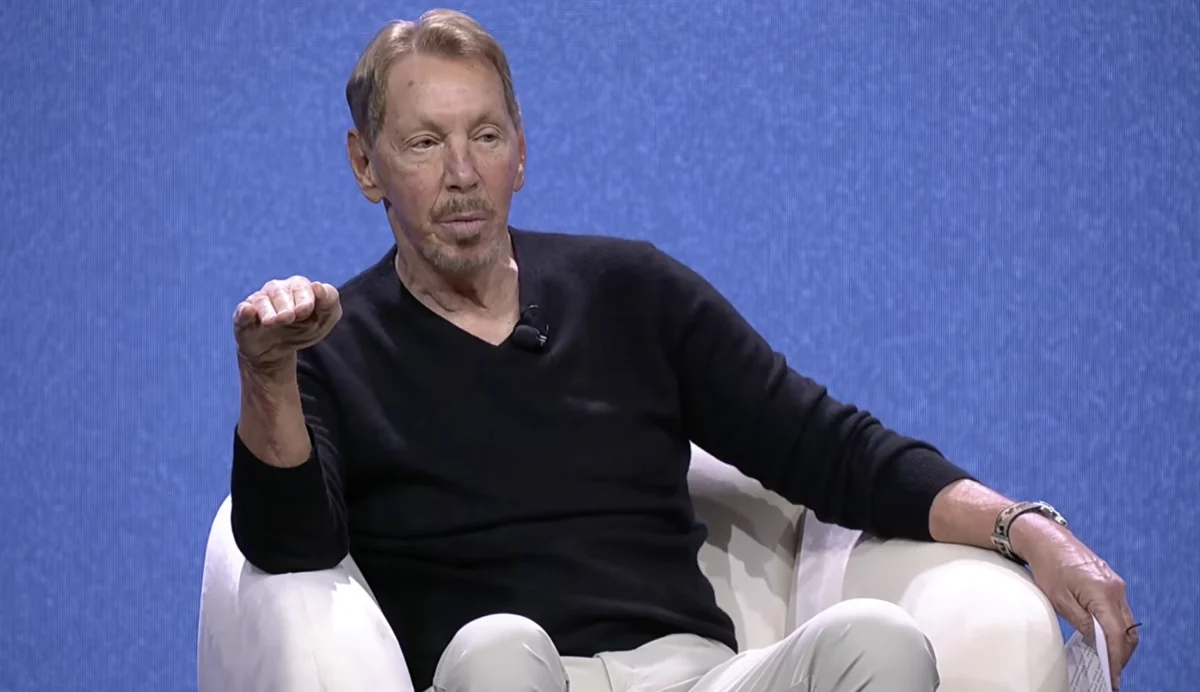

Oracle co-founder and chief technology officer Larry Ellison delivered a wide-ranging, ambitious keynote address at AI World 2026, outlining a transformative vision for artificial intelligence in healthcare, robotic surgery, and future economic models. Known for his candid and often unconventional stage presence, Ellison used his keynote to discuss the intersection of cutting-edge technology and deep personal history, while also detailing Oracle’s aggressive product roadmap following its multi-billion-dollar acquisition of Cerner.
The annual AI World conference serves as a major gathering point for enterprise technology leaders, software developers, and industry analysts. This year’s event drew thousands of attendees eager to hear from one of Silicon Valley’s longest-tenured executives. While industry keynotes are frequently dominated by rigid product demonstrations and corporate talking points, Ellison’s address stood out for its blend of macro-level socioeconomic predictions, highly personal reflections, and concrete enterprise software announcements.
Personal Motivations and the Acquisition of Cerner
Ellison’s focus on the healthcare sector is not merely a commercial strategy, but a deeply personal mission. During a Q&A session with Seema Verma, executive vice president and general manager of Oracle Health and Life Sciences, Ellison candidly discussed the foundational moments that shaped his outlook on medicine. Recalling his mother’s death from cancer when he was a freshman at the University of Illinois, Ellison described the experience as a profound shock that fundamentally altered his perspective on human health and mortality.
This personal tragedy has heavily influenced Oracle’s strategic trajectory in recent years, most notably marked by the $28 billion acquisition of healthcare IT giant Cerner in 2022. The corporate merger positioned Oracle as a major player in Electronic Health Records (EHR) and healthcare infrastructure, setting the stage for the company’s current push to integrate cloud computing and artificial intelligence into clinical workflows.
Eradicating Cancer and Democratizing Drug Discovery
Among the most headline-grabbing assertions made by Ellison was his timeline for the eradication of cancer. Ellison stated that artificial intelligence will act as a catalyst for a golden age of drug discovery, predicting that most forms of cancer will be effectively eliminated or successfully managed within five to ten years.
However, Ellison emphasized that scientific breakthroughs alone are insufficient if treatments remain inaccessible to the general population. He stressed that the true measure of success will be the global distribution of therapeutics at scale, ensuring that advanced treatments are not restricted to wealthy urban centers in regions like New York or California.
To address systemic bottlenecks in clinical research, Oracle is deploying modules designed to integrate with diverse hospital infrastructure regardless of underlying EHR systems. By expanding clinical trial networks into underserved regions—such as ongoing initiatives in Africa—Oracle aims to broaden data diversity and accelerate trial timelines. Ellison argued that mass distribution will naturally drive down costs, making advanced diagnostics and targeted therapies universally available.
Robotic Surgery and the Evolution of Clinical Workflows
Building upon his predictions for oncology, Ellison discussed the rapid advancement of robotic surgery systems. Drawing on independent reading and industry developments, he noted that modern surgical robots possess optical capabilities capable of detecting individual cellular structures and tumor margins with exceptional precision.
According to Ellison, once surgical robotics achieve a certain threshold of reliability, they transition from merely effective tools to near-perfect execution engines, ultimately reducing procedural costs and improving patient outcomes. When addressing broader societal concerns regarding automation and workforce displacement, Ellison dismissed the narrative of total job replacement as nonsensical. He drew parallels to commercial aviation, noting that long-standing autopilot systems have assisted pilots for decades without replacing them entirely. While acknowledging that certain job functions will inevitably evolve or disappear, he projected a managed transition rather than a wholesale displacement of the human workforce.
Economic Restructuring: A Value-Added Tax on Robotics
Perhaps the most economically provocative segment of Ellison’s address focused on the societal impact of widespread automation and artificial intelligence. He proposed that governments must eventually reevaluate traditional taxation models to account for labor performed by non-human systems.
Ellison suggested shifting the tax burden away from human labor and toward a value-added tax levied directly on productivity generated by robots and AI. Under this theoretical economic model, as automation drives down the cost of physical goods and services—such as home construction—the resulting economic efficiency could fund a universal high income or reverse income tax, a concept previously explored by economist Milton Friedman. Ellison conceded that such sweeping economic transformations will likely require more than a decade to materialize, framing the concept as an ambitious blueprint for future governance in an automated society.
Product Strategy and Enterprise Applications
Moving from macro-level philosophy to enterprise execution, Ellison addressed the software industry’s broader direction. He rejected the premise of the so-called SaaS apocalypse—the theory that enterprises will increasingly rely on generative AI to custom-build their own applications from scratch. Instead, Ellison argued that AI enables major software vendors to finally complete and refine turnkey applications on an industry-by-industry basis, eliminating the need for extensive customer-side customization and integration.
Oracle’s near-term product schedule reflects this philosophy. The company is rolling out specialized healthcare modules designed to integrate seamlessly with existing hospital infrastructure. For instance, Ellison highlighted capabilities allowing facilities running competitor platforms, such as Epic, to activate Oracle’s oncology module via SMART on FHIR standards without requiring complex data migrations or extensive staff retraining.
Additional impending features include automated prior authorization systems designed to cross-reference patient eligibility rules for specialized medications, such as GLP-1 treatments, before requests are submitted. Furthermore, Oracle is developing national-scale patient portals capable of aggregating health records across disparate EHR platforms, including Epic, Cerner, and Allscripts. These modules are slated for commercial release early next year.
Industry Implications and Outlook
Ellison’s keynote at AI World 2026 underscored the tension between ambitious long-term visions and immediate enterprise realities. While industry observers and skeptics frequently question the feasibility of timelines predicting the eradication of cancer within a decade or the implementation of robotic-funded universal incomes, the core message resonated with attendees seeking alternatives to incremental software updates.
By framing artificial intelligence as a tool to enhance human capability and streamline complex administrative systems rather than merely a mechanism for headcount reduction, Oracle is attempting to position itself as a trusted partner for enterprise buyers navigating an uncertain technological landscape. Whether Oracle Health and its underlying cloud infrastructure can successfully execute at the sweeping scale outlined by its co-founder remains a critical question for healthcare providers and technology analysts alike, setting high expectations for the company’s performance at future industry gatherings.
