
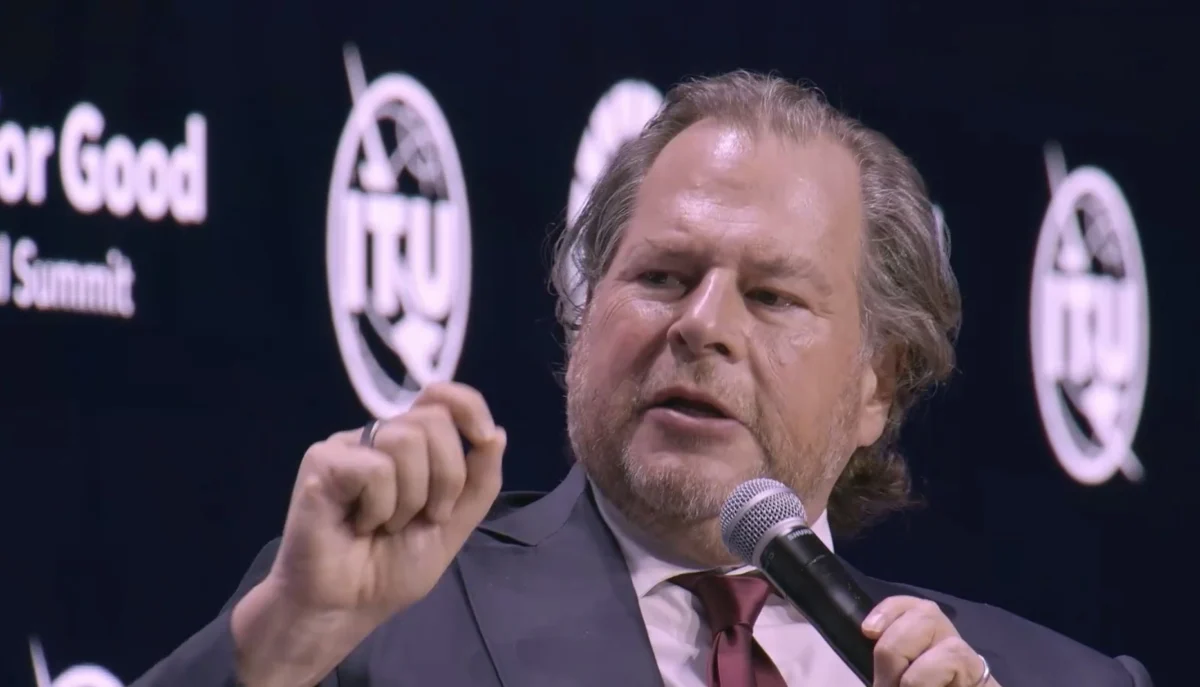

Marc Benioff, the CEO of Salesforce and a long-standing advocate for corporate social responsibility, delivered a series of pointed warnings regarding the trajectory of artificial intelligence at the AI for Good Summit in Geneva this week. Addressing an audience of international delegates, technology leaders, and policymakers, Benioff characterized AI not merely as the defining technology of the current generation, but as the most significant technological advancement in human history. However, this praise was tempered by a call for immediate and rigorous accountability, as Benioff cautioned that the industry stands on the precipice of repeating the systemic failures of the social media era.
The summit, organized by the International Telecommunication Union (ITU)—the United Nations’ specialized agency for information and communication technologies—serves as a primary global platform for dialogue on the ethical deployment of AI. Benioff’s participation coincides with his appointment as co-chair of the newly formed AI for Good Global Commission, a body designed to bridge the gap between rapid technological innovation and the development of protective regulatory frameworks.
The Specter of Social Media 2.0
Central to Benioff’s address was the comparison between the current state of AI development and the historical rise of social media. He argued that for over a decade, social media conglomerates were granted a "pass" by regulators, allowing them to deploy technologies that prioritized engagement and profit over societal well-being. This lack of oversight, Benioff contended, resulted in documented harm to minors and the erosion of social cohesion.
"Is this going to be social media 2.0, where companies can build whatever they want, deliver whatever technology they want?" Benioff asked the assembly. He framed the current moment as a "warm-up act" for AI, suggesting that the potential for damage is exponentially higher given AI’s capability to influence every facet of human existence, from labor markets to cognitive processes.
This rhetoric builds upon Benioff’s previous interventions at the World Economic Forum in Davos earlier this year. In January, he specifically highlighted instances where AI-driven algorithms were found to facilitate or encourage self-harm among teenagers. His consistent message has been that the "Wild West" era of technology must end, replaced by a system where developers are held legally and ethically liable for the outputs and consequences of their products.
The AI for Good Global Commission: A Multi-Stakeholder Approach
In response to these challenges, the ITU has established the AI for Good Global Commission. Benioff co-chairs the commission alongside President Paul Kagame of Rwanda, representing a strategic partnership between the private sector and the Global South. The commission comprises more than 40 founding members, including high-profile industry figures such as Amazon CEO Andy Jassy, NVIDIA’s Jensen Huang, Microsoft’s Brad Smith, and Anthropic’s Jack Clark.
The commission’s mandate is structured around three primary pillars:
- Inclusive Development: Ensuring that AI benefits are not concentrated in wealthy nations but are accessible to developing economies to prevent a widening "digital divide."
- Risk Mitigation: Identifying and establishing safeguards against the misuse of AI, including its potential for weaponization or the propagation of misinformation.
- Governance Frameworks: Creating a standardized dialogue between governments, NGOs, and tech firms to align AI development with the UN Sustainable Development Goals (SDGs).
President Kagame echoed Benioff’s sentiments, emphasizing that technology must be a force for equity. For Rwanda and many other developing nations, AI represents a leapfrog opportunity for healthcare and education, provided the technology is governed by a framework that prevents exploitation.
The Economics of Innovation vs. Ethics
Despite his calls for regulation, Benioff remains an "unashamed capitalist," acknowledging the immense financial stakes involved in the AI race. He pointed to the upcoming wave of Initial Public Offerings (IPOs) for firms like OpenAI and Anthropic, as well as the massive influx of venture capital into the sector. According to market data, global investment in AI reached nearly $142 billion in 2023, even as other tech sectors saw a slowdown.
Benioff argued that the commercial nature of AI—packaged as software and sold for profit—necessitates the same level of oversight applied to other high-stakes industries. He drew a direct parallel to the pharmaceutical industry, particularly in Switzerland, a global hub for life sciences.
"There are lots of pharmaceutical companies here in Switzerland," Benioff noted. "If they build drugs that harm humans, there are frameworks in place to hold those companies responsible." He questioned why the technology sector, which now produces "agents" capable of self-creation and autonomous operation, should be exempt from similar liability structures.
Data Integrity and the Problem of "Stolen Data"
A significant point of contention in the enrichment of AI models is the source of training data. Benioff touched upon the burgeoning legal crisis surrounding intellectual property, stating that the current frontier models were largely "built on stolen data." This refers to the practice of scraping the internet for copyrighted books, articles, and art without compensation or consent from the original creators.
While Benioff noted that some companies have begun to face consequences—citing the $1.5 billion legal pressure faced by various firms and the ongoing lawsuits from authors and news organizations—he suggested the industry has yet to undergo a true reckoning. Salesforce itself is an investor in Anthropic, highlighting the complex web of interests where even those calling for reform are deeply embedded in the ecosystem they seek to regulate.
AI as a Geopolitical Weapon
The summit also addressed the "weaponization" of AI, a concern that recently manifested in US export controls. Benioff referenced a specific incident involving Anthropic’s models, which were briefly subjected to an export ban after being identified as potentially dangerous. He expressed approval of the US government’s "aggressive action," viewing it as a necessary step in treating high-level AI models with the same gravity as physical armaments.
However, this move created friction with European allies. Many European CEOs expressed anxiety that US regulatory intervention could abruptly cut off access to the foundational models upon which their own businesses are built. Benioff dismissed these concerns, arguing that the protection of global security outweighs the immediate commercial convenience of unrestricted technology transfer.
Analysis of Implications: The Road Ahead
The AI for Good Summit concludes with a consensus that dialogue is essential, but skeptics remain wary of whether "conversation" will translate into "action." Historically, the tech industry has utilized ethics boards and commissions as a method of "blue-washing"—using the appearance of UN-aligned goals to forestall more stringent, legally binding government regulations.
Benioff himself admitted that the new commission is not a rule-making body. Its power lies in its ability to shape the international narrative and provide a blueprint for national governments. The real test will be the implementation of the "liability structure" Benioff mentioned. If AI companies are held legally responsible for the "hallucinations," biases, or harmful actions of their models, it would represent a fundamental shift in the American legal doctrine of Section 230, which has long shielded internet platforms from liability for third-party content.
Furthermore, the "self-creating" nature of AI, as described by Benioff, presents a unique legal challenge. If an AI system evolves beyond its original programming to cause harm, determining whether the liability rests with the developer, the user, or the data provider remains a complex judicial hurdle that no current framework fully addresses.
Conclusion: A Pivot Point for Global Tech
As the delegates depart Geneva, the message from the AI for Good Summit is clear: the era of "move fast and break things" is no longer tenable in the context of artificial intelligence. Marc Benioff’s warnings serve as a bridge between the optimism of Silicon Valley and the caution of global regulators.
The success of the AI for Good Global Commission will be measured by its ability to turn these high-level ethical discussions into a standardized set of global norms. With AI market valuations soaring and the technology integrating into critical infrastructure, the window for establishing a "responsibility structure" is closing. As Benioff concluded, the technology itself is neutral; its legacy will be determined by whether humanity possesses the collective will to govern it for the common good rather than allowing it to become a more potent version of the social media crises of the past decade.
