
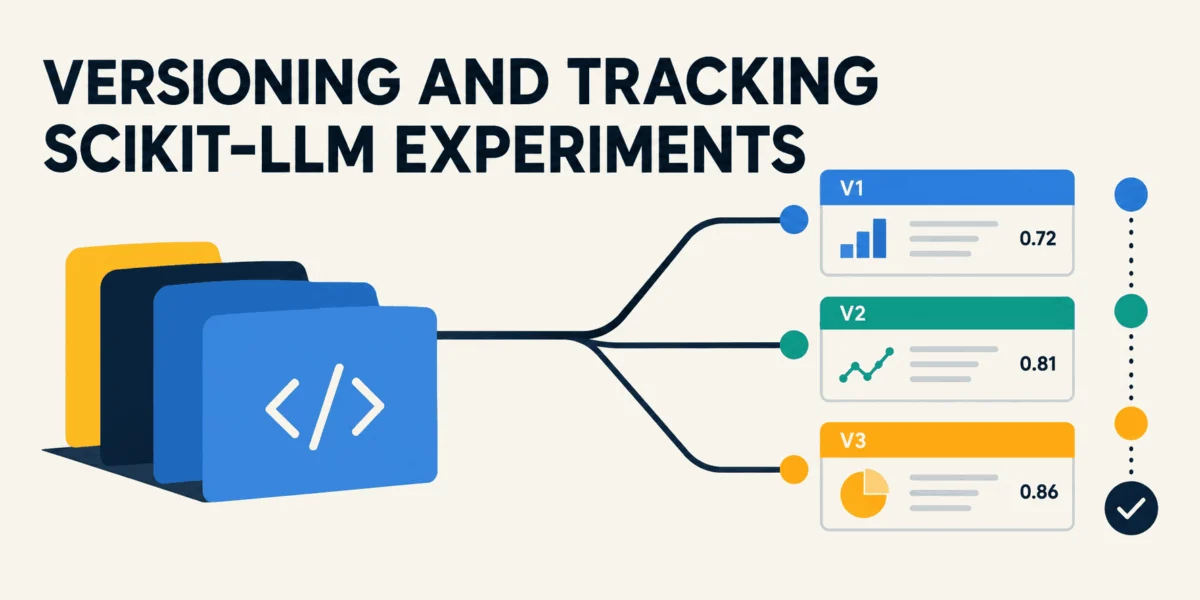

The integration of Large Language Models (LLMs) into standard machine learning workflows has shifted from an experimental curiosity to a fundamental requirement for modern software architecture. As organizations move beyond simple API calls and begin deploying complex, scikit-learn-compatible pipelines that wrap LLM functionality, the necessity for robust versioning, tracking, and model registration has become critical. Without a systematic approach to managing these lifecycles, engineering teams risk technical debt, inconsistent inference results, and the inability to reproduce specific model behaviors when backend configurations are updated. By combining the Scikit-LLM library—which provides a seamless interface for LLM-based tasks—with MLflow, an industry-standard open-source platform, practitioners can create a rigorous framework for tracking the evolution of AI-driven applications.
The Evolution of LLM Experimentation
In traditional machine learning, model versioning primarily focused on hyperparameters, training datasets, and feature engineering. With the advent of LLMs, the variables have expanded to include prompt engineering, model temperature, context window management, and the specific underlying weights of local or cloud-based models. A significant challenge in this transition is that many LLM-powered pipelines are treated as "black boxes," making it difficult to audit why a particular output was generated or to roll back to a stable version after an update to a model backend.
The use of Scikit-LLM allows developers to treat LLMs as first-class citizens within the scikit-learn ecosystem, leveraging familiar methods like .fit() and .predict(). However, these abstractions do not inherently solve the problem of provenance. When an engineering team updates an underlying model—for example, switching from a smaller, faster model like Orca Mini to a more robust architecture like Falcon—they must ensure that this change is documented, tested, and validated against the same criteria as their previous iterations. This is where the synergy between Scikit-LLM and MLflow becomes indispensable.
Infrastructure and Setup Requirements
To establish a production-grade tracking system, the initialization phase must account for both the execution environment and the persistence layer. Installing the necessary dependencies is the first technical milestone. Using the command pip install "scikit-llm[gpt4all]" mlflow ensures that the user has access to the local GPT4All execution engine, which is frequently used in secure or resource-constrained environments where cloud-based API calls are not feasible.
The configuration of Scikit-LLM requires dummy keys for local execution to satisfy the library’s internal validation requirements. Concurrently, establishing an MLflow tracking URI, typically via a SQLite database backend, provides a centralized repository for experiment logs. This database acts as the single source of truth, capturing every metadata point—from the specific model version file to the status of a training run—thereby providing the transparency required for enterprise-level auditing.
Chronology of a Pipeline Experiment
The lifecycle of an LLM-based pipeline typically follows a structured progression: initialization, iterative testing, auditing, and final registration.
Initially, developers define a baseline pipeline. For instance, using ZeroShotGPTClassifier with a lightweight model file provides a foundational performance metric. During this stage, developers should leverage the mlflow.start_run context manager. This ensures that every parameter, such as the llm_backend and the llm_model_file, is explicitly logged. By using cloudpickle as the serialization format, developers can ensure that the entire pipeline object, including the Scikit-LLM wrapper, is preserved exactly as it existed during training. This prevents the "it worked on my machine" syndrome, ensuring that the model state is portable across staging and production environments.
Once the baseline is established, the "upgraded" pipeline—using a more sophisticated model—follows the same procedural logic but in a distinct run. This isolation is crucial. It allows for a direct, side-by-side comparison of results, enabling developers to assess whether the increased computational cost of a heavier model is justified by improved classification accuracy.
Auditing and Comparative Analysis
The true utility of this workflow manifests when it comes time to audit. By utilizing the MLflow search API, practitioners can aggregate disparate runs into a structured pandas DataFrame. This audit trail is essential for regulatory compliance and internal quality assurance. The data often reveals that not all experiments result in success; tracking "FAILED" runs is as important as tracking "FINISHED" ones, as it provides insight into resource exhaustion, network timeouts, or configuration mismatches that occurred during the development cycle.
In a professional setting, this capability allows data science managers to perform a quantitative comparison of multiple model iterations. By filtering the DataFrame by metrics such as classification accuracy, the team can objectively identify the top-performing candidate. This eliminates the guesswork inherent in manual model selection and ensures that only models that meet predefined quality gates are promoted to the production environment.
Formal Registration and Model Governance
The final phase of the lifecycle involves promoting a candidate to the Model Registry. This is the act of formalizing a model’s status. Once a model is registered, it receives a version number and can be transitioned through stages such as "Staging" and "Production." This formalization provides a layer of governance that prevents unauthorized or unvetted code from reaching live users.
When a developer calls mlflow.register_model(), they are creating a permanent record of the model’s provenance. This includes the exact configuration, the training dataset used, and the associated code artifacts. This level of traceability is the cornerstone of MLOps (Machine Learning Operations). Should a production issue arise, the registry allows the team to pinpoint the exact version of the model, roll back to a known good state, or perform a root-cause analysis by inspecting the original experiment run.
Broader Implications for AI Engineering
The implications of this workflow extend far beyond simple code management. As LLMs become integrated into critical business infrastructure, the demand for "explainability" and "reproducibility" will only intensify. Organizations that adopt a systematic approach to versioning are better positioned to navigate the risks associated with AI deployment.
By treating LLM pipelines as versioned assets rather than transient scripts, engineering teams gain several strategic advantages:
- Accelerated Debugging: When a model behaves unexpectedly, the ability to re-run the specific code and parameter set that generated it is invaluable.
- Reduced Latency in Deployment: Automated registration processes allow for faster CI/CD (Continuous Integration/Continuous Deployment) pipelines, moving models from experimentation to production with minimal manual intervention.
- Enhanced Collaboration: A centralized registry allows different team members to access, evaluate, and iterate on existing models, fostering a more collaborative and efficient development environment.
In conclusion, the combination of Scikit-LLM and MLflow provides a robust, scalable, and highly transparent framework for managing the complexities of LLM-based pipelines. By moving from ad-hoc experimentation to a structured, audit-ready lifecycle, organizations can ensure that their AI initiatives remain reliable, reproducible, and aligned with the rigorous standards of modern software engineering. As the ecosystem continues to evolve, the ability to manage the provenance of these models will undoubtedly remain a defining competency for organizations looking to leverage the full potential of large language models in production.
