

In the modern enterprise landscape, where perimeter defenses dissolve into complex hybrid and remote working environments, the need for stringent access control has never been more critical. As organizations increasingly rely on digital infrastructure for day-to-day operations, internal networks and mission-critical servers face an escalating volume of sophisticated cyberthreats. Centralized network access control has transformed from a routine administrative chore into a foundational pillar of enterprise cybersecurity. At the center of this paradigm sits Microsoft’s Network Policy Server (NPS), an enterprise-grade utility that serves as the Windows Server implementation of the Remote Authentication Dial-In User Service (RADIUS) protocol. By consolidating authentication, authorization, and accounting (AAA) into a singular framework, NPS enables network administrators to design, implement, and enforce precise access policies across sprawling corporate topologies.
The Evolution and Core Mechanics of the RADIUS Protocol
To fully grasp the operational mechanics and architectural significance of Network Policy Server, one must first examine the foundational standard upon which it is built: the RADIUS protocol. Established initially in 1991 to manage dial-up access for internet service providers, RADIUS quickly evolved into the global benchmark for client-server network access control. Operating on a client-server model, RADIUS decouples the network access server (NAS)—such as a virtual private network (VPN) gateway, a wireless access point, or a switch—from the central user database.
When a user or connected device initiates a connection request, the NAS acts as a RADIUS client, relaying the encrypted credentials across the network to the RADIUS server. This interaction is divided into three distinct functional pillars known collectively as AAA. The first pillar, Authentication, involves verifying the identity of the entity attempting access. The server cross-references the submitted credentials, which may range from traditional usernames and passwords to multi-factor authentication tokens and digital certificates, against its internal directory or integrated database.
Once identity verification succeeds, the process transitions to the second pillar: Authorization. This crucial phase dictates precisely what an authenticated user or device is permitted to accomplish within the network perimeter. Through granular rule sets, administrators can restrict standard users to specific subnets while granting privileged engineers elevated access rights. Finally, the third pillar, Accounting, logs critical operational metrics. Accounting tracks the exact duration of a user session, the specific services utilized, and the cumulative volume of data transferred. This historical telemetry provides network architects and security auditors with the visibility required for compliance verification, capacity planning, and forensic analysis.
Architecture and Deployment Roles of Microsoft Network Policy Server
Microsoft implemented the RADIUS standard natively within its server operating systems under the moniker Network Policy Server, succeeding the older Internet Authentication Service (IAS) found in legacy Windows NT and Server 2003 deployments. NPS functions as a multifaceted engine capable of operating in three distinct structural capacities: as a standalone RADIUS server, as a RADIUS proxy, and as a specialized policy enforcement point.
When deployed as a dedicated RADIUS server, NPS directly processes and evaluates authentication and authorization requests generated by network access devices. It establishes deep integrations with Active Directory Domain Services (AD DS), allowing administrators to leverage existing user accounts, organizational units, and group memberships without maintaining a parallel, fragmented credential repository. This capability extends to a diverse array of hardware and software vendors, ensuring that NPS can securely authenticate clients connecting through enterprise Wi-Fi controllers, remote access firewalls, and 802.1X-enabled switch ports.
In complex, multi-site, or distributed enterprise environments, NPS can be configured to operate as a RADIUS proxy. In this proxy architecture, the NPS instance does not evaluate the authentication requests locally; instead, it intelligently forwards the packets to one or more remote RADIUS servers based on predefined routing rules. This configuration introduces vital enterprise resiliency features, including automated load balancing across server clusters and robust failover mechanisms that maintain network availability even if a primary authentication node experiences an outage.
The third operational role transforms NPS into a comprehensive Network Policy Server. Beyond simple credential checking, this role governs the precise environmental conditions under which access is granted or denied. Administrators can construct conditional access rules based on a myriad of parameters, including the time of day, the physical or logical location of the client, the protocol being used (such as PEAP or EAP-TLS), and the health compliance status of the connecting endpoint. By correlating these variables, organizations can construct a Zero Trust architecture that continuously validates every access attempt regardless of whether the device originates from inside the corporate office or an external location.
Strategic Benefits and Operational Efficiency of Centralized Access Control

Implementing an NPS-driven architecture yields substantial operational advantages for IT departments and security teams alike. Foremost among these is the elimination of administrative sprawl. In decentralized environments, managing local user accounts on individual wireless controllers and VPN gateways introduces significant administrative overhead and increases the risk of orphaned accounts or inconsistent security baselines. Centralizing these controls via NPS ensures that when an employee departs the organization or changes roles, disabling their account in Active Directory instantly revokes their access across every connected network segment.
Furthermore, NPS facilitates rigorous compliance with stringent regulatory frameworks, including the Health Insurance Portability and Accountability Act (HIPAA), the Payment Card Industry Data Security Standard (PCI-DSS), and the General Data Protection Regulation (GDPR). Because NPS logs every connection attempt, authentication success, and policy violation with granular precision, security teams can readily generate the audit trails required by external regulatory bodies. These logs serve as critical evidence during security incident investigations, allowing forensic analysts to trace unauthorized access attempts back to their precise origin.
Enterprise Best Practices for Managing and Securing NPS
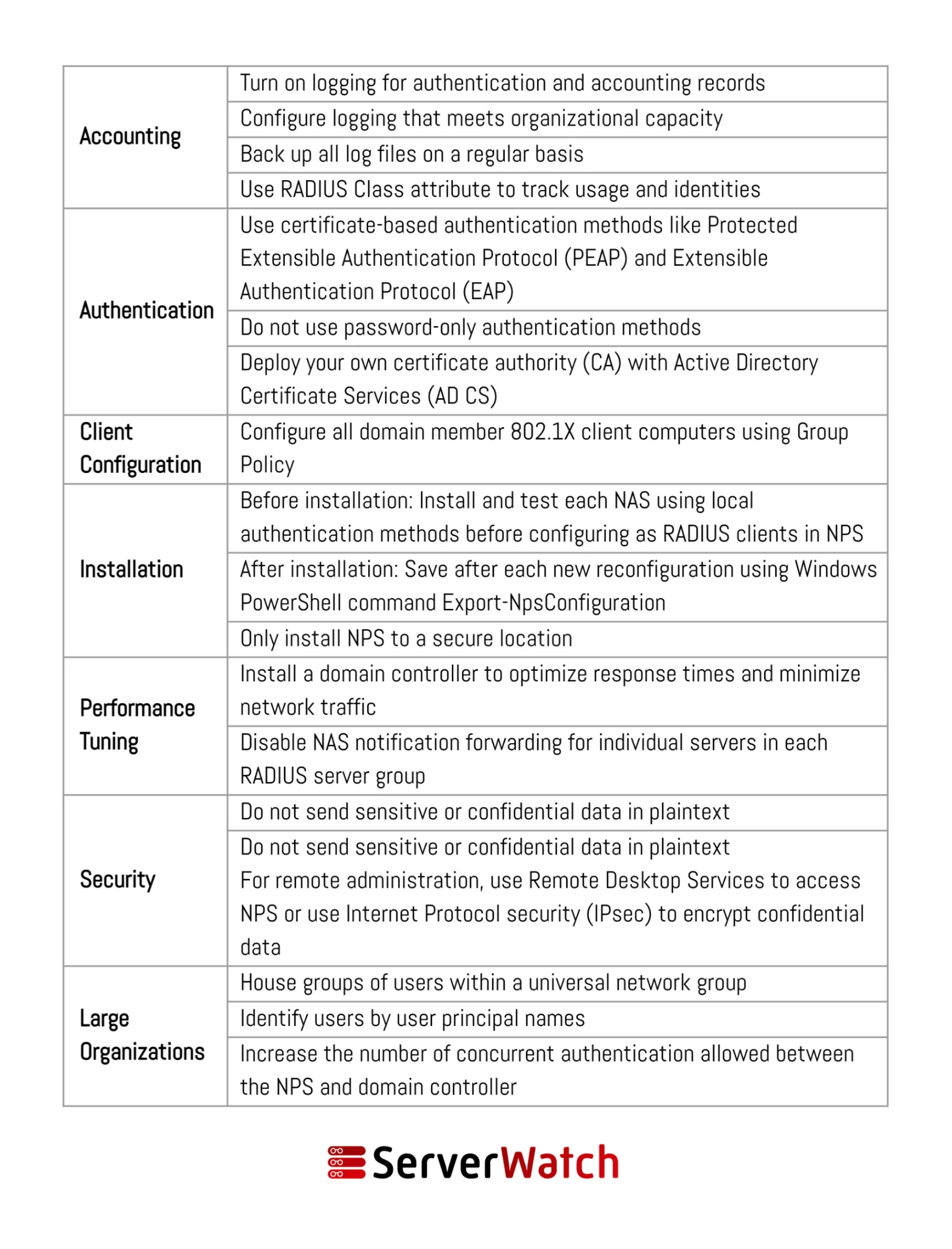
Deploying a Network Policy Server requires adherence to strict server management and cybersecurity best practices to prevent the authentication infrastructure from becoming a single point of failure or an attractive target for threat actors. Microsoft and industry security frameworks recommend several vital protocols for hardening NPS deployments:
-
Redundancy and High Availability: Because an offline NPS instance can effectively halt all network access for incoming users and devices, organizations must deploy at least two NPS servers in a primary and secondary configuration. Both servers should synchronize their network policies and maintain identical configurations to ensure seamless failover capabilities.
-
Shared Secret Security: RADIUS relies on shared secrets to encrypt packet identifiers between the RADIUS client (such as a wireless access point) and the NPS server. Administrators must utilize complex, randomly generated shared secrets of significant length and rotate them on a scheduled basis to mitigate the risk of brute-force and sniffing attacks.
-
Restricting RADIUS Clients: NPS administrators should explicitly define the IP addresses or subnets of authorized RADIUS clients within the NPS console. Permitting dynamic or unverified clients to communicate with the NPS server exposes the infrastructure to unauthorized relay attempts.
-
Comprehensive Log Management and Monitoring: While NPS accounting logs are vital, audit logging for NPS operational events must also be enabled and forwarded to a centralized Security Information and Event Management (SIEM) platform. Real-time alerting should be configured to detect anomalies, such as a sudden surge in authentication failures, which may indicate a credential-stuffing attack or an active breach attempt.
-
Regular Certificate Lifecycle Management: When utilizing EAP-TLS or PEAP for secure wireless and VPN authentication, the underlying Public Key Infrastructure (PKI) issuing certificates to the NPS servers must be meticulously managed. Expired or compromised server certificates will immediately disrupt enterprise-wide authentication, underscoring the necessity of automated certificate renewal and monitoring protocols.
Implications for Modern Network Infrastructure
The integration of Microsoft Network Policy Server into an enterprise architecture represents a mature, cost-effective approach to mastering network access control without necessitating the immediate adoption of expensive third-party identity solutions. By leveraging built-in operating system capabilities alongside robust directory services, IT organizations can establish an unyielding security perimeter that adapts to the complexities of modern hybrid work models.
As cyber threats continue to grow in frequency and sophistication, the imperative for comprehensive authentication, authorization, and accounting will only intensify. Organizations that proactively invest in hardening their NPS infrastructure, standardizing their network policies, and continuously auditing their access logs will remain exceptionally well-positioned to protect sensitive corporate assets, maintain regulatory compliance, and ensure uninterrupted business operations in an increasingly interconnected world.
