

The modern enterprise perimeter is no longer defined by physical office walls, but by the strength of its digital identity and access management controls. As remote workforces expand, cloud migrations accelerate, and cyber threats grow increasingly sophisticated, organizations face unprecedented pressure to secure their network infrastructure. At the center of this security paradigm is the Network Policy Server (NPS), Microsoft’s robust implementation of the Remote Authentication Dial-In User Service (RADIUS) protocol. By centralizing Authentication, Authorization, and Accounting (AAA), NPS empowers network administrators to enforce rigorous security policies, govern user access, and maintain compliance across complex hybrid infrastructures.
The Evolution of Network Security and Policy Management
To fully appreciate the role of Network Policy Server within enterprise architectures, one must examine the broader historical context of network security. Over the past three decades, the transition from isolated local area networks to highly interconnected, cloud-enabled environments has radically altered the threat landscape. Historically, perimeter defense relied heavily on static firewalls and physical port security. However, the proliferation of BYOD (Bring Your Own Device) policies, IoT deployments, and distributed workforces rendered traditional perimeter defenses insufficient.
In response to these evolving threats, the networking industry recognized the necessity of dynamic, policy-based access control. Organizations could no longer assume that a device connected to an internal Ethernet jack or Wi-Fi network was inherently trustworthy. This realization catalyzed the widespread adoption of AAA frameworks, ensuring that every connection attempt is rigorously vetted, rights-restricted, and continuously audited. Effective policy management ensures that a compromised endpoint or a stray set of credentials cannot serve as an open gateway to mission-critical corporate databases.
Deconstructing the RADIUS Protocol: The Foundation of AAA
The architectural foundation of Microsoft’s NPS rests upon the RADIUS protocol, an industry-standard networking protocol formally established in the early 1990s. Initially designed to manage dial-up access for Internet Service Providers, RADIUS has evolved into a cornerstone of enterprise network access control. Operating on a client-server model, the protocol decouples the network access server (such as a Virtual Private Network gateway, wireless access point, or switch) from the centralized database containing user credentials and access policies.
The core mechanism of RADIUS is defined by the AAA triad: Authentication, Authorization, and Accounting.
Authentication represents the initial verification phase. When a user or device attempts to interface with a secured network segment, the network access server intercepts the request and forwards the provided credentials—such as usernames, passwords, digital certificates, or multi-factor authentication tokens—to the RADIUS server. The RADIUS server queries its integrated directory services, typically Active Directory, to confirm the validity of the identity.
Once identity is established, the authorization phase begins. Authorization dictates the granular privileges and boundaries assigned to the authenticated entity. For instance, a systems administrator connecting from an authenticated corporate laptop may receive full access to core server clusters, whereas a visiting contractor utilizing a guest wireless network will be restricted strictly to external internet routing. RADIUS processes these rules dynamically, returning attribute-value pairs to the network access server that instruct the hardware on how to handle the session.
Finally, the accounting component records telemetry regarding network utilization. RADIUS accounting logs the exact timestamp of connection initiation, session duration, data volume transferred, and session termination reasons. In contemporary IT environments, this accounting data is vital for billing allocations, usage auditing, and forensic investigations following security incidents.
The Architectural Purpose and Core Roles of Network Policy Server
Within the Windows Server ecosystem, Network Policy Server serves as the direct realization of RADIUS functionality, combining server and proxy capabilities into a singular, highly scalable management tool. Organizations deploy NPS to streamline disparate authentication mechanisms into a unified control plane, reducing administrative overhead while simultaneously bolstering structural security.
NPS fulfills three distinct operational roles within an enterprise network architecture: functioning as a RADIUS server, a RADIUS proxy, and a dedicated network policy server.
When operating as a RADIUS server, NPS directly evaluates and processes authentication and authorization requests. It interfaces seamlessly with diverse network access servers—including remote access gateways, VPN endpoints, and 802.1X-enabled wireless controllers—providing a centralized repository for access rules. This centralization eliminates the administrative nightmare of configuring security policies individually on hundreds of disparate networking devices.

In scenarios involving large-scale, multi-site, or segmented corporate networks, NPS can be deployed as a RADIUS proxy. In this capacity, the server receives connection requests and intelligently forwards them to other internal or external RADIUS servers based on pre-configured realm-based routing tables. This role facilitates robust load balancing across multiple server instances and establishes automatic failover mechanisms, ensuring high availability and business continuity even during sudden hardware failures or heavy authentication surges.
As a network policy server, NPS provides administrators with granular control over connection requests through the creation of explicit network policies and connection request policies. These policies evaluate multiple contextual conditions before granting access. Administrators can restrict network entry based on time-of-day constraints, specific Active Directory group memberships, the cryptographic strength of authentication methods (such as PEAP-MSCHAPv2 or EAP-TLS), and device health compliance metrics.
Integration with Network Access Protection and Device Health Compliance
A critical dimension of modern NPS deployment is its historical and ongoing integration with device health verification systems, such as Network Access Protection (NAP). In an era where endpoint compromise represents one of the primary vectors for corporate data breaches, verifying user identity alone is no longer sufficient. Security teams must also verify the hygienic state of the connecting machine.
Through integrated health policies, NPS can evaluate whether a connecting endpoint meets enterprise security baselines prior to granting access. This includes checking whether antivirus definitions are up to date, operating system patches are current, and mandatory disk encryption is active. If a device fails these health checks, NPS can dynamically quarantine the machine, routing it to a remediation VLAN where the necessary updates can be applied without exposing the broader production network to potential malware or vulnerabilities.
Strategic Benefits of Implementing NPS in Enterprise Environments
The integration of Network Policy Server yields measurable improvements across operational efficiency, security posture, and regulatory compliance. By centralizing policy enforcement, organizations eliminate policy drift—a common vulnerability where individual network administrators apply inconsistent security rules across different access points.
Furthermore, NPS significantly simplifies auditing and reporting workflows. Regulatory frameworks such as the Health Insurance Portability and Accountability Act (HIPAA), the Payment Card Industry Data Security Standard (PCI-DSS), and the European Union’s General Data Protection Regulation (GDPR) mandate strict access controls and comprehensive logging of data interactions. The accounting logs generated by NPS provide compliance officers with the immutable audit trails required to demonstrate adherence to these stringent regulatory mandates.
From a scalability standpoint, NPS leverages the existing Active Directory infrastructure of Windows Server environments. This integration allows organizations to utilize established user stores and group structures without requiring the deployment of proprietary, third-party directory systems for network access control.
Best Practices for Managing and Securing Network Policy Server Deployments
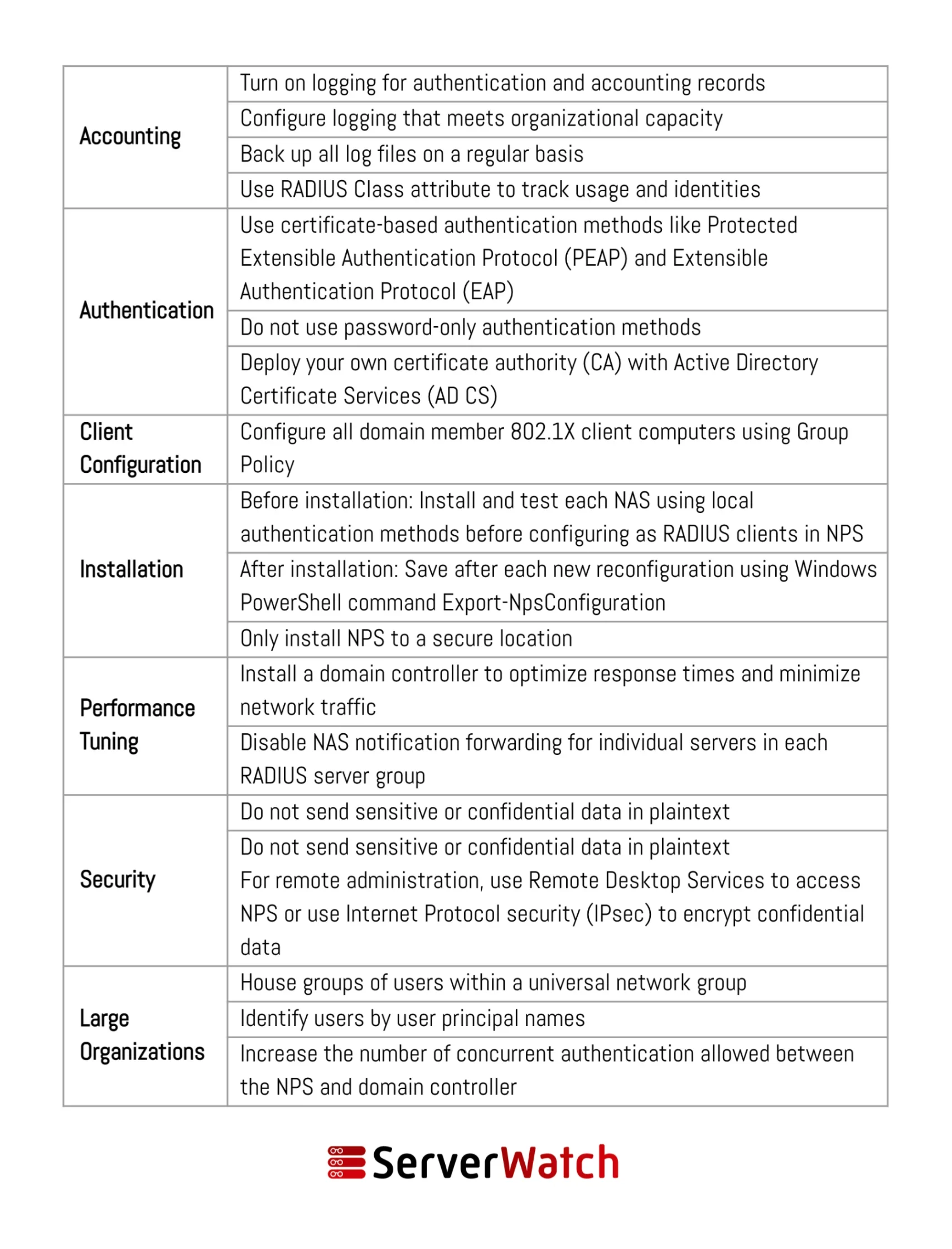
To ensure that an NPS deployment remains resilient against sophisticated cyber attacks, IT and security administrators must adhere to rigorous management and hardening best practices. Because NPS handles sensitive credential validation traffic and processes cryptographic keys, it represents a high-value target for malicious actors attempting lateral movement within a corporate network.
Industry experts and enterprise architecture guidelines recommend several key strategies for maintaining a secure NPS environment:
- Secure RADIUS Client Configuration: Network access servers must be meticulously registered as RADIUS clients using strong, high-entropy shared secrets. Weak shared secrets leave the authentication channel vulnerable to brute-force attacks and packet sniffing.
- Implementation of Cryptographic Best Practices: Administrators should mandate advanced Extensible Authentication Protocol (EAP) types, such as EAP-TLS or PEAP with strong inner methods, while deprecating legacy, insecure protocols like MS-CHAPv1 or PAP that transmit credentials with weaker cryptographic protections.
- Network Segmentation and Firewall Hardening: NPS servers should be isolated within secure management segments. Firewalls must be explicitly configured to restrict UDP ports 1812 (RADIUS Authentication) and 1813 (RADIUS Accounting) exclusively to authorized network access clients.
- Redundancy and Failover Planning: Given the critical nature of authentication services, organizations must deploy secondary and tertiary NPS nodes configured identically to primary servers, ensuring uninterrupted network access during maintenance cycles or unexpected outages.
- Continuous Log Monitoring and Analysis: Organizations should integrate NPS event logs and accounting outputs with Security Information and Event Management (SIEM) platforms. Real-time analysis of failed authentication spikes can provide early warning indicators of credential stuffing or brute-force attacks against the enterprise perimeter.
Implications for Modern Network Administration
The enduring relevance of Network Policy Server underscores a fundamental truth of enterprise IT: while technologies and perimeters evolve, the core necessity for centralized, verifiable, and policy-driven access control remains absolute. As organizations navigate the complexities of hybrid cloud architectures, zero-trust security models, and increasingly stringent regulatory environments, tools that consolidate identity and policy management will continue to serve as the bedrock of enterprise defense.
By deploying NPS according to established cryptographic and architectural best practices, network administrators can successfully balance the operational demand for seamless connectivity with the imperative of uncompromising security. Properly maintained, NPS transforms network access from an administrative vulnerability into a dynamic, intelligent security control plane capable of safeguarding modern digital assets against the threats of tomorrow.
