
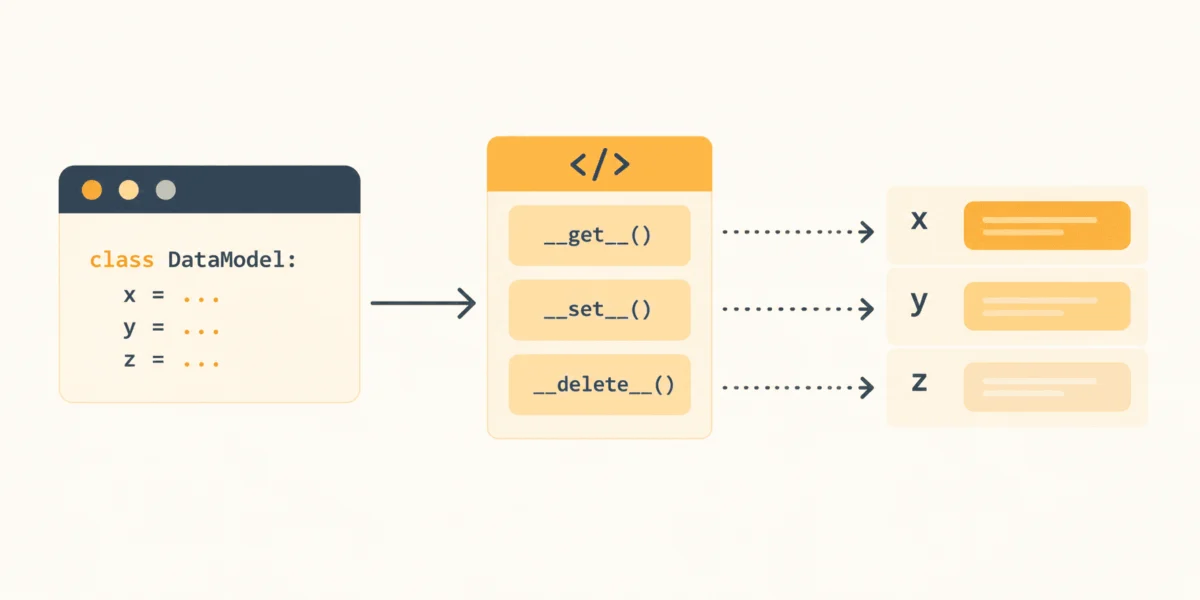

Python descriptors represent a cornerstone of the language’s internal architecture, providing a sophisticated mechanism to intercept and customize attribute access. While developers often rely on standard techniques like @property decorators to manage getters and setters, descriptors offer a more powerful, reusable, and scalable approach to data management. By implementing the descriptor protocol—specifically the __get__, __set__, and __delete__ methods—programmers can centralize complex logic, reduce code redundancy, and ensure strict data integrity across large-scale software systems. This article explores the mechanics of descriptors and demonstrates their practical application in constructing validated, computed, and lazily loaded attributes through the lens of a simulated Japan tourism data management system.
The Evolution and Mechanics of the Descriptor Protocol
The history of the descriptor protocol is deeply intertwined with the development of Python’s object-oriented capabilities. Introduced to allow developers to define how attributes behave at the class level, descriptors became increasingly refined with the release of Python 3.6, which introduced the __set_name__ method. This addition solved a long-standing issue regarding name collisions, allowing descriptors to automatically capture the name of the attribute they are assigned to.
A descriptor is, fundamentally, a class that acts as a gatekeeper for another class’s attributes. When an object accesses an attribute managed by a descriptor, the Python interpreter delegates the operation to the descriptor’s methods rather than performing a standard dictionary lookup. This protocol serves as the engine behind many of the features developers use daily, including @classmethod, @staticmethod, and the built-in property object. Understanding this low-level interaction is essential for engineers building frameworks, configuration systems, or data-intensive applications where attribute state must be strictly governed.
Implementing Validated Attributes for Data Integrity
Data integrity remains a primary concern in software engineering, particularly when dealing with user-provided inputs or external APIs. Traditional validation often involves repetitive if-else blocks or boilerplate setter methods, which clutter class definitions and increase the surface area for bugs. Descriptors allow for a "define-once, use-many" approach to validation.
Consider the requirements of a tourism management application where a rating system must be constrained to a scale of 1.0 to 5.0. By creating a ValidatedRating descriptor, developers can encapsulate the logic for type-checking and range-validation within a single class.
class ValidatedRating:
    def __init__(self, min_val=1.0, max_val=5.0):
        self.min_val = min_val
        self.max_val = max_val

    def __set_name__(self, owner, name):
        self.public_name = name
        self.private_name = f"_name"

    def __get__(self, obj, objtype=None):
        if obj is None:
            return self
        return getattr(obj, self.private_name)

    def __set__(self, obj, value):
        if not isinstance(value, (int, float)):
            raise TypeError(f"self.public_name must be a number.")
        if not (self.min_val <= value <= self.max_val):
            raise ValueError(f"self.public_name must be between self.min_val and self.max_val.")
        setattr(obj, self.private_name, float(value))
The implications of this approach are significant. By centralizing the validation logic, any class using ValidatedRating inherits consistent behavior. If the business logic for ratings changes—for instance, expanding the scale to 10.0—the update occurs in one location, ensuring global compliance across the application.
Dynamic Computations via Computed Attributes
Modern applications frequently require data that is derived from existing states rather than stored explicitly. In a globalized economy, currency conversion is a prime example of a "computed attribute." Storing both the original Japanese Yen (JPY) price and the converted USD price creates a risk of data drift, where one value is updated without the other.
A descriptor can bridge this gap by calculating the USD price on demand. By overriding the __get__ method, the ComputedUSDPrice descriptor ensures that whenever the attribute is accessed, it performs the conversion using the most current exchange rate stored in the parent object.
class ComputedUSDPrice:
    def __init__(self, exchange_rate=0.0067):
        self.exchange_rate = exchange_rate

    def __set_name__(self, owner, name):
        self.name = name

    def __get__(self, obj, objtype=None):
        if obj is None:
            return self
        jpy_price = getattr(obj, 'price_jpy', 0)
        return round(jpy_price * self.exchange_rate, 2)

    def __set__(self, obj, value):
        raise AttributeError(f"self.name is a computed read-only attribute.")
This pattern effectively enforces an immutable interface for derived data. Because the __set__ method raises an AttributeError, it prevents developers from inadvertently overwriting calculated values, maintaining a single source of truth for financial data.
Enhancing Performance with Lazy Loading
The demand for high-performance applications often hinges on how efficiently they handle expensive resources. Operations such as fetching itineraries from a remote database, parsing massive JSON files, or initializing complex graphical assets can significantly degrade startup times if performed eagerly.
Lazy loading, or call-by-need, allows an application to defer these expensive operations until the exact moment the data is requested. The LazyItinerary descriptor achieves this by performing the "heavy lifting" only during the first access. Once computed, the result is cached directly into the object’s __dict__, bypassing the descriptor logic for all subsequent requests.
import time

class LazyItinerary:
    def __set_name__(self, owner, name):
        self.name = name

    def __get__(self, obj, objtype=None):
        if obj is None:
            return self
        # Simulating expensive network/database latency
        print(f"[System] Querying database for obj.destination...")
        time.sleep(1)
        itinerary = f"Itinerary for obj.destination: Guided tour and Shinkansen travel."
        obj.__dict__[self.name] = itinerary
        return itinerary
This pattern has profound implications for memory management and network utilization. By preventing unnecessary data fetches, developers can optimize the resource footprint of large objects, ensuring that the application remains responsive even when handling complex, data-rich entities.
Integration and Broader Implications
When these descriptors are integrated into a central management class, such as JapanTour, the resulting code is both cleaner and more maintainable. The class definition serves as a declarative blueprint, where descriptors clearly define the behavior of each attribute without hiding the logic inside complex __init__ or property blocks.
class JapanTour:
    rating = ValidatedRating(1.0, 5.0)
    price_usd = ComputedUSDPrice()
    itinerary = LazyItinerary()

    def __init__(self, destination, price_jpy, rating):
        self.destination = destination
        self.price_jpy = price_jpy
        self.rating = rating
The use of descriptors represents a shift toward a more declarative programming style in Python. By treating attribute access as a first-class citizen, developers can move away from manual state management and toward systems that are self-regulating and robust.
Industry Analysis and Future Outlook
The broader impact of mastering descriptors cannot be overstated. In complex systems, such as Object-Relational Mappers (ORMs) like SQLAlchemy or the Django ORM, descriptors are the invisible infrastructure that allows for seamless database interaction. When a developer accesses user.name, they are interacting with a descriptor that handles database queries, type coercion, and change tracking.
For the modern Python engineer, proficiency with the descriptor protocol is a benchmark of advanced competency. As applications grow in scale, the need for clean, modular, and performant code becomes paramount. Descriptors provide the necessary tools to build abstractions that are not only powerful but also intuitive to use.
While some critics argue that descriptors introduce a layer of "magic" that can be difficult to debug, this is largely mitigated by well-documented code and a clear understanding of the protocol. When used judiciously, descriptors eliminate the "spaghetti code" often found in large-scale property management, offering a structured and elegant solution to one of the most common challenges in object-oriented programming: controlling how data is read, written, and generated.
In conclusion, the transition from basic property usage to advanced descriptor implementation marks a maturation in a developer’s ability to influence the language’s execution model. Whether it is ensuring data accuracy through validation, maintaining consistency through computation, or optimizing performance through lazy loading, descriptors provide the flexibility required to build professional-grade software in Python. By internalizing these concepts, developers can produce code that is not only functional but resilient, scalable, and built to withstand the rigors of modern enterprise requirements.
