
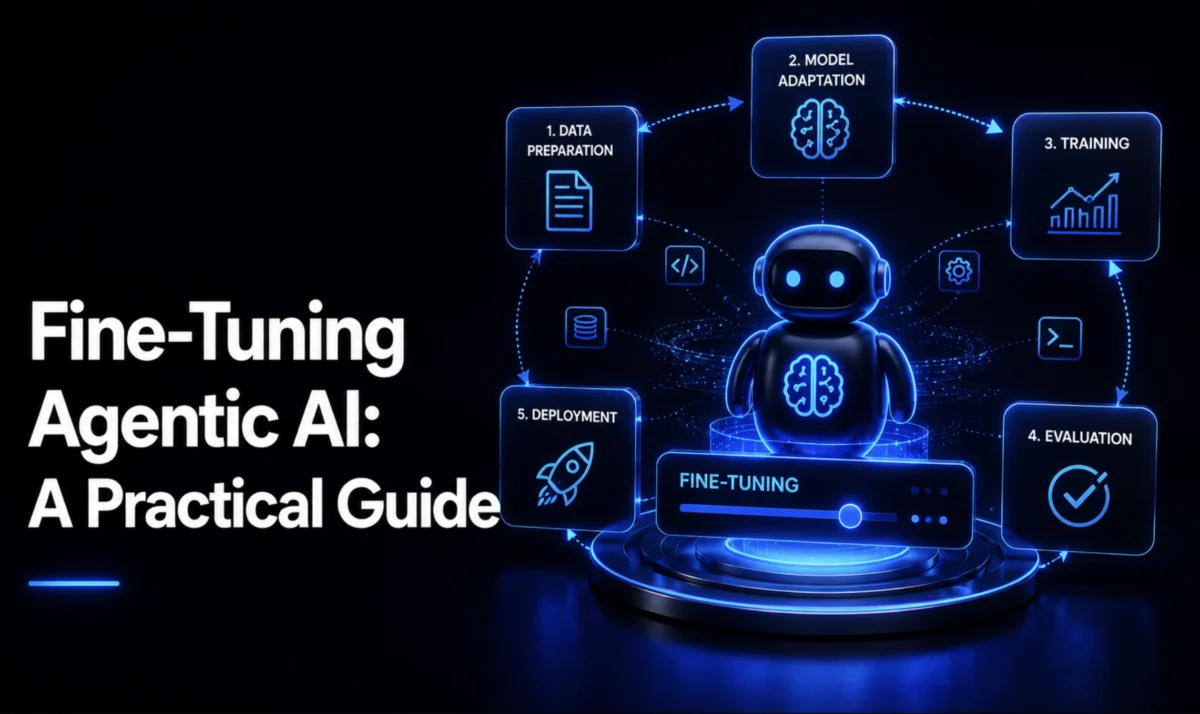

In the rapidly evolving landscape of artificial intelligence, the transition from conversational chatbots to autonomous agentic systems has shifted the focus of developers from mere language fluency to functional reliability. Agentic AI, characterized by its capacity to utilize external tools—such as database lookups, API interactions, and human-in-the-loop escalations—demands a rigorous, multi-dimensional approach to model optimization. Industry practitioners have increasingly recognized that fine-tuning is not a singular event but a complex integration of four distinct levers: training data quality, parameter-efficient fine-tuning (PEFT), runtime hyperparameter management, and preference alignment. When these elements are addressed in isolation, agents frequently suffer from "brittle" behavior, manifesting as hallucinations in tool-call syntax or catastrophic forgetting of core language capabilities.
The Evolution of Agentic Fine-Tuning
The shift toward agentic frameworks, which gained significant momentum throughout 2025 and 2026, stems from the limitations of prompting alone. While frontier large language models (LLMs) are adept at instruction following, they often struggle with the rigid output schemas required for reliable tool invocation. Historical data from deployment logs in enterprise environments suggests that approximately 65% of production failures in agentic workflows originate from malformed JSON outputs or improper argument passing—issues that general instruction tuning rarely addresses.
The current standard for addressing these failures involves a holistic methodology. Rather than focusing solely on the "training" phase, organizations are now adopting a systems-engineering perspective. This approach treats the agent as a pipeline where the base model, the fine-tuning adapter, the runtime configuration, and the feedback loop work in concert.
Constructing High-Precision Datasets
The foundation of a reliable agent is the training dataset. Unlike traditional generative tasks where linguistic nuance is paramount, tool-calling requires structural precision. Developers are finding that volume is secondary to format fidelity. A dataset of 200 meticulously curated, schema-compliant examples often outperforms 5,000 loosely formatted interactions.
Modern validation protocols now include mandatory schema-checking before training commences. By programmatically verifying that every assistant turn conforms to the required JSON structure—and that all mandatory function arguments are present—developers prevent "training-in" errors. This preprocessing step effectively eliminates the risk of teaching a model to hallucinate non-existent tool names or omit critical parameters, a common pitfall that previously led to high latency in production due to necessary post-hoc error correction.
Parameter-Efficient Fine-Tuning (PEFT) with QLoRA
As models scale toward the 70B parameter range, full fine-tuning becomes computationally prohibitive for most organizations. The adoption of Quantized Low-Rank Adaptation (QLoRA) has become the industry standard for democratizing access to high-performance agents. By freezing the base model in 4-bit precision and training only a small set of low-rank adapter matrices, engineers can achieve significant behavioral shifts while consuming a fraction of the memory footprint.
Current research indicates that configuring the adapter rank (r) and alpha (scaling factor) is the most critical optimization decision. A configuration of r=4 and alpha=32 has emerged as a baseline for tool-calling agents, balancing the need for model expressivity with the risk of overfitting. When implemented correctly, these adapters account for less than 2% of total model parameters, ensuring that the model retains its foundational reasoning capabilities while gaining specialized competence in internal tool execution.
The Role of Runtime Hyperparameters
A common oversight in AI deployment is the assumption that fine-tuning alone guarantees production stability. However, inference-time configurations—specifically temperature, retry logic, and iteration limits—are just as influential as the weights themselves.
Data from controlled experiments demonstrates that agentic systems operating at higher temperatures (e.g., 0.7 to 1.0) often exhibit creative flair but suffer from increased function-calling instability. Conversely, forcing a temperature of 0.0 can sometimes stifle the model’s ability to handle ambiguous user queries. The optimal solution identified by leading AI infrastructure teams involves a hybrid approach: maintaining a moderate temperature for task analysis while implementing a "deterministic fallback" policy. In this setup, if an agent fails to execute a valid tool call, the system automatically initiates a retry at a lower, more rigid temperature. This simple runtime adjustment has been observed to improve overall task success rates by up to 15% without the need for additional retraining.
Preference Alignment and DPO
While Supervised Fine-Tuning (SFT) can teach a model how to call a tool, it cannot inherently teach a model when to choose one tool over another in a nuanced situation. This is where Direct Preference Optimization (DPO) has fundamentally changed the development lifecycle. DPO allows developers to present the model with pairs of responses: a "chosen" response and a "rejected" one.
This distinction is vital for complex triage tasks. For example, a customer support agent might technically be capable of issuing a refund, but if the request is high-value or ambiguous, the "correct" action is to escalate to a human. SFT struggles to capture this hierarchy of judgment, as it views all valid outputs as equally correct. DPO provides the mathematical framework to penalize plausible but suboptimal choices, effectively aligning the agent’s decision-making process with business policy and safety guidelines.
Evaluation and the "Ship/Hold" Threshold
The final and most rigorous stage of the lifecycle is evaluation. The industry is moving away from subjective "vibes-based" testing toward quantifiable verdict functions. These functions monitor two primary metrics: the improvement in tool-call accuracy and the stability of general capability.
The primary risk here is "catastrophic forgetting," where the agent becomes so specialized in tool-calling that it loses its ability to communicate effectively or reason through general logic. A robust evaluation pipeline must automatically compare the fine-tuned model against benchmarks like MMLU or GSM8K alongside the specific tool-calling test set.
Industry leaders now implement automated "Ship/Hold" gates. If the gain in tool-calling accuracy is offset by a drop in general reasoning capabilities beyond a predefined threshold (typically 3%), the build is automatically rejected. This objective, data-driven approach removes the ambiguity from deployment decisions, ensuring that only models that pass both functional and safety criteria reach the end user.
Broader Implications and Future Outlook
The transition to this holistic, four-dial approach reflects the maturation of the AI industry. As agents move from experimental sandboxes into critical enterprise workflows, the standard of care for their development is rising. By integrating data validation, efficient parameter updates, runtime tuning, and preference alignment, organizations are building agents that are not only functional but also predictable and maintainable.
As we look toward the remainder of the decade, the focus will likely shift further toward automated evaluation and self-correcting agents. However, the core principle remains: an agent is only as reliable as the weakest link in its development chain. Whether it is a support-ticket triage agent or a complex code-generation assistant, the commitment to rigorous, systemic fine-tuning will continue to be the primary differentiator between successful production deployments and those that collapse under real-world traffic. The methodology described herein serves as a blueprint for developers tasked with building the next generation of reliable, autonomous digital workers.
