

Voice interfaces have transitioned from the periphery of consumer technology to the center of the artificial intelligence revolution. As businesses scramble to integrate sophisticated, human-like interaction into customer service, healthcare diagnostics, and smart infrastructure, the industry is witnessing a shift from static text-based LLMs to dynamic, low-latency voice agents. This evolution represents a fundamental change in how humans interact with machines, demanding a rigorous, multi-disciplinary approach to engineering, design, and deployment.
The Evolution of Conversational AI
The lineage of modern voice agents can be traced back to the mid-20th century with early speech synthesis experiments like Bell Labs’ Voder. However, the contemporary landscape was shaped by the 2010s explosion of virtual assistants like Apple’s Siri and Amazon’s Alexa. While these early iterations relied on rigid, command-based decision trees, current voice agents utilize large language models (LLMs) to facilitate fluid, open-ended conversations.
The transition from text to voice is not merely a change in medium; it is a profound engineering shift. While a text-based AI can process information at a variable pace, a voice agent operates under the strict, unforgiving constraints of real-time communication. Industry benchmarks suggest that for a conversation to feel natural, the total round-trip time (RTT)—the duration from when a user finishes speaking to when the agent begins its response—must remain under 600 to 800 milliseconds. Any latency exceeding 1,000 milliseconds is typically perceived by users as a technical failure, leading to a breakdown in trust and engagement.
The Anatomy of a Voice Pipeline
A modern voice agent functions as a tripartite system, integrating three distinct technological pillars that must operate in near-perfect synchronization:
- Automatic Speech Recognition (ASR/STT): This initial layer captures acoustic signals and converts them into high-fidelity text. The efficacy of this stage is governed by the Word Error Rate (WER), a metric that tracks inaccuracies in transcription. Modern systems now utilize transformer-based models that adapt to regional accents and background noise, which historically served as primary failure points.
- The Reasoning Engine: At the core lies the LLM, which processes the transcribed text. Unlike text-based agents, this layer must be optimized for "conversational brevity." The engine must decide not only what to say but how to structure its output to be digestible when heard rather than read.
- Text-to-Speech (TTS) Synthesis: The final stage converts the LLM’s text into natural-sounding audio. Recent advancements in neural vocoders have allowed for the replication of human-like prosody, pacing, and emotional inflection, which are critical for maintaining user engagement.
Strategic Roadmap for Development
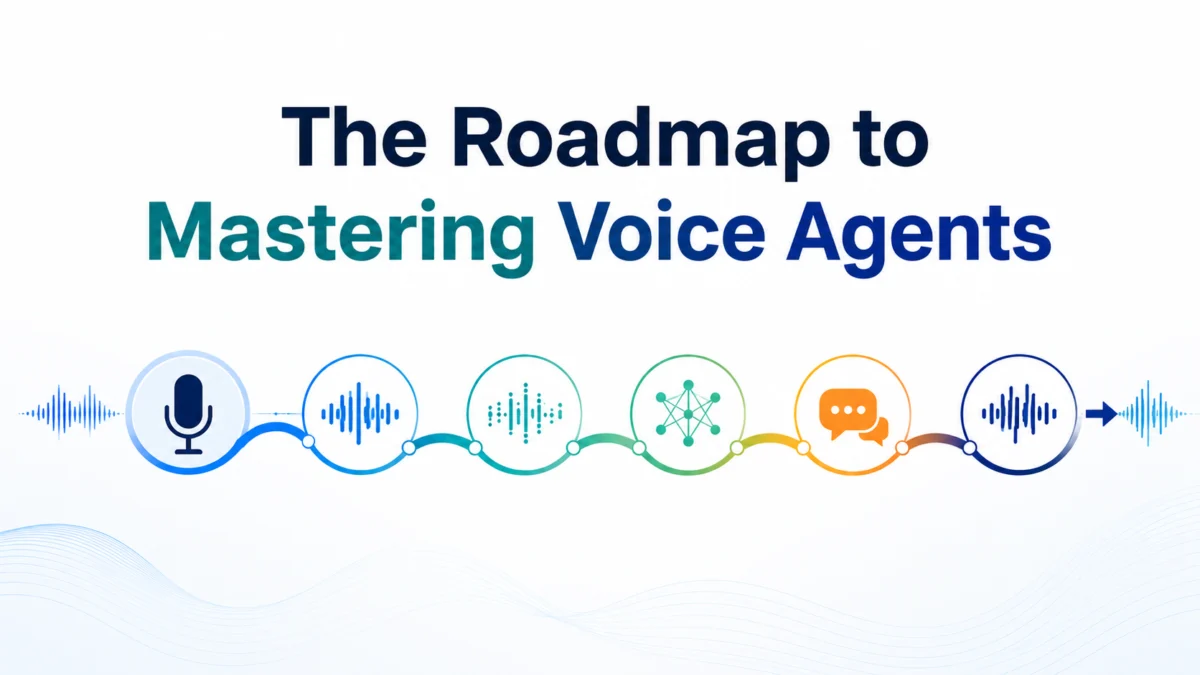
For organizations and developers looking to master this stack, a structured, seven-stage progression is essential to mitigate the compounding risks of the pipeline.
Phase I: The Architectural Foundation
Engineers must first master the data flow. This involves understanding audio encoding formats (e.g., Opus, G.711) and the mechanics of buffer management. A foundational understanding of how STT models manage audio segments is required to minimize the delay inherent in audio chunking.
Phase II: The Language Processing Layer
Unlike standard LLM applications, voice-specific prompt engineering requires a focus on "speech-readability." Developers must train models to avoid jargon, complex punctuation, and nested lists, which do not translate well to auditory formats.
Phase III: Streaming and Latency Optimization
This is the most significant technical hurdle. By implementing streaming architectures—where the TTS engine begins synthesizing the beginning of a sentence while the LLM is still generating the remainder—developers can reduce latency by up to 50%. This requires sophisticated orchestration to handle "interruptions" (barge-in), where the system must instantly abort the current audio output if the user speaks again.
Phase IV: Conversation Design and Linguistics
Technological success is insufficient if the user experience is jarring. Conversation design involves implementing "turn-taking" protocols, managing silence, and establishing a consistent persona. Research from human-computer interaction (HCI) studies indicates that users subconsciously evaluate voice agents based on social norms; therefore, the agent’s ability to use appropriate filler words or acknowledge interruptions is a key competitive advantage.
Phase V: Integration and Memory Architecture
Voice agents gain utility through external tool usage. By integrating Retrieval-Augmented Generation (RAG) and function-calling capabilities, an agent can pull real-time data from CRM systems or databases. Long-term memory, or the ability to maintain context across disparate sessions, allows for a personalized experience that distinguishes enterprise-grade systems from simple bots.
Phase VI: Production Deployment and Telephony
Transitioning to a production environment introduces telephony infrastructure (such as SIP or WebRTC). This stage requires rigorous monitoring of "task completion rates" rather than just accuracy. Continuous evaluation involves analyzing call logs to identify specific failure points in the STT-to-LLM handoff.
Phase VII: Advanced Specialization
The final stage involves optimizing for emotion detection and multilingual support. By analyzing the user’s acoustic features—such as pitch, speed, and energy—the agent can adapt its tone, potentially de-escalating frustrated customers or matching the enthusiasm of a user.
Market Implications and Future Outlook
The deployment of these agents is poised to reshape the labor and service economies. Market analysis from major consulting firms projects that voice-first customer service could reduce operational costs by up to 30% within the next five years. However, the adoption of this technology carries significant responsibilities. Data privacy, particularly regarding biometric voice data, and the potential for deep-fake voice impersonation have prompted calls for stricter regulatory oversight.
Industry experts note that we are reaching an inflection point. As inference costs for LLMs continue to decline and the accuracy of small, on-device models improves, the capability of voice agents will migrate from cloud-dependent servers to local hardware. This shift will likely lead to a proliferation of "ambient computing," where AI assistants are embedded in every household appliance and vehicle.
For the developer, the lesson is clear: the technical pipeline is merely the skeleton. The "soul" of the voice agent—the ability to converse, persuade, and resolve problems—lies in the synthesis of robust engineering and thoughtful, human-centric design. Those who master this holistic approach will define the next generation of human-machine interaction.
