
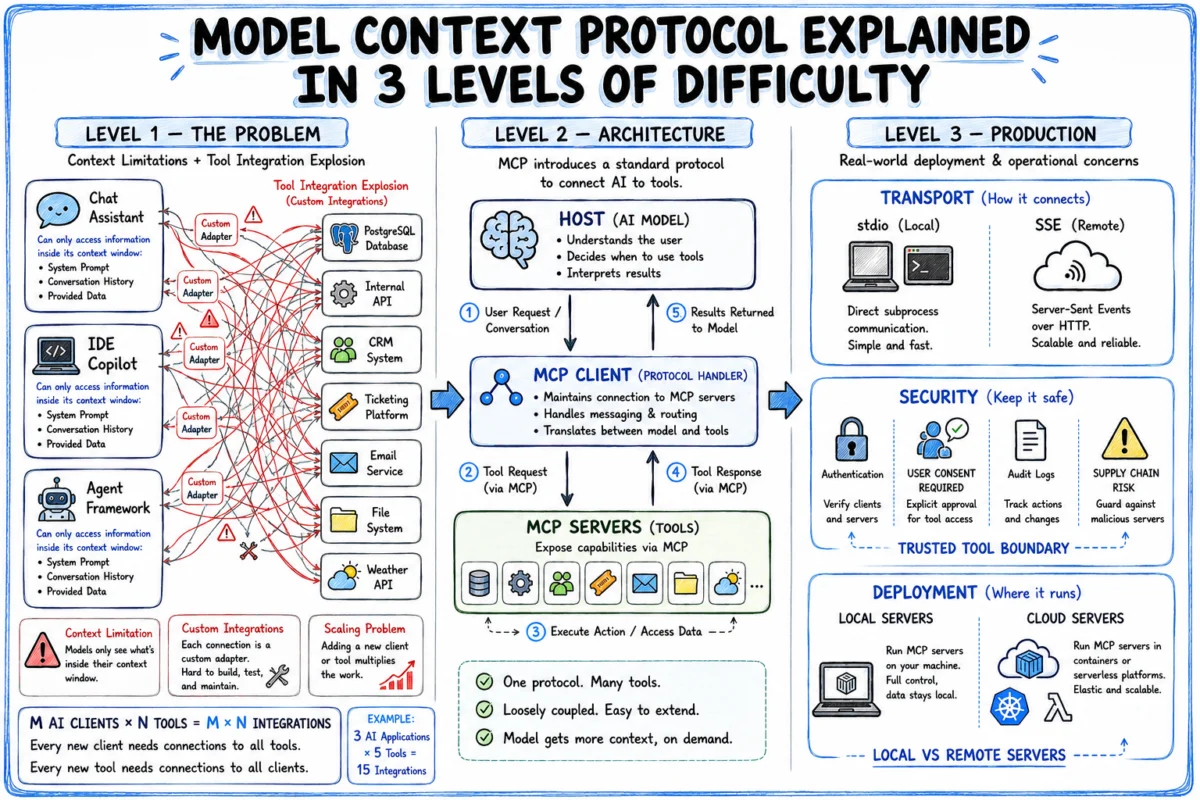

The Model Context Protocol (MCP) is emerging as a critical open standard designed to standardize how artificial intelligence applications, particularly large language models (LLMs), connect with external tools and data sources. Introduced by Anthropic, MCP directly addresses a fundamental limitation of AI models: their inherent knowledge cut-off at training time, which renders them incapable of interacting with real-time, proprietary, or dynamic external information without bespoke integrations. This standardization effort aims to streamline development, enhance security, and foster a more composable ecosystem for AI-powered applications.
The Integration Conundrum: Why a Standard Was Needed
The proliferation of sophisticated AI models has dramatically expanded the potential for intelligent automation and enhanced user experiences across various industries. However, a significant bottleneck has consistently plagued developers: the challenge of connecting these powerful, yet isolated, models to the real-world systems they need to operate within. An LLM, for instance, cannot inherently access a file on a user’s local machine, query a database for the latest sales figures, or draft an email based on recent communications without explicit instructions and a mechanism to bridge this data gap. When confronted with such requests, a model’s default behavior is often to halt or resort to generalized, potentially inaccurate, guesses.
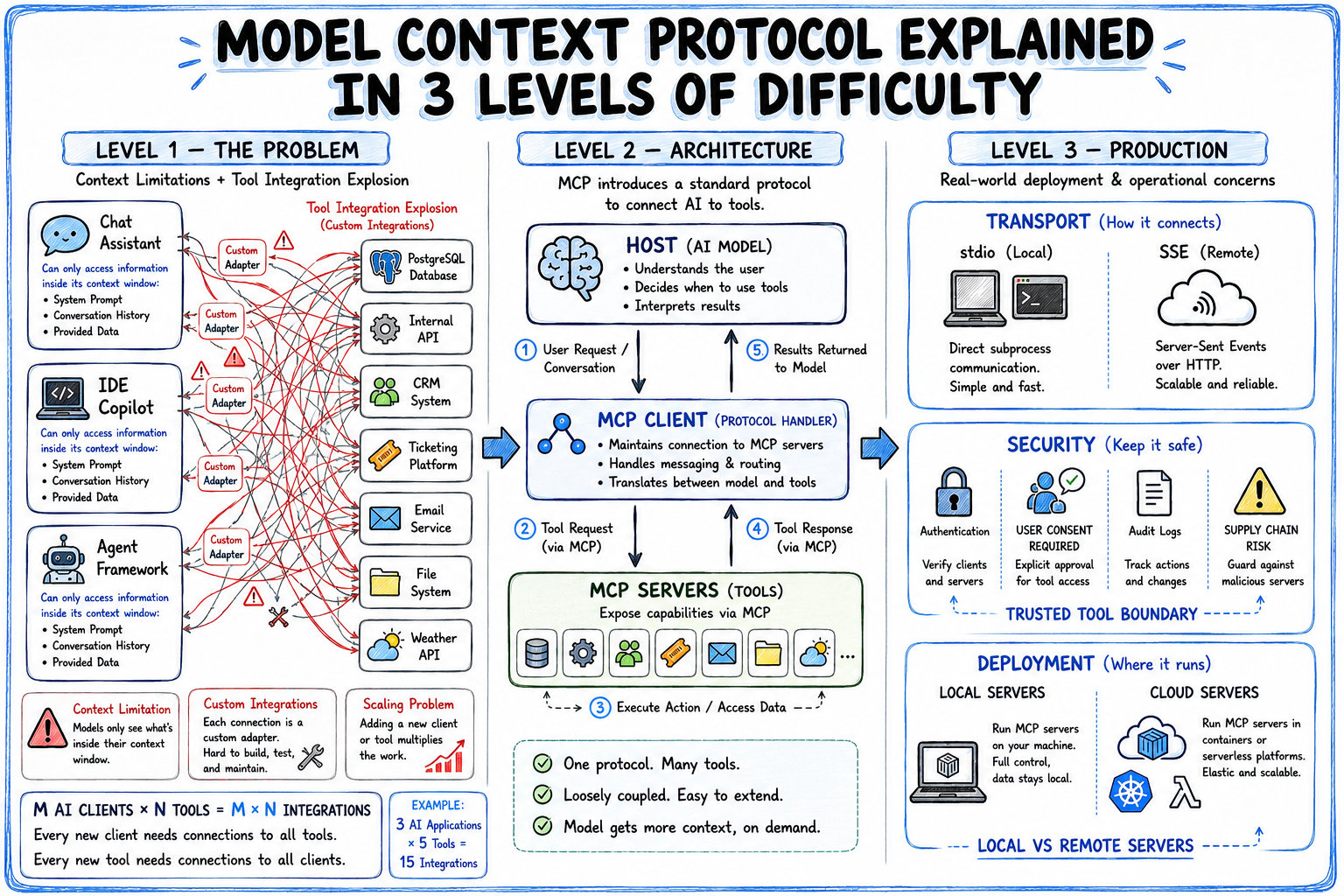
Historically, bridging this gap has fallen squarely on the shoulders of developers. The prevailing approach has been to write custom integrations – a collection of functions, API wrappers, and tool definitions – meticulously crafted to pipe external data into the model’s context window. While feasible for small-scale projects involving a single model and a handful of tools, this method quickly devolves into an unmanageable "matrix of one-off adapters" as the number of AI applications (M) and external services (N) grows. Each adapter comes with its own authentication logic, schema assumptions, and potential failure modes, leading to an integration complexity that scales as M × N. For a typical enterprise deploying, for example, five distinct AI applications that need to interact with ten different internal systems (databases, CRMs, ticketing systems, internal APIs), this translates to potentially fifty unique integrations that must be built, maintained, and secured. Adding a new AI application or a new external service necessitates reworking a substantial portion of this entire matrix, consuming significant development resources and introducing substantial technical debt. Industry reports indicate that enterprises spend upwards of 30-40% of their AI development budget on integration challenges, a figure MCP aims to drastically reduce.
Introducing the Model Context Protocol (MCP)
Recognizing this pervasive integration problem, Anthropic introduced the Model Context Protocol as an open standard to provide a cleaner, more efficient solution. Instead of each AI application individually building bespoke connectors for every external system, MCP proposes a shared protocol that both sides implement. An external service, such as a PostgreSQL database or a company’s internal API, exposes its capabilities as an MCP server once. Subsequently, any MCP-compatible client – whether it’s an AI assistant, an intelligent IDE, or a custom agent framework – can seamlessly interact with that server without requiring a custom integration for that specific client.
This paradigm shift effectively transforms the integration surface from M × N custom adapters into a more manageable M + N protocol implementations. Each AI client implements the MCP specification once, and each external tool implements it once. This architectural change drastically reduces development overhead, accelerates deployment cycles, and creates a more inherently composable AI ecosystem. An MCP server designed to interface with a Salesforce instance, for example, can be immediately utilized by multiple AI assistants, developer tools, and agent frameworks, fostering interoperability that was previously elusive.
Anatomy of an MCP Interaction: Host, Client, and Server
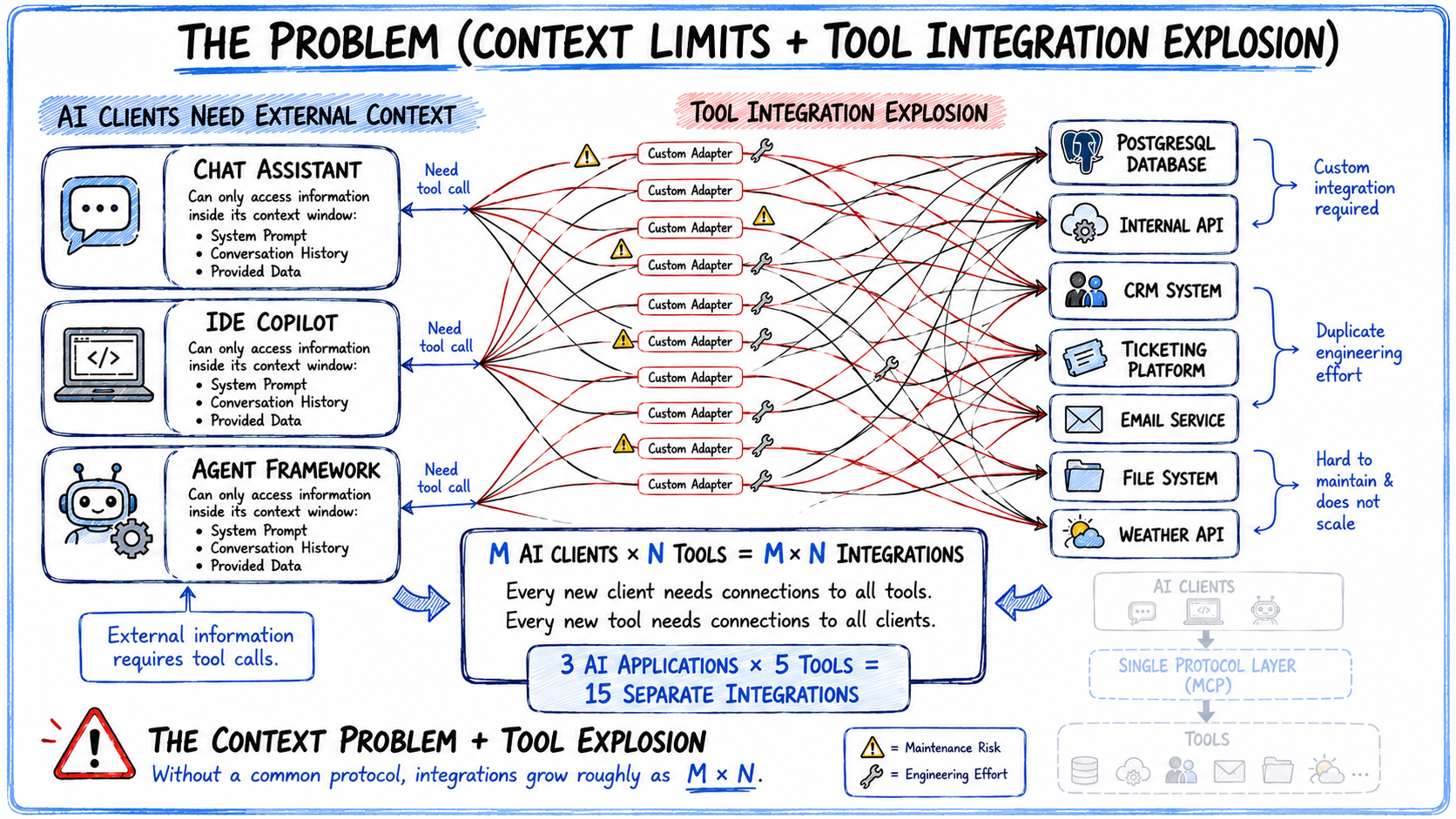
MCP interactions are structured around three core components: the host, the client, and the server, each playing a distinct role in facilitating communication between the AI model and external systems.
The Host: The host is the user-facing application that initiates and manages the interaction. This could manifest as a conversational AI interface, a sophisticated AI-powered integrated development environment (IDE), or a custom agent orchestrating complex workflows. It houses the large language model and drives the overall conversation or task execution. When the model determines that external information or action is required, the decision to reach out originates within the host.
The Client: Sitting within the host application, the MCP client is responsible for handling the intricate mechanics of the protocol. It maintains a dynamic registry of available MCP servers and their exposed capabilities. When the model articulates a need for external interaction, the client translates the model’s high-level request into a properly formatted MCP call, dispatches it to the appropriate server, and subsequently converts the server’s response back into a format that the model can readily interpret and utilize. From the AI model’s perspective, the client functions as an invisible layer of abstraction, handling all the underlying "plumbing" of external communication.
The Server: The MCP server acts as the dedicated bridge to a specific external system. It is responsible for registering its capabilities – detailing what tools it offers, what data resources it can provide, and any relevant prompts or instructions – with the client. When it receives a request from an MCP client, the server executes the necessary operations against its underlying external system. For instance, a server fronting a database would securely run a structured query requested by the client and return the results in a model-friendly format. Critically, the server encapsulates all the implementation details of that external system; the client and the AI model only interact with the standardized MCP interface, abstracting away system-specific complexities.
Consider a user instructing an AI assistant: "Retrieve the Q2 revenue numbers from the financial database and then draft a summary email for the executive team." The AI model, realizing it lacks direct access to this data and email functionality, formulates a plan. The MCP client, upon receiving this intent, consults its registry of available servers. It identifies a financial_database_query tool exposed by one MCP server and an email_drafting tool from another. The model first calls financial_database_query with parameters like "Q2 revenue" and "financial database." The database server executes the query, formats the results (e.g., as JSON), and sends them back to the model via the client. Armed with the actual revenue figures, the model then calls email_drafting, providing parameters such as recipient list, summary content, and subject line. The email server handles the composition and sending of the email, confirms successful delivery, and the model then informs the user that the task is complete. Throughout this entire sequence, neither server needed to know anything about the other, the model orchestrated the steps, and the developer was spared from writing any custom glue code between the AI and these two disparate systems.
MCP servers expose three distinct types of capabilities:
- Tools: These represent active operations that can modify an external system or trigger an action (e.g.,
create_ticket,send_email,update_record). Calling a tool typically involves a higher level of risk and requires robust authorization. - Resources: These are passive data retrieval operations that fetch information from an external system without causing any side effects (e.g.,
read_document,get_user_profile,list_files). Reading a resource is generally a lower-risk operation compared to calling a tool. - Prompts: These provide specific instructions or context to the AI model about how to interact with the server or interpret its capabilities.
The operational distinction between tools and resources is critical for security. It allows for the application of granular authorization policies, ensuring that an AI model or a specific user can read data from a resource but may require explicit consent or higher-level permissions to execute a write operation via a tool.
Under the Hood: Transport, Security, and Deployment Considerations
Beyond the architectural components, the practical implementation of MCP hinges on understanding its underlying communication mechanisms, robust security measures, and flexible deployment options. These factors determine the protocol’s reliability, safety, and scalability in real-world production environments.
How Client and Server Actually Talk: Communication Layers
MCP communication is conceptually divided into two layers:
- Data Layer: This layer defines the logical structure and semantics of the messages exchanged, including tool calls, resource requests, and responses. It dictates what information is communicated.
- Transport Layer: This layer specifies how these messages are physically moved between the client and server. It is responsible for the actual data transmission.
This clear separation is a key design feature, allowing MCP to support various transport mechanisms without altering the core behavior of any tool or resource. For instance, two servers exposing identical tools could operate over entirely different transports, and the data layer would remain oblivious to these underlying differences.
MCP currently defines two primary transports:
- HTTP: Leveraging the ubiquitous Hypertext Transfer Protocol, this transport is ideal for stateless requests and responses, making it suitable for many typical API interactions. Its simplicity and widespread support make it a foundational choice.
- WebSockets: Providing a full-duplex communication channel over a single TCP connection, WebSockets are better suited for stateful interactions, real-time data streaming, or scenarios requiring persistent connections, such as event notifications or long-running operations.
The Trust Problem and Security Constraints
Granting an AI model direct reach into sensitive systems like databases, inboxes, or proprietary applications introduces significant security implications. The Model Context Protocol, therefore, places a strong emphasis on robust security best practices. Most direct risks stem from authentication and authorization plumbing. Key considerations include:
- Authentication and Authorization: MCP clients and servers must implement strong authentication mechanisms (e.g., OAuth 2.0, API keys, mutual TLS) to verify identities. Authorization policies, often implemented as Role-Based Access Control (RBAC), must strictly define what actions a particular client or model is permitted to perform on a given server.
- Least Privilege: Servers should only expose the minimum necessary capabilities, and clients should only be granted the narrowest possible scopes of access. This limits the blast radius in case of compromise.
- Input and Output Sanitization: All data received by a server from a client, and vice-versa, must be rigorously sanitized to prevent injection attacks (e.g., SQL injection, cross-site scripting) or the propagation of malicious content.
- User Consent and Transparency: Especially for user-facing AI applications, obtaining explicit user consent before an agent acts on their behalf or shares sensitive data is paramount. Transparency regarding tool activity and data access builds user trust.
- Sandboxing and Isolation: When running MCP servers locally or in less trusted environments, sandboxing techniques (e.g., Docker containers, virtual machines) are crucial to isolate the server process and limit its access to the host system’s resources, mitigating risks from potentially malicious or unvetted servers.
- Auditing and Logging: Comprehensive logging of all MCP client-server interactions, including successful and failed calls, parameters, and results, is essential for security auditing, incident response, and detecting misuse.
Google’s overview of MCP security further underscores the importance of these measures, recommending that organizations continuously audit tool activity, validate tokens issued for specific identities, bind sessions to real user identities, and never implicitly trust a tool’s self-description unless the server has been thoroughly vetted.
Choosing Where MCP Servers Run
The decision of where to deploy MCP servers directly impacts performance, data locality, and operational overhead. This choice often mirrors the local-versus-remote split observed in transport selection.
- Local Deployment: Running an MCP server directly on the user’s machine (e.g., a desktop application, an IDE plugin) can offer significant performance benefits by reducing network latency and allowing direct access to local resources like filesystems or desktop applications. However, this model raises security concerns as the server operates with the user’s local privileges, necessitating stringent sandboxing and validation.
- Remote Deployment: Hosting MCP servers in the cloud or on private data centers provides centralized management, scalability, and enhanced security controls. This is ideal for tools accessing enterprise-wide data sources or services that require high availability and resilience.
On the hosting side, various infrastructure choices exist. Serverless platforms like Google Cloud Run or AWS Lambda are well-suited for simple, stateless tools that can scale down to zero when not in use, offering cost efficiency. For more complex, stateful, or high-throughput servers, managed Kubernetes environments provide finer control over resource allocation, scaling, and orchestration. The decision between managed hosting and self-hosted infrastructure typically boils down to compliance requirements, data residency constraints, and the organization’s appetite for operational convenience versus granular control. Managed services abstract away much of the infrastructure management, while self-hosting offers complete autonomy but demands significant internal expertise.
A Growing Ecosystem to Build On
The Model Context Protocol is an open-source initiative, fostering community collaboration and rapid development. Its growing ecosystem is a testament to its value proposition. SDKs are available for major programming languages, enabling developers to easily build MCP clients and servers. Crucially, a steadily expanding set of ready-made MCP servers for common enterprise systems – including GitHub, Slack, PostgreSQL, and various CRM platforms – means developers often don’t need to build connectors from scratch. This significantly lowers the barrier to entry and accelerates adoption. Client support is also following a similar trajectory, with leading IDEs like Visual Studio Code and prominent AI assistants such as Claude integrating native MCP capabilities.
This growing ecosystem has profound implications. It promises to unlock new levels of developer efficiency by reducing the time and effort spent on repetitive integration tasks. It also fosters innovation by enabling developers to quickly compose powerful AI applications from a library of standardized tools and resources, rather than being bogged down by custom integration work. The vision is a future where AI systems can reliably and securely interact with the entire digital landscape, leading to more intelligent, context-aware, and impactful applications across all sectors. Industry analysts predict that standardized protocols like MCP will be instrumental in driving the next wave of AI adoption, moving beyond standalone models to deeply integrated, enterprise-grade AI solutions.
Wrapping Up
The Model Context Protocol addresses a critical and persistent integration problem faced by anyone building AI-powered applications. By standardizing the way AI models connect to external tools and data sources, MCP transforms a repetitive, fragile, and unscalable process into a clean, composable, and secure framework. It establishes a clear separation between the AI application’s logic and the external capability’s implementation, with a well-defined and shared interface between them. As adoption continues to grow and the ecosystem of compatible clients and servers expands, MCP is poised to become a foundational standard for building AI systems that can interact reliably, securely, and scalably with the vast array of software and data they depend on, ultimately accelerating the deployment and impact of artificial intelligence across industries.
Here are a few resources worth bookmarking for further exploration:
- Model Context Protocol Official Documentation: The primary source for understanding the specification and core concepts.
- Anthropic’s MCP Introduction: Insights from the creators of the protocol.
- MCP Servers Repository: A hub for discovering and contributing to ready-made MCP server implementations.
- Google Cloud Overview of MCP: An external perspective on the protocol’s significance and security considerations.
Happy learning!
