
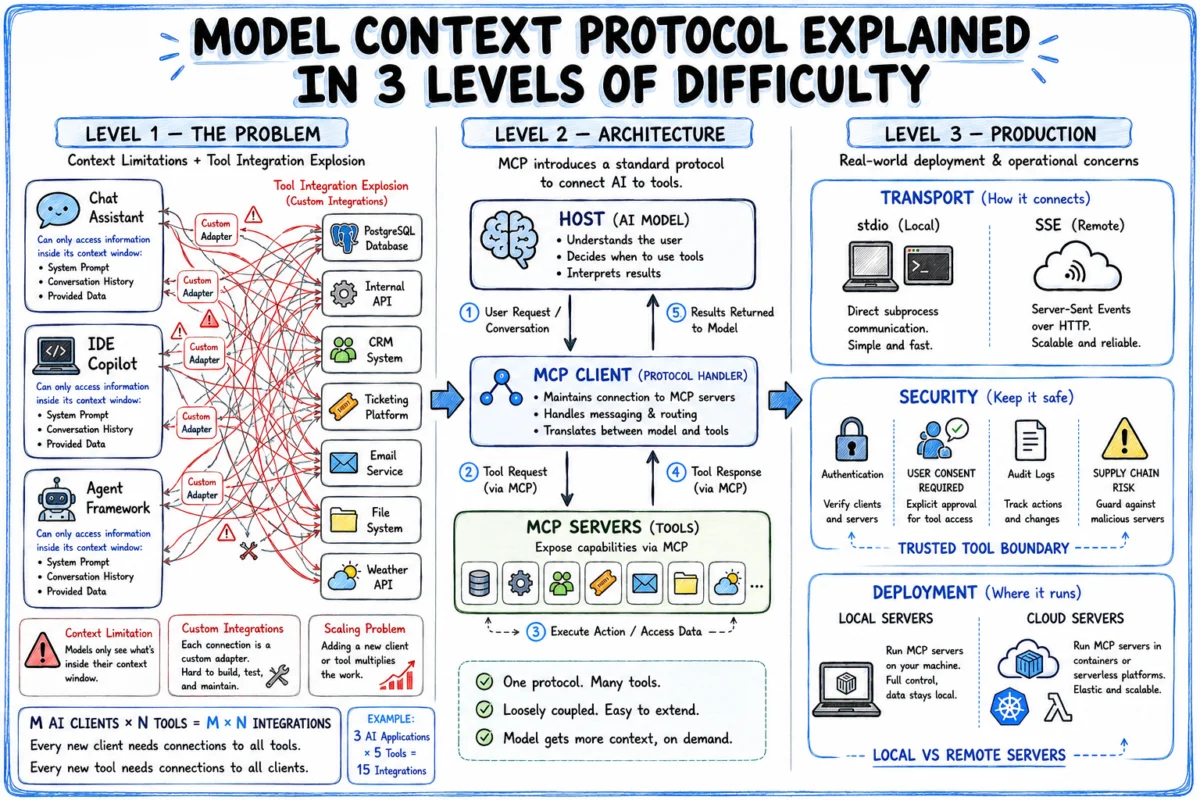

The Model Context Protocol (MCP) standardizes the way artificial intelligence (AI) applications connect to external tools and data sources, addressing a critical bottleneck in the deployment and scalability of sophisticated AI systems. This open standard, initially introduced by Anthropic, provides a unified framework for AI models to interact with the vast ecosystem of enterprise and web services, moving beyond the limitations of their training data. This article explores the necessity, architecture, and operational considerations of MCP across three levels of depth, detailing its implications for the future of AI development and enterprise integration.
The Genesis of a Standard: Bridging the AI Knowledge Gap
Every large language model (LLM) possesses an inherent limitation: its knowledge is confined to its training data. This "knowledge cutoff" means that an LLM, no matter how powerful, cannot inherently access real-time information, interact with dynamic systems, or perform actions based on current external data. Queries about a file on a local machine, a recent entry in a database, or a newly arrived email will either result in a halt or an unreliable guess. The model remains sealed off from the live operational systems that modern applications rely upon, leaving the arduous task of bridging this gap entirely to developers.
Historically, bridging this gap has involved the creation of custom integrations—bespoke functions and tool definitions designed to funnel external data into the model’s context window. While feasible for small-scale projects involving a few models and services, this approach rapidly devolves into an unmanageable "matrix of one-off adapters" as complexity grows. Each integration demands its own authentication logic, schema assumptions, and failure modes, creating significant technical debt. Adding a new AI model or an additional external service necessitates a reworking of this entire integration matrix, hindering agility and escalating maintenance costs. Industry reports indicate that up to 40% of developer time in early AI projects was consumed by building and maintaining these custom connectors, diverting resources from core innovation.
The Model Context Protocol emerges as a timely solution to this pervasive problem. By establishing an open standard, MCP enables both AI applications and external services to implement a shared communication protocol. Instead of each AI application building unique connectors for every external system, a service now exposes its capabilities as an MCP server once, making it accessible to any MCP-compatible client. This shift promises a more robust, scalable, and secure foundation for AI integration, akin to how standards like HTTP and OpenAPI transformed web service interoperability.
Deconstructing the Model Context Protocol: Addressing Integration Complexity (Level 1)
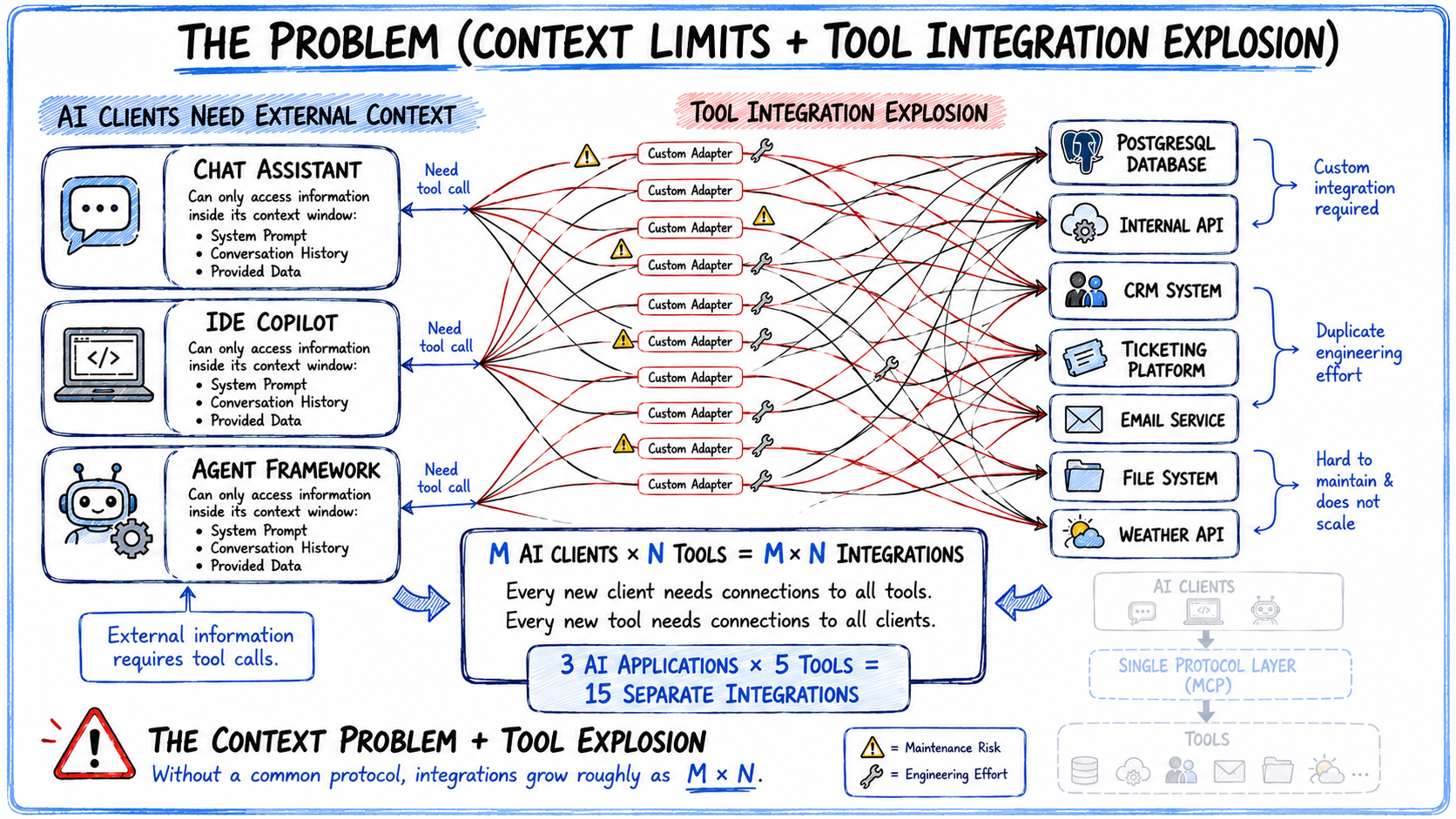
The fundamental premise of MCP lies in addressing the exponentially growing complexity of AI-external system integrations. AI models operate within a "context window," which includes the system prompt, conversation history, and any supplementary data provided during an interaction. To access information or perform actions beyond this immediate context, external tools are indispensable.
Most advanced AI systems support "tool calling," where a model can request an external tool to execute a specific function, retrieve data, or interact with an API, database, or file system. The application then performs the requested action and returns the result to the model, effectively extending the model’s capabilities into the real world.
However, as the number of AI applications (M) and external tools (N) proliferates within an organization, the integration complexity escalates dramatically. Without a shared standard, each client typically requires a unique integration with each tool, leading to M × N custom adapters. Consider a hypothetical large enterprise utilizing five distinct AI applications—such as a customer service chatbot, an internal knowledge management assistant, an AI-powered IDE, a data analysis agent, and a marketing content generator—each needing access to ten critical internal tools like Salesforce, Oracle Database, Slack, Jira, and a proprietary CRM. This scenario would mandate building and maintaining 5 × 10 = 50 separate, custom integrations. The introduction of a new AI application would require ten new integrations, and adding a new tool would necessitate five more. This quadratic growth in integration points quickly becomes an insurmountable barrier to broad AI adoption.
MCP fundamentally reshapes this landscape. AI applications implement the MCP client specification, while tools and data sources expose their capabilities through MCP servers. Because both sides adhere to the same protocol, an MCP server can be utilized by any compatible MCP client without the need for client-specific custom integrations. This paradigm shift reduces the integration surface from approximately M × N custom adapters to M + N protocol implementations. In our enterprise example, instead of 50 custom integrations, you would have 5 MCP client implementations and 10 MCP server implementations, drastically simplifying the architecture and maintenance burden. This streamlined approach not only accelerates development but also enhances reliability and reduces the potential for integration-related vulnerabilities. The practical outcome is a highly composable ecosystem where a single MCP server for a PostgreSQL database or an internal API can serve multiple AI assistants, developer environments, and agent frameworks through a unified, standardized interface.
Architectural Blueprint: How MCP Facilitates Seamless Interaction (Level 2)
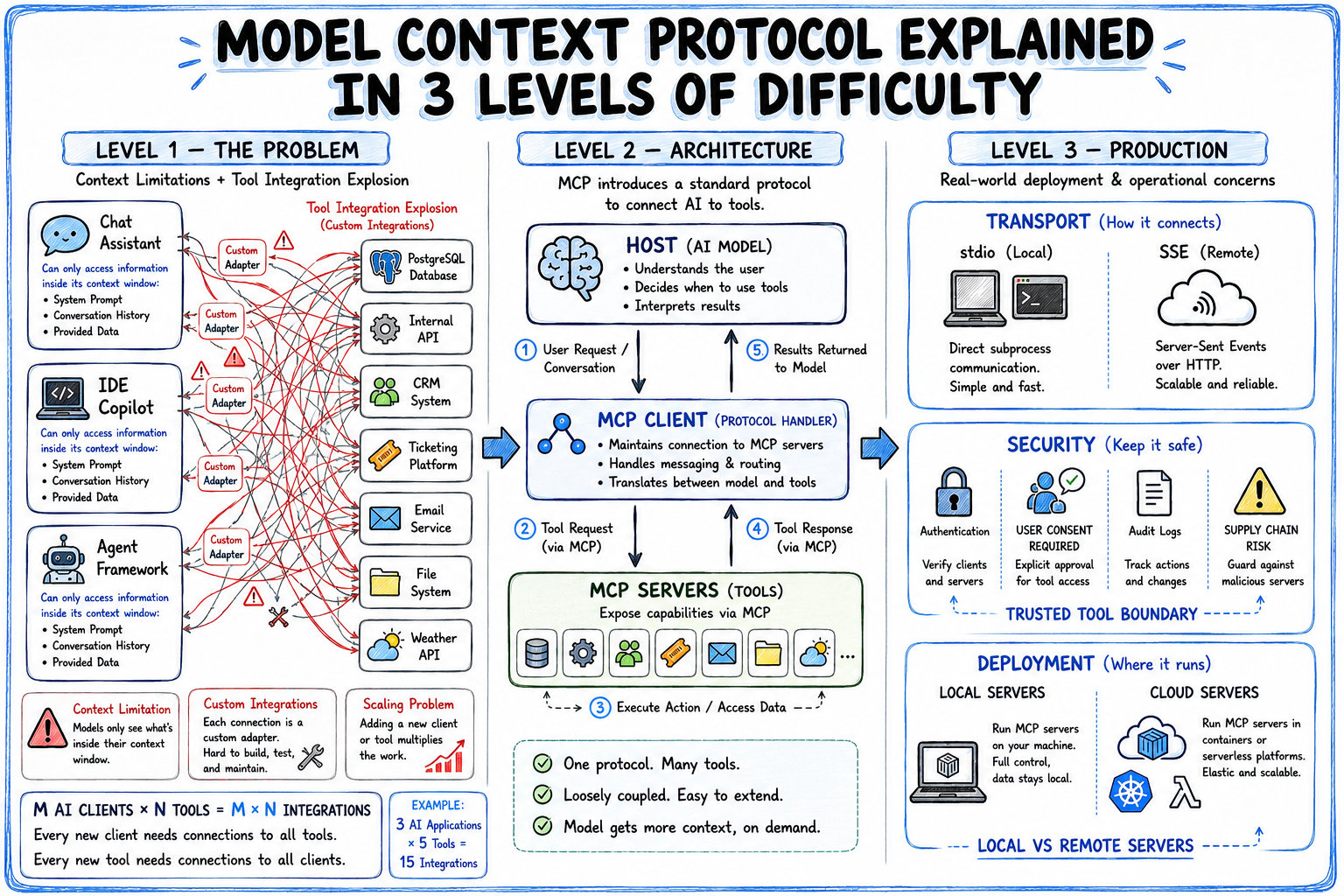
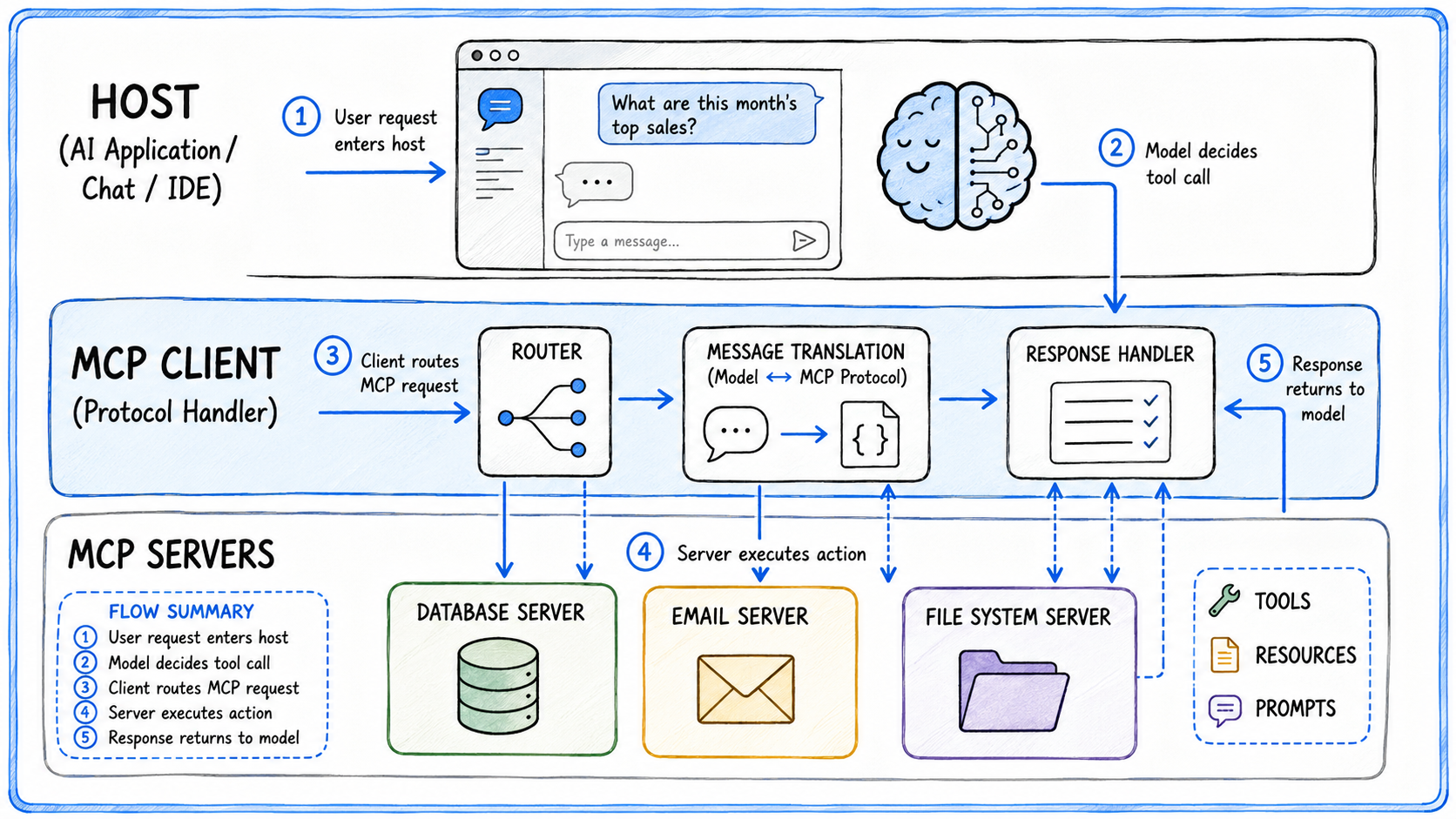
MCP interactions are structured around three core components: the host, the client, and the server, each playing a distinct yet interconnected role in facilitating external communication for AI models.
The Host: The host represents the user-facing application, serving as the primary interface through which users interact with the AI. This could manifest as a sophisticated chat interface, an AI-enhanced Integrated Development Environment (IDE), or a custom-built AI agent. It houses the underlying language model and orchestrates the conversational flow. When the model determines that an external action or data retrieval is necessary, this decision originates within the host application.
The Client: Nestled within the host, the client acts as the protocol’s central nervous system. It manages the intricate mechanics of MCP, maintaining a dynamic registry of available MCP servers and their capabilities. The client is responsible for translating the model’s high-level requests into precisely formatted MCP calls, dispatching these calls to the appropriate server, and subsequently converting the server’s responses back into a format that the model can readily interpret and utilize. From the model’s perspective, the client abstracts away all the underlying plumbing, presenting a seamless interface for external interaction.
The Server: The server serves as the critical bridge to an external system. It advertises its specific capabilities—the tools it offers, the data it can provide, and the prompts it can execute—and responds to requests from MCP clients. For instance, an MCP server positioned in front of a financial database would receive a structured tool call from the client, securely execute the relevant query, and return the results in a model-friendly format. The server encapsulates all the complex implementation details of the external system it represents, ensuring that the client and the model only interact with the standardized MCP interface, maintaining abstraction and security.
Tracing a Request: A Real-World Scenario
Consider a user instructing an AI assistant: "Retrieve the Q2 revenue numbers from the database and draft an email summary for the sales team."
- Model’s Intent: The AI model analyzes the request and recognizes the need for two external actions: querying a database and drafting an email.
- Client Discovery: The MCP client, residing within the AI assistant’s host, consults its registry of available MCP servers. It identifies a
database_querytool exposed by a database MCP server and anemail_drafttool provided by an email service MCP server. - First Tool Call: The model formulates a call to the
database_querytool, passing parameters like "Q2 revenue." - Server Execution: The MCP client dispatches this call to the database MCP server. The server securely executes the database query, retrieves the Q2 revenue data, and formats the results.
- Result Return: The database MCP server sends the formatted results back to the client, which then presents them to the AI model.
- Second Tool Call: Armed with the actual revenue figures, the model then formulates a call to the
email_drafttool, providing parameters such as recipient list, summary content, and subject line. - Server Execution (Email): The MCP client dispatches this request to the email service MCP server. This server handles the email composition and sending process.
- Confirmation: The email server confirms successful delivery, and this confirmation is relayed back through the client to the model. The model then informs the user that the task is complete.
Crucially, neither the database server nor the email server had any direct knowledge of each other. The AI model orchestrated the sequence of operations, with the MCP client managing all protocol translations and dispatches. This process entirely eliminates the need for developers to write any custom "glue code" between the model and the external systems, showcasing MCP’s efficiency.
Tools, Resources, and Prompts: Categorizing Capabilities
MCP servers categorize their capabilities into three distinct types, each with specific implications for functionality and security:
- Tools: These represent active operations that can modify external systems or trigger significant actions. Examples include
write_to_database,send_email,create_ticket, orexecute_code. Calling a tool typically carries higher security implications as it involves state changes or sensitive operations. - Resources: These are passive data retrieval operations that fetch information without altering the external system. Examples include
read_file,query_database_for_data, orfetch_user_profile. Reading a resource is generally considered a lower-risk operation compared to executing a tool. - Prompts: These are dynamic instructions or context snippets that an MCP server can provide to an AI model. They can be used for guiding the model’s behavior, providing specific context for a task, or dynamically adjusting the model’s persona based on the external system’s state.
The clear distinction between tools and resources is operationally significant. It allows for the application of different authorization policies, auditing levels, and user consent requirements. For instance, an AI agent might be authorized to read customer data (resource) but require explicit user approval before updating a customer record (tool).
Operationalizing MCP: Transport, Security, and Deployment Considerations (Level 3)
Beyond the architectural concepts, the practical implementation of MCP in a production environment hinges on crucial decisions regarding communication transport, robust security, and optimal server deployment. These factors determine the protocol’s reliability, safety, and scalability.
How Client and Server Actually Talk: Communication Layers
MCP’s communication model is stratified into two distinct layers, offering flexibility and abstraction:
- Data Layer: This layer defines the actual messages, data structures, and semantic meaning exchanged between an MCP client and server. It specifies how tool calls, resource requests, prompts, and their respective responses are structured, regardless of the underlying communication channel.
- Transport Layer: This layer handles the physical movement of data between the client and server. It dictates the specific network protocols or inter-process communication mechanisms used. The separation ensures that the data layer remains agnostic to the transport, allowing different transport mechanisms to be swapped without impacting how tools behave or data is structured.
MCP currently defines two primary transports:
mcp-over-http: This transport leverages standard HTTP(S) for communication. It is ideal for remote MCP servers hosted in cloud environments or on separate machines, benefiting from HTTP’s ubiquitous nature, built-in security features (TLS/SSL), and existing infrastructure for load balancing and monitoring. It’s suitable for distributed AI systems where clients and servers might be geographically dispersed.mcp-over-stdio: This transport utilizes standard input/output (STDIO) streams. It is particularly well-suited for local MCP servers, such as those running as child processes or within sandboxed environments on the same machine as the AI application. This approach minimizes network overhead and simplifies local deployment but requires careful management of process lifecycle and resource isolation.
The choice of transport depends heavily on the deployment context. mcp-over-http is generally preferred for enterprise-grade, distributed AI applications requiring high availability and robust security, while mcp-over-stdio excels in local development, desktop agents, or highly constrained embedded environments.
The Trust Problem and Security Constraints
Empowering AI models with direct access to external systems via MCP introduces significant security considerations. A malicious or compromised MCP server could potentially gain unauthorized access to sensitive data, execute destructive operations, or exploit vulnerabilities in the broader system. The "trust problem" arises because an AI model, by its nature, cannot fully discern the intent or integrity of an external system.
The MCP security best practices emphasize several critical measures:
- Robust Authentication: Implement strong authentication mechanisms, such as OAuth 2.0, to ensure that only authorized MCP clients can communicate with servers and vice versa. Token validation is paramount, verifying that tokens were issued for the specific client and server involved.
- Granular Authorization (Narrow Scopes): Grant MCP servers and the tools they expose the absolute minimum necessary privileges. This principle of least privilege ensures that even if a server is compromised, the blast radius of potential damage is contained. For example, a server providing database access should only have permissions for specific tables or operations relevant to its advertised tools.
- Identity Binding: Bind sessions and actions to real user identities. This enables comprehensive auditing and accountability, allowing organizations to trace every AI-initiated external action back to a specific user or system.
- Input/Output Sanitization: All data flowing into and out of MCP servers must be rigorously sanitized to prevent injection attacks (e.g., SQL injection, command injection) and other data manipulation vulnerabilities. This is particularly crucial for data returned to the model, which might inadvertently expose sensitive information if not properly scrubbed.
- Server Vetting and Auditing: Never implicitly trust a tool’s self-description. Enterprises must vet MCP servers before deployment, especially those from third parties. Continuous auditing of tool activity and server logs is essential to detect anomalous behavior or misuse.
- Sandboxing Local Servers: For
mcp-over-stdiodeployments, local servers should run within tightly controlled, sandboxed environments. This prevents them from accessing unauthorized filesystems, network resources, or executing commands with elevated privileges, mitigating risks associated with potentially untrustworthy local tools.
Google’s overview of MCP security further underscores the importance of user consent before an agent acts or shares data, limiting server visibility, and sanitizing output before logging or displaying it. These practices are not merely recommendations but essential safeguards for maintaining data integrity, privacy, and system security in an AI-powered environment.
Choosing Where MCP Servers Run
The decision of where to deploy MCP servers directly impacts scalability, security, and operational overhead. This choice often aligns with the transport layer selected.
- Local Servers: These run on the same machine or environment as the AI application. They are ideal for personal AI assistants, developer tools, desktop automation, or edge computing scenarios where low latency and offline capabilities are crucial. However, they inherit the privileges of the user running them, necessitating strict sandboxing and security controls.
- Remote Servers: Hosted in data centers or cloud environments, remote MCP servers are suited for enterprise-grade AI applications requiring high availability, scalability, and centralized management. They can serve multiple AI clients across an organization and benefit from cloud infrastructure’s inherent security and operational features.
For hosting remote MCP servers, various cloud platforms offer suitable environments:
- Serverless Platforms (e.g., Google Cloud Run, AWS Lambda, Azure Functions): These are excellent for simple, stateless tools that scale down to zero when not in use, offering cost efficiency and automatic scaling. They are well-suited for event-driven tool calls.
- Managed Container Orchestration (e.g., Kubernetes, Google Kubernetes Engine, Azure Kubernetes Service): For stateful or high-throughput MCP servers, Kubernetes provides fine-grained control over resource allocation, scaling policies, and network configurations. It is ideal for complex tools requiring persistent storage or specific hardware requirements.
The choice between managed hosting and self-hosting typically boils down to compliance requirements, data residency constraints, and the level of operational control desired. Managed hosting handles uptime, scaling, and infrastructure maintenance, while self-hosting offers complete control at the cost of increased operational responsibility.
A Growing Ecosystem to Build On: The Future of AI Integration
MCP is an open-source standard, fostering a collaborative development environment. Its ecosystem is rapidly expanding, with Software Development Kits (SDKs) available for major programming languages, simplifying client and server implementation. Furthermore, a steadily growing collection of ready-made MCP servers for common systems like GitHub, Slack, and PostgreSQL means developers often don’t need to build connectors from scratch, significantly accelerating development cycles. Client support is also gaining traction, with popular IDEs like Visual Studio Code and leading AI models like Claude offering native MCP compatibility.
This burgeoning ecosystem underscores MCP’s potential to become a foundational layer for AI integration. By abstracting away the complexities of disparate external systems, MCP empowers developers to focus on building innovative AI applications rather than wrestling with integration boilerplate. It facilitates the creation of more capable, reliable, and secure AI agents that can seamlessly interact with the vast digital landscape, driving forward the next generation of intelligent automation and decision-making systems.
Wrapping Up
The Model Context Protocol directly addresses a critical integration challenge that rapidly emerges in AI-powered application development: the repetitive, fragile, and non-composable nature of connecting AI models to external systems. By providing an open, standardized protocol, MCP establishes a clean separation between the AI application and external capabilities, defining a clear and consistent interface between them.
Key benefits of MCP include:
- Reduced Integration Complexity: Shifting from M × N custom adapters to M + N protocol implementations.
- Enhanced Scalability: Enabling AI applications to seamlessly connect to a growing number of external services without exponential overhead.
- Improved Security: Providing a framework for robust authentication, granular authorization, and secure data handling.
- Accelerated Development: Allowing developers to leverage pre-built servers and focus on core AI logic.
- Greater Composability: Fostering a modular AI ecosystem where tools and data sources are reusable across diverse AI applications.
As adoption continues to grow, MCP is poised to become an indispensable foundation for building AI systems that can interact reliably and securely with the software and data they depend on, ultimately unlocking the full potential of agentic AI.
Here are a few resources worth bookmarking:
- Model Context Protocol Official Documentation:
https://modelcontextprotocol.io/docs/getting-started/intro - MCP Architecture Deep Dive:
https://modelcontextprotocol.io/docs/learn/architecture - MCP Security Best Practices:
https://modelcontextprotocol.io/docs/tutorials/security/security_best_practices - Google Cloud MCP Overview:
https://cloud.google.com/discover/what-is-model-context-protocol - Community MCP Servers List:
https://mcpservers.org/
Happy learning!
