
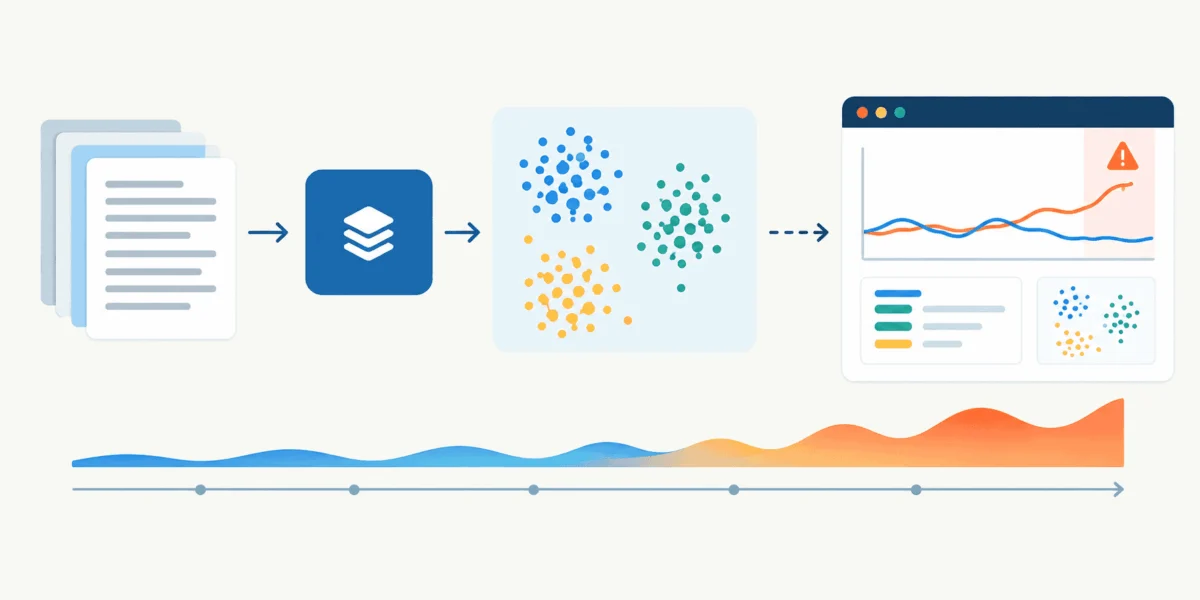

The Lifecycle of Production LLMs and the Challenge of Drift
In the context of machine learning, an embedding is a high-dimensional vector representation of text, designed to capture semantic relationships. When these vectors shift significantly from the baseline distribution established during the model’s development phase, the model is essentially operating on "unfamiliar" data. This misalignment often stems from what practitioners call "data drift" or "covariate shift."
Historically, data scientists monitored drift in tabular data by tracking simple statistical moments—mean, variance, and distribution percentiles. However, high-dimensional embeddings (often ranging from 384 to 1,536 dimensions or more) render these traditional, feature-by-feature metrics ineffective. A drift in a 768-dimensional space might be invisible when examining any single dimension in isolation, yet it can represent a profound change in the overall semantic meaning of the data stream. Consequently, engineering teams are now forced to adopt sophisticated, multidimensional detection strategies to maintain the reliability of their LLM pipelines.
Chronology of Model Decay
The degradation of an LLM in production typically follows a predictable trajectory. During the "Deployment Phase," the model performs optimally because the input data closely mirrors the training set. In the "Early Drift Phase," which can occur weeks or months after launch, subtle changes in user intent begin to emerge. For example, a customer support bot trained on standard password-reset queries may begin to receive inquiries about new, undocumented platform features.
By the "Critical Drift Phase," the model’s vector space representation of user inputs no longer overlaps significantly with the original training clusters. At this stage, the model’s internal decision-making process—or its ability to retrieve relevant documents from a vector database—becomes unreliable. Research from industry practitioners suggests that for models in volatile sectors like finance or cybersecurity, the "half-life" of model relevance can be as short as three to six months without periodic updates or retraining.
Technical Approaches to Detecting Embedding Drift
To combat this decay, machine learning engineers have pioneered several robust detection frameworks. These approaches generally fall into two categories: model-based detection and distance-based heuristics.
1. The Domain Classifier Strategy
The most effective method for detecting complex, non-linear shifts in high-dimensional space is the use of a domain classifier. In this approach, a lightweight, secondary machine learning model—typically a Random Forest or a Gradient Boosting Machine—is trained to distinguish between "Baseline Data" (the training set) and "Production Data" (the incoming stream).
If the classifier can easily distinguish between the two datasets, it is a mathematical certainty that the distributions have drifted. The performance of this classifier is measured using the Area Under the ROC Curve (ROC-AUC). An ROC-AUC score of 0.5 suggests the datasets are indistinguishable (no drift), while a score approaching 1.0 indicates a catastrophic shift. Implementing this in a pipeline allows for automated alerting, enabling developers to trigger data re-labeling or fine-tuning workflows before the end-user experience is severely compromised.
2. Centroid Distance Analysis
For organizations requiring a computationally inexpensive, real-time monitoring solution, the centroid calculation method is the standard alternative. By calculating the mean vector (the "center of mass") for a batch of reference embeddings and comparing it to the mean vector of the current production batch using Cosine Distance, developers can identify large-scale shifts in thematic focus.
While this method lacks the granular sensitivity of a domain classifier—it may overlook shifts that occur in the shape of the data distribution rather than its mean—it provides a vital "early warning system." In practice, a threshold is set: if the cosine distance between the baseline centroid and the current centroid exceeds a predetermined limit, an automated flag is raised for manual review.
Practical Implementation: The Scikit-LLM Integration
The emergence of libraries like Scikit-LLM has democratized the ability to integrate sophisticated LLM monitoring into standard data science workflows. By wrapping embedding generation services (such as those provided by Groq, OpenAI, or local sentence-transformer models) into the scikit-learn API, developers can treat LLM components as standard objects within a pipeline.
In a simulated production environment, developers can leverage all-MiniLM-L6-v2 or similar models to generate embeddings for baseline and production text. For instance, if a company shifts its service offerings from basic IT support to cryptocurrency-related transactions, the resulting embedding shift will be stark.
Simulation of Drift detection logic:
import numpy as np
from sklearn.ensemble import RandomForestClassifier
from sklearn.model_selection import train_test_split
from sklearn.metrics import roc_auc_score

# Baseline Data (Original Training Corpus)
X_reference = np.random.normal(loc=0.0, scale=1.0, size=(500, 384))
# Production Data (New, shifted user queries)
X_production = np.random.normal(loc=0.3, scale=1.0, size=(500, 384))

# Labeling and Concatenation
X_combined = np.vstack((X_reference, X_production))
y_combined = np.hstack((np.zeros(500), np.ones(500)))

# Classifier Training
X_train, X_test, y_train, y_test = train_test_split(X_combined, y_combined, test_size=0.3)
clf = RandomForestClassifier().fit(X_train, y_train)

# Evaluation
roc_auc = roc_auc_score(y_test, clf.predict_proba(X_test)[:, 1])
if roc_auc > 0.65:
    print("Drift Detected: Retraining Required.")
Broader Implications and Industry Impact
The necessity of monitoring embedding drift highlights a fundamental shift in the software development paradigm. We are moving from a "build-and-ship" model to a "continuous monitoring" model. As regulatory bodies begin to scrutinize the output of generative AI systems, the ability to explain why a model behaved a certain way becomes tied to data provenance. If an organization cannot prove that it monitored for and mitigated data drift, it may face significant liability if its model provides incorrect or harmful advice due to outdated knowledge.
Furthermore, the integration of these monitoring tools is driving a new economy of "MLOps" (Machine Learning Operations). The tools used to detect drift are now being bundled into enterprise platforms, allowing companies to automate the retraining of models as soon as a drift threshold is breached. This creates a self-healing loop: the system detects the shift, the pipeline triggers a data collection task for the new topic, and the model is fine-tuned and redeployed without human intervention.
Conclusion
Embedding drift is not merely a technical nuisance; it is an inherent characteristic of any intelligent system operating in a dynamic, real-world environment. As demonstrated, the combination of domain classification and centroid distance analysis provides a comprehensive toolkit for maintaining model integrity. By treating LLM pipelines as living, evolving systems that require constant vigilance, developers can ensure that their models remain accurate, relevant, and secure long after their initial deployment. The future of production AI lies not in the perfection of the initial training run, but in the efficiency and reliability of the monitoring systems that support the model’s ongoing existence.
