

The Evolution of Multilingual NLP
Historically, natural language processing (NLP) has faced the "Tower of Babel" problem. Because most machine learning models rely on statistical patterns within a specific vocabulary, a model trained on English product reviews could not inherently understand a Spanish review. For years, the industry standard for bridging this gap was machine translation. Organizations would translate all incoming data into a single, dominant language—usually English—before processing. While functional, this method introduced latency, increased costs, and frequently resulted in the loss of cultural nuance or idiomatic meaning.
The alternative was the creation of "siloed" models. A multinational corporation might maintain a suite of fifty different classifiers for fifty different languages, each requiring its own training data, maintenance cycle, and infrastructure. This approach created substantial technical debt and made global performance monitoring nearly impossible.
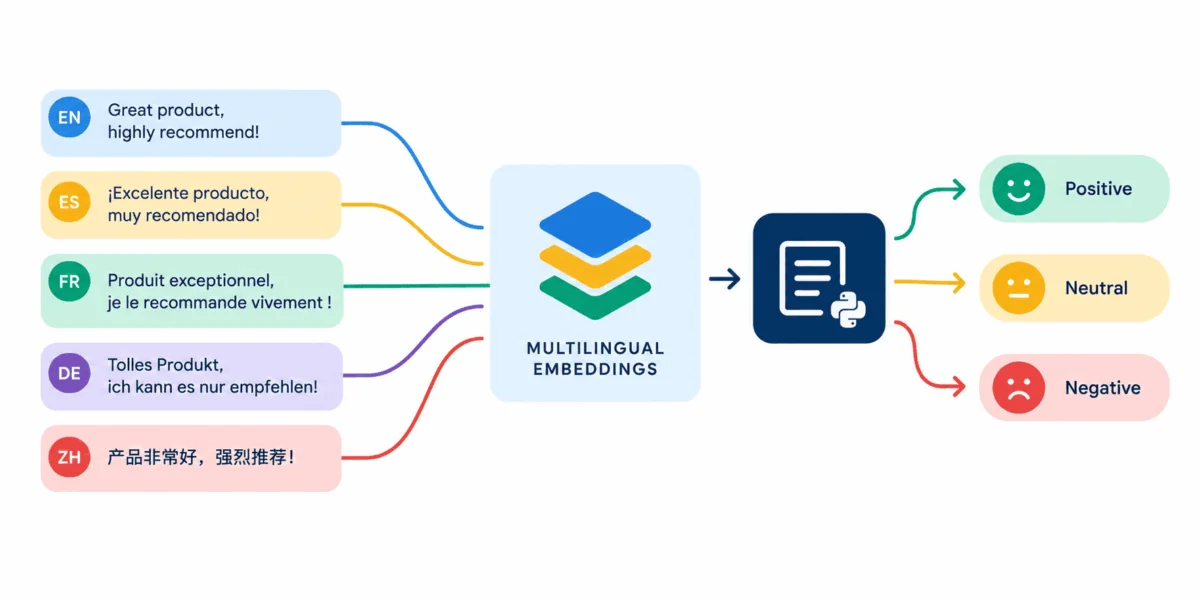
The emergence of multilingual LLMs has fundamentally altered this landscape. By mapping text from different languages into a shared, high-dimensional "vector space," these models allow for semantic understanding that transcends linguistic boundaries. In this common space, the English phrase "This product is fantastic" and the Spanish equivalent "¡Este producto es fantástico!" occupy nearly identical coordinates, allowing a downstream classifier to interpret them as the same sentiment.
Setting the Foundation for Universal Classification
To implement a unified pipeline, developers must first establish an infrastructure that supports multilingual embedding generation. In recent months, the deployment of local, open-source models through platforms like Ollama has gained traction, offering a cost-effective alternative to proprietary cloud APIs. By utilizing models such as BGE-M3—a state-of-the-art embedding model capable of processing over 100 languages—developers can generate high-quality vector representations locally.
The process begins by installing the necessary dependencies, including the Scikit-LLM library and the Datasets framework. Once the environment is configured, the system must be pointed toward a local Ollama instance. This setup bypasses the need for costly per-token API fees and ensures that data privacy is maintained within the user’s local infrastructure.
Building the Pipeline: A Technical Chronology
The construction of a modern multilingual pipeline follows a systematic four-stage process:
- Data Acquisition and Normalization: Using datasets like the Amazon Multi-language Reviews, developers aggregate text across multiple languages. A critical step here is the balancing of classes. If the training set contains significantly more English positive reviews than Spanish negative reviews, the model will naturally inherit this bias. Shuffling and stratified sampling are essential to ensure the model learns semantic sentiment rather than linguistic frequency.
- Embedding Generation: This is the most computationally intensive phase. The
GPTVectorizerfrom the Scikit-LLM library acts as the bridge. As data is passed through the model, the BGE-M3 engine converts raw text into numerical vectors. These vectors encapsulate the meaning of the input, effectively stripping away the language-specific syntax. - Supervised Learning: Once the data is transformed into numerical vectors, the linguistic nature of the original text is no longer a factor. A standard Scikit-learn classifier, such as a Logistic Regression model, can then be trained on this data. Because the vectors are "language-agnostic," the classifier learns the relationship between the semantic meaning and the target label (e.g., a 1-star to 5-star rating).
- Inference and Evaluation: The final stage involves testing the pipeline on unseen data. The model predicts the rating of a review, regardless of whether it was written in English, Spanish, German, or Mandarin.
Performance Analysis and Challenges
While the results of such pipelines are promising, they are not without limitations. Initial evaluations often show higher precision for extreme labels (1-star or 5-star reviews) compared to intermediate labels. This phenomenon, known as the "central tendency bias," occurs because extreme sentiments often rely on highly emotional, universally understood adjectives that are easier for models to distinguish. Intermediate reviews, which often contain nuanced or mixed feedback, present a higher degree of complexity.
Furthermore, the quality of the embedding model is paramount. While BGE-M3 is highly capable, the performance of the entire pipeline is gated by the quality of the vector representations. If the embedding model fails to capture the nuance of a specific dialect or a highly technical industry, the downstream classifier will inevitably struggle. Additionally, the computational overhead of generating embeddings can be significant; for large-scale enterprise deployments, batch processing and hardware acceleration (such as GPU support) are essential to maintain acceptable inference times.
Broader Implications for Global Business
The shift toward unified multilingual classification has profound implications for data strategy. For global businesses, this means that customer support systems, automated sentiment trackers, and market analysis tools can now be scaled globally without linear increases in model maintenance costs.
Instead of waiting for a team of data scientists to train a new model every time the company expands into a new linguistic market, engineers can now simply ingest data, generate embeddings via a pre-trained model, and plug them into an existing classifier. This "write once, run everywhere" approach allows companies to react to market trends in real-time, regardless of the language in which their customers are interacting.
Furthermore, this democratization of advanced NLP tools allows smaller organizations to compete on a global scale. By leveraging open-source LLMs, a local startup can now deploy a classification system that rivals the capabilities of multinational corporations, provided they have access to quality, labeled data.
Future Outlook
The path forward for multilingual classification lies in the continued refinement of "instruction-tuned" embedding models and the reduction of latency in local inference. As hardware becomes more efficient, the ability to run these pipelines on edge devices—such as local servers or even high-end workstations—will become standard.
Ultimately, the integration of Scikit-LLM and Scikit-learn is not merely a technical convenience; it is a fundamental correction in the trajectory of NLP. By abstracting language away from the classification process, we are moving toward a future where the barriers between languages in the digital space are no longer a technical obstacle, but a manageable input in a broader, globalized data infrastructure. As the industry continues to refine these techniques, the focus will likely shift from the mechanics of "how to translate" to the higher-level challenge of "how to interpret" the global conversation with greater precision and ethical oversight.
