
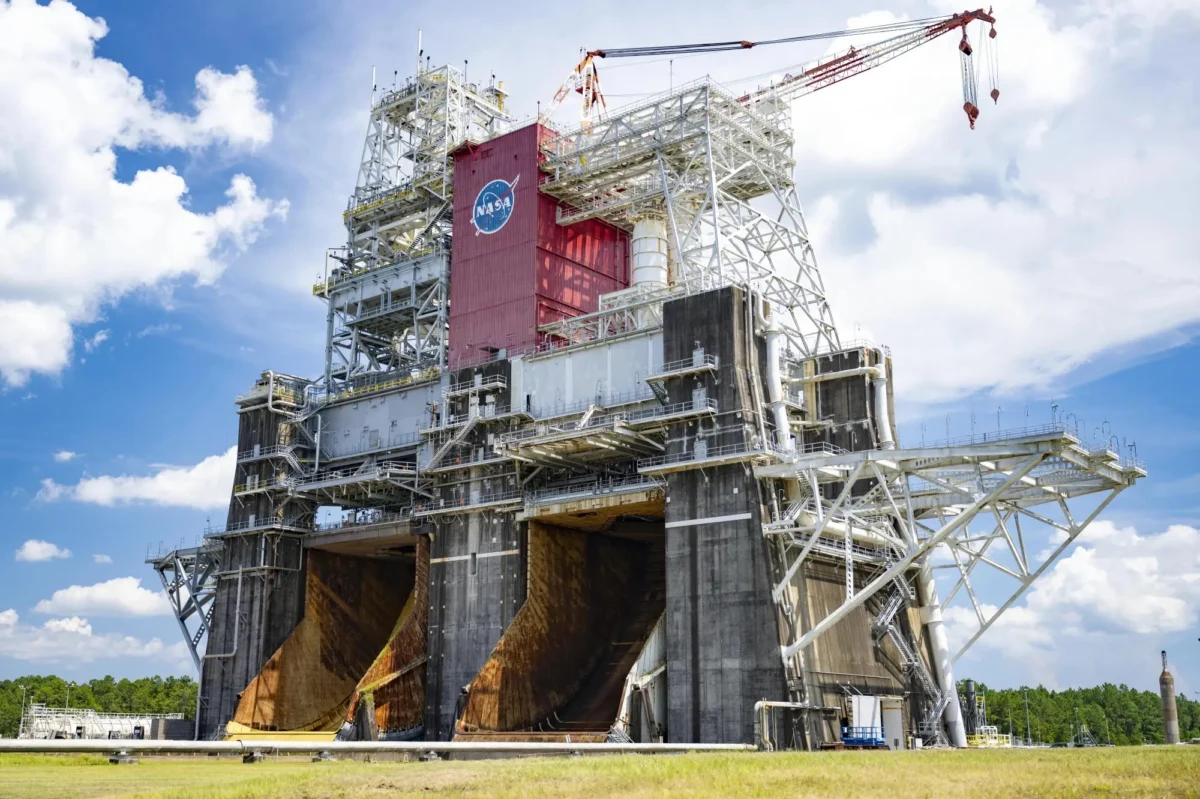

NASA and Blue Origin have formalized a significant technical partnership to conduct critical hot fire testing for the second stage of the New Glenn heavy-lift orbital launch vehicle. This collaboration, centered at the John C. Stennis Space Center near Bay St. Louis, Mississippi, marks a pivotal step in the development of the hardware necessary to support the Artemis program and the burgeoning commercial space economy. The agreement, structured as an annex to a previously signed reimbursable Space Act Agreement, underscores a deepening integration between federal aerospace infrastructure and private sector innovation. Under the terms of the arrangement, Blue Origin will utilize the historic B-2 test stand, a facility with a storied legacy of propelling American lunar ambitions, to validate the performance and reliability of the New Glenn’s upper stage.
The upcoming testing phase, targeted to commence this fall, represents a major milestone for Blue Origin as it nears the inaugural flight of its massive New Glenn rocket. The B-2 test stand is uniquely suited for this task; it was originally engineered to handle the immense thrust of the Saturn V rocket stages during the Apollo era and has since been modernized to support the next generation of space exploration. By leveraging NASA’s specialized workforce and world-class facilities, Blue Origin aims to accelerate its development timeline while ensuring the highest standards of safety and performance for its heavy-lift capabilities.
Technical Specifications and the Scope of Testing
The New Glenn rocket is a cornerstone of Blue Origin’s vision to enable a sustained human presence in space. Standing approximately 320 feet (98 meters) tall with a 7-meter fairing, the vehicle is designed to carry twice the payload volume of any existing commercial launch vehicle. While the first stage is powered by seven BE-4 engines—the same engines utilized by United Launch Alliance’s Vulcan Centaur—the second stage relies on two vacuum-optimized BE-3U engines. These engines utilize a liquid hydrogen and liquid oxygen (LH2/LOX) propellant combination, known for its high efficiency in the vacuum of space.
The "hot fire" testing scheduled for this autumn at Stennis is a rigorous process where the second stage will be secured to the B-2 test stand and its engines ignited for a duration simulating an actual flight profile. This "green run" style testing allows engineers to monitor propellant flow, thermal management, pressure regulation, and the overall structural integrity of the stage under the stresses of active combustion. It is a critical "final exam" for the hardware before it is integrated into a full launch vehicle stack.
NASA’s role in this partnership extends beyond merely providing a location. The agency will supply a dedicated team of engineers, specialized equipment, and comprehensive building services required to design and install the necessary interfaces to adapt the B-2 stand for the New Glenn hardware. This includes the installation of fluid procurement systems, electrical interfaces, and data acquisition hardware. NASA will also share its extensive institutional knowledge gained from decades of propulsion testing, ranging from the Space Shuttle Main Engines to the Space Launch System (SLS) core stage.
A Legacy Reborn: The B-2 Test Stand at Stennis
The selection of the Stennis Space Center is a testament to the facility’s enduring importance in the American aerospace landscape. Located on the banks of the Pearl River, Stennis is NASA’s primary center for rocket propulsion testing. The B-2 test stand is a dual-position, vertical-firing facility that provides a massive steel structure capable of withstanding millions of pounds of thrust.
In the 1960s, the B-2 stand was used to test the S-IC first stage and the S-II second stage of the Saturn V. More recently, it was the site of the SLS "Green Run" test campaign, where the core stage of the rocket that powered the Artemis I mission was fired for eight minutes to prove its flight readiness. By bringing New Glenn to this same site, NASA and Blue Origin are effectively bridging the gap between the mid-20th-century space race and the modern era of public-private partnerships.
Blue Origin CEO Dave Limp highlighted this historical continuity, noting that the partnership builds on a shared commitment to returning to the Moon. "Stennis helped take Americans to the Moon, and through this partnership, it will help take us back," Limp stated. The use of federal facilities by commercial entities is a central tenet of NASA’s current strategy, allowing the agency to offset maintenance costs while fostering a competitive domestic launch industry.
Strategic Alignment with the Artemis Program
The successful testing and deployment of the New Glenn rocket are vital to NASA’s Artemis program, which seeks to establish a long-term presence on and around the Moon. Blue Origin is a primary contractor for NASA’s Human Landing System (HLS) program. In May 2023, NASA awarded Blue Origin a $3.4 billion contract to develop the "Blue Moon" lander for the Artemis V mission.
The Blue Moon lander is expected to launch atop a New Glenn rocket. Furthermore, New Glenn’s heavy-lift capacity is essential for transporting the massive amounts of propellant and infrastructure needed for sustained lunar operations. The second stage, which will undergo testing at Stennis, is the component responsible for the final orbital insertion and the trans-lunar injection maneuvers. Ensuring its reliability is therefore not just a commercial priority for Blue Origin, but a national security and scientific priority for the United States.
Timeline and Project Milestones
The agreement comes at a time of heightened activity for Blue Origin. The company has been working toward the debut of New Glenn for several years, facing various developmental hurdles common in the production of high-performance cryogenic rockets. The announcement of the fall testing window at Stennis suggests that the manufacturing of the second-stage hardware has reached a mature phase.
Chronology of recent New Glenn developments:
- Early 2024: Blue Origin successfully integrated the first flight-ready BE-4 engines onto the New Glenn first stage at its Cape Canaveral production facility.
- Mid-2024: Completion of structural load testing on the New Glenn interstage and fairing components.
- August 2024: Formalization of the Space Act Agreement annex for Stennis B-2 testing.
- Fall 2024 (Targeted): Commencement of second-stage hot fire testing at Stennis Space Center.
- Late 2024/Early 2025: Anticipated maiden flight of New Glenn from Space Launch Complex 36 (SLC-36) at Cape Canaveral Space Force Station.
This timeline is closely watched by the broader industry, particularly as New Glenn is slated to launch the EscaPADE (Escape and Plasma Acceleration and Dynamics Explorers) mission for NASA, a dual-spacecraft mission to study Mars’ magnetosphere.
Broader Implications for the Aerospace Sector
The collaboration between NASA and Blue Origin at Stennis reflects a broader shift in how the United States approaches space exploration. The transition from a government-led model to a government-enabled commercial model has created a "virtuous cycle" of innovation. By utilizing existing NASA infrastructure, commercial companies reduce their capital expenditure on fixed assets, allowing them to reinvest in R&D and rapid prototyping.
From an economic perspective, this agreement provides a significant boost to the Gulf Coast aerospace corridor. The Stennis Space Center is one of the largest employers in the region, and the influx of private-sector projects ensures the retention of a highly skilled workforce. For Mississippi, the partnership solidifies its position as a critical hub for the 21st-century space economy.
Industry analysts suggest that the success of New Glenn is essential for maintaining a competitive balance in the heavy-lift market. Currently dominated by SpaceX’s Falcon 9 and Falcon Heavy, and with the Starship vehicle in active testing, the market requires additional heavy-lift options to ensure redundant access to space for both government and commercial payloads (such as Amazon’s Project Kuiper satellite constellation).
Official Responses and Industry Outlook
NASA officials have expressed confidence that the partnership will yield significant technical insights. By working side-by-side with Blue Origin engineers, NASA personnel gain exposure to new manufacturing techniques and agile development methodologies, which can then be applied to future agency projects. The "reimbursable" nature of the agreement means that Blue Origin pays for the costs associated with the testing, ensuring that taxpayer funds are utilized efficiently while the government’s fixed assets are put to productive use.
The aerospace community has reacted positively to the news, viewing the move as a sign that Blue Origin is entering the final stretch of New Glenn’s development. "The use of the B-2 stand is a major vote of confidence in the facility’s capabilities and a clear signal that Blue Origin is moving into the operational validation phase," said one industry consultant.
As the fall testing window approaches, the eyes of the aerospace world will be on Mississippi. The roar of the BE-3U engines on the B-2 stand will not only signal the progress of a single rocket but will also echo the legacy of the Saturn V, reaffirming the Stennis Space Center’s role as the place where the path to the stars is paved. Through this partnership, NASA and Blue Origin are ensuring that the next chapter of lunar exploration is built on a foundation of proven expertise and cutting-edge commercial ambition.
