

The integration of agentic AI into the semiconductor and system design lifecycle has shifted from a theoretical aspiration to an operational necessity as design complexity outpaces the capacity of human engineering teams. While the industry frequently employs the term "agentic" to describe various AI-driven tools, the degree of autonomy afforded to these systems is rarely uniform. To provide clarity for engineering organizations, a structured taxonomy has emerged, defining five distinct levels of autonomy that delineate the boundary between manual task execution and autonomous, outcome-driven workflows. This progression is not merely a technical evolution but a fundamental change in how design teams manage decision-making, validation, and accountability in the race toward faster time-to-market.
The Scaling Challenge and the Genesis of Agentic AI
For decades, the electronic design automation (EDA) industry relied on scripting and point-tool automation to manage the growing complexity of chips. However, as designs migrate to 3nm and 2nm process nodes, the heterogeneity of systems—combining advanced packaging, multi-die architectures, and complex AI accelerators—has created a "complexity wall." Engineering teams are now tasked with managing verification, implementation, and signoff processes that are too vast to be handled by traditional manual methods or simple static scripts.

The industry’s pivot toward agentic AI began in earnest around 2023 and 2024, as the capabilities of Large Language Models (LLMs) and specialized machine learning models matured. Unlike general-purpose AI, EDA-specific agentic AI is designed to operate within the constraints of physics-based models, design rules, and electrical models. The objective is to transition the engineer from a manual "tool operator" to a high-level "design orchestrator." This shift is already yielding results; leading-edge companies have reported that autonomous workflows can reduce design iteration cycles from weeks to mere days, providing a critical competitive advantage in high-performance computing (HPC) and automotive markets.
The Five-Level Taxonomy of Autonomy
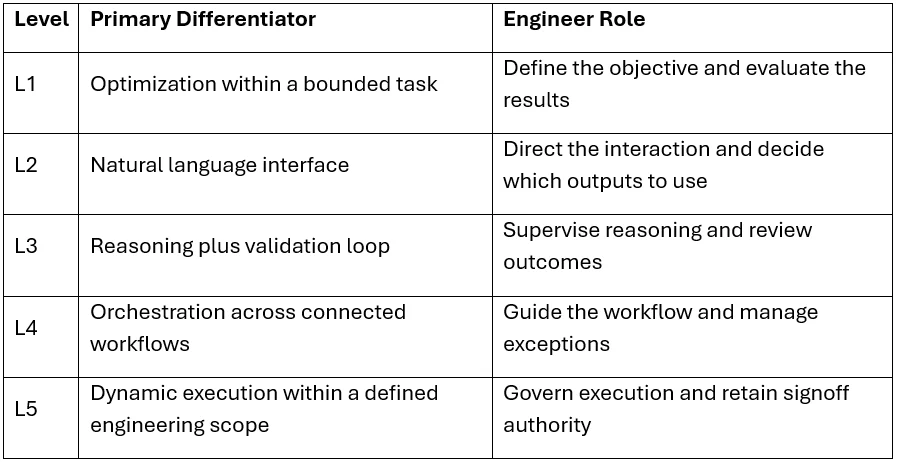
To standardize how the industry evaluates these emerging technologies, experts have categorized agentic capabilities into a five-level framework. This hierarchy, while cumulative in nature, does not imply that higher levels render lower levels obsolete; rather, the higher levels rely on the foundational accuracy of the lower ones.
Level 1: Optimization AI (Task-Specific Automation)
At the foundational level, AI is employed to optimize specific, bounded engineering tasks. The AI does not manage the broader workflow but excels at finding the global optimum for a set of defined parameters, such as power, performance, and area (PPA) metrics. A primary example is the use of AI to automate floorplanning or cell placement, where the system iterates through thousands of variations to identify the most efficient layout. The engineer remains the architect of intent, defining the constraints and the success criteria, while the AI executes the mathematical optimization.

Level 2: Natural Language as the Interface (Conversational Utility)
Level 2 represents a shift in accessibility rather than autonomy. Here, natural language processing (NLP) is used to lower the barrier between the engineer and complex toolsets. Instead of navigating intricate command-line interfaces or deep menu structures, engineers can utilize conversational agents to query tool capabilities, debug code, or request documentation. While the AI manages the interaction layer, it possesses no independent authority over the design objective. It is an enhancement of the user experience that accelerates task execution by removing linguistic and syntax-based friction.
Level 3: Complex Reasoning (The Validation Threshold)
L3 marks a critical threshold in the autonomy hierarchy. At this level, the agent is empowered to reason through a problem, propose a result, and—crucially—validate that result using internal feedback loops. By connecting to formal engines, linter checkers, or simulation environments, the AI can "self-correct." It acts as an iterative partner that understands the design’s mental model, including hierarchy and historical context. The engineer maintains control by reviewing the agent’s conclusions, but the AI is now responsible for generating the path to the solution rather than just optimizing a parameter.
Level 4: Agentic Workflows (Orchestration)
At the fourth level, the focus shifts to orchestration. Multiple specialized agents are coordinated to manage a multi-step engineering flow. For example, a super-agent might initiate a sequence involving RTL generation, followed by verification planning, and finally, initial implementation checks. The differentiator here is the coordination of diverse skills across the design domain. Because these workflows are interconnected, governance becomes a major factor, with the system ensuring that the output of one agent remains consistent with the input requirements of the next.

Level 5: Full Autonomy Within Defined Scopes
The pinnacle of current development, Level 5, involves dynamic, autonomous execution within a strictly defined engineering scope. The system does not merely follow a static, pre-programmed script; it evaluates intermediate results in real-time and determines the subsequent course of action. This is particularly relevant for complex tasks like full-flow verification, where the system might trigger formal analysis or simulation based on the outcomes of previous RTL checks. Despite the term "full autonomy," this is always constrained by human-defined boundaries. The human engineer remains the ultimate authority, with the responsibility for signoff and critical strategic pivots.
The Crucial Distinction: Orchestration vs. Execution
While L4 and L5 both involve complex, multi-agent systems, the fundamental difference lies in the decision-making trigger. In L4, the flow is often governed by a logical, albeit complex, orchestration plan. In L5, the system possesses the agency to pivot based on intermediate, non-linear findings.
Design teams often make the error of assuming that "more agentic" is always better. In reality, the most efficient design environment is one where the autonomy level matches the maturity of the design phase. A high-level L5 agent may be counterproductive in the early stages of architectural exploration, where human creativity and high-level trade-offs are the priority. Conversely, failing to employ L5 agents in the labor-intensive verification phase represents a missed opportunity for efficiency.

Governance, Responsibility, and the Human Role
As these systems take on more of the workload, the question of accountability becomes paramount. It is a common misconception that autonomy replaces the engineer. In truth, it elevates the engineer’s role to a supervisory position. The engineer becomes a "governor of intent," responsible for defining the guardrails within which the AI must operate.
From a regulatory and risk-management perspective, "fallback" protocols are the most important aspect of this taxonomy. Organizations must have a clear, documented strategy for what happens when an agent fails to meet a constraint or encounters an unhandled exception. An autonomy claim that does not explicitly define the "break-glass" procedure for human intervention is not a mature engineering solution.
Broader Implications for the Semiconductor Industry
The transition toward these five levels of autonomy is already reshaping the EDA market. Major players like Cadence have begun incorporating these principles into their "super-agent" architectures, which serve as the backbone for next-generation design flows. This trend has several long-term implications:

- Workforce Transformation: The demand for engineers who are proficient in managing AI-driven flows will eclipse the demand for those who only possess manual tool expertise. Education and training curricula in electrical engineering are expected to pivot toward systems-level thinking and AI orchestration.
- Market Dynamics: Companies that successfully adopt these autonomous workflows will likely experience shorter product development cycles, allowing them to release chips faster than competitors still relying on manual or semi-automated processes.
- Data as a Strategic Asset: Because these agents rely on historical context and design knowledge, the quality of a firm’s internal data—its design libraries, legacy simulations, and documentation—becomes a primary competitive differentiator.
- Hardware-Software Co-Design: As these systems become more adept at spanning the entire design flow, the traditional silos between hardware and software teams will continue to erode, replaced by unified, agentic workflows that optimize the system as a whole.
Conclusion: Evaluating Autonomy
When assessing an agentic AI solution, engineering managers must move past the marketing labels. Instead of asking, "Is this tool agentic?" teams should ask a more precise set of questions: What is the specific engineering scope of this agent? What are its decision rights? How does it validate its own work? What is the explicit fallback mechanism? And ultimately, how does this tool enhance, rather than obscure, the engineer’s ability to sign off on the final product?
The progression from L1 to L5 provides a roadmap for this evaluation. It offers a neutral, technical framework for understanding the trajectory of EDA technology. As the semiconductor industry moves toward increasingly complex system architectures, this taxonomy will serve as the essential language for defining the future of design, ensuring that even as machines take on more of the labor, the integrity, accountability, and innovation of the engineering process remain firmly under human guidance.
