
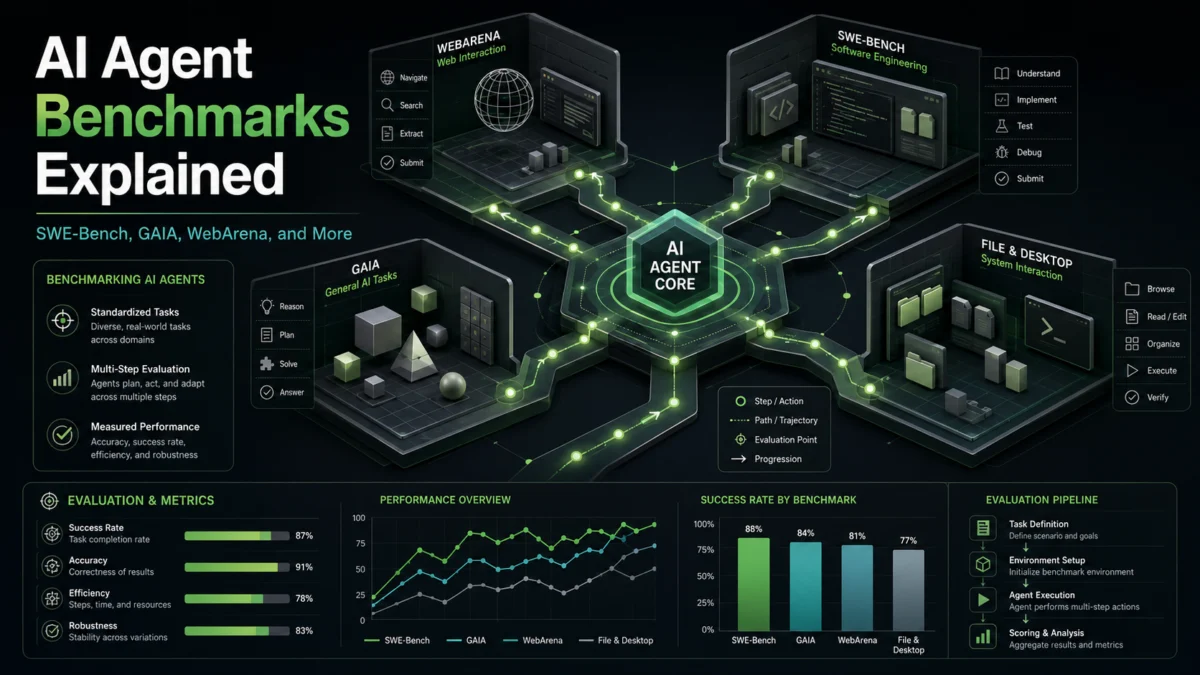

The rapid proliferation of artificial intelligence agents has transformed the software landscape, shifting the focus from static, text-generating models to autonomous systems capable of executing multi-step workflows. As AI providers continue to publish weekly updates to competitive leaderboards, the industry finds itself at a crossroads regarding how to effectively measure these systems. While marketing materials often prioritize high-percentage success rates, engineers tasked with deploying these agents in production environments increasingly realize that public benchmarks serve better as directional indicators than as definitive guarantees of reliability.
The Evolution of Model Evaluation
The genesis of AI benchmarking dates back to early natural language processing assessments like MMLU (Massive Multitask Language Understanding) and HumanEval. These legacy metrics were designed to evaluate a model’s "zero-shot" or "few-shot" reasoning capabilities—essentially, how well a system could answer a single prompt without external interaction. While these scores remain relevant for measuring the fundamental intelligence of Large Language Models (LLMs), they fail to capture the complexity of an agentive system.
The modern shift toward agent benchmarks represents a move from passive intelligence to active execution. Unlike traditional evaluations, which operate in a vacuum, agent benchmarks require a system to navigate external tools, manage state across long-term processes, and recover from failures in real-time. This transition mirrors the evolution of the field itself: moving from systems that "know" to systems that "do."
Chronology and the Rise of Specialized Benchmarks
As agents began to move into software engineering, research, and web-based tasks, the research community introduced specialized frameworks to measure performance in these specific domains.
- 2023 (SWE-bench): Introduced by Princeton University researchers, SWE-bench provided the first rigorous environment for testing AI on real-world software engineering issues. By requiring agents to resolve GitHub issues in popular open-source repositories like scikit-learn, it moved beyond theoretical coding exercises to authentic, messy codebase maintenance.
- Late 2023 (GAIA): Recognizing that agents needed to synthesize information across tools, the GAIA (General AI Assistants) benchmark was launched. It focuses on tasks that are trivial for humans but difficult for AI, such as retrieving a specific document and cross-referencing it with a live data source.
- 2024 (WebArena and OSWorld): These frameworks marked the move toward environment-centric evaluation. WebArena provided a sandbox for browser navigation, while OSWorld pushed the boundary to full-system operation, forcing agents to interface with operating system GUIs and file systems.
Analysis of Major Benchmarking Frameworks
Each benchmark serves a specific purpose, yet each possesses distinct limitations that stakeholders must recognize before integrating them into their decision-making processes.
SWE-bench and the "Verified" Subset
SWE-bench remains the gold standard for software engineering. However, the introduction of "SWE-bench Verified" was a critical development in 2024. It addressed the "noisy data" problem—instances where test suites were broken or tasks were unsolvable. Even with this verification, the benchmark measures only the output of a functional patch. It does not account for the maintainability, security, or "technical debt" introduced by the AI. An agent might pass a unit test while simultaneously creating a vulnerability or writing inefficient code that would be rejected in a professional code review.
GAIA and the Multi-Tool Challenge
GAIA serves as a test of orchestration. It evaluates whether an agent can utilize tools sequentially—such as browsing, then calculating, then writing—without losing the thread of the user’s intent. The limitation here lies in the "correct answer" bias. Many GAIA questions have singular, factual answers, which do not reflect the ambiguity of real-world enterprise tasks, where success is often subjective or requires balancing competing priorities.
WebArena and the Contamination Risk
WebArena provides a sandbox for agents to function as digital employees, interacting with e-commerce and forum platforms. A significant concern here is data contamination; because these tasks are increasingly used in training sets, newer models may be "memorizing" the environment rather than reasoning through it. This creates a risk where high leaderboard scores mask a lack of true generalizability.
OSWorld: The Complexity Frontier
OSWorld represents the most ambitious attempt to date to simulate a human’s desktop experience. While it mirrors the complexity of real work, it is inherently fragile. The benchmark relies on the stability of the underlying GUI and simulated OS, meaning a low score might reflect an agent’s failure or, conversely, a failure in the simulation environment itself.
The Hidden Costs of Performance
While leaderboards highlight success rates, they systematically ignore the metrics that drive production costs: latency, token consumption, and compute efficiency. A model that achieves a 90% success rate on a benchmark might do so by running hundreds of speculative, redundant API calls, making it commercially unviable.
Furthermore, the industry lacks a standardized "safety benchmark." Current evaluations do not consistently measure how an agent handles boundary-following or how it reacts to ambiguous instructions that could lead to unauthorized file deletion or incorrect data transmission. As organizations transition from prototyping to production, these safety and cost factors will likely become the primary drivers of model selection, rather than top-line accuracy scores.
Industry Implications and Best Practices
The consensus among AI developers is that while public leaderboards provide a helpful initial filter, they are insufficient for mission-critical deployments. The most successful organizations are currently adopting a "filter and customize" strategy:
- Use Leaderboards as a Filter: Eliminate models or architectures that fail to perform on core benchmarks like SWE-bench or WebArena. This narrows the field to the most capable contenders.
- Develop Private, Task-Specific Evaluations: The only reliable metric for a production-grade agent is its performance on the specific, proprietary tasks it will be hired to perform. If an agent is designed to manage customer support tickets, it must be evaluated on actual historical ticket data, not general-purpose reasoning benchmarks.
- Implement Human-in-the-Loop Monitoring: Given the "automated grading noise" identified in many benchmarks, organizations should maintain a human-in-the-loop component for all high-stakes agent workflows. Automated graders are prone to being fooled by confident, incorrect answers—a phenomenon known in the industry as "hallucination inflation."
Conclusion
As AI agent technology continues to mature, the gap between controlled benchmark environments and the chaotic nature of real-world production will persist. These benchmarks are not flawed; they are merely specialized tools that provide a snapshot of capability under ideal, static conditions.
The future of agent evaluation lies in the creation of more dynamic, adaptive testing suites that incorporate error recovery, cost analysis, and safety parameters. Until such industry-wide standards are established, practitioners must treat existing leaderboards as a starting point for exploration, not the final word in quality assurance. By building bespoke evaluation frameworks that reflect their unique operational needs, organizations can move beyond the "leaderboard noise" and deploy agents that are not only intelligent but reliable and sustainable.
