
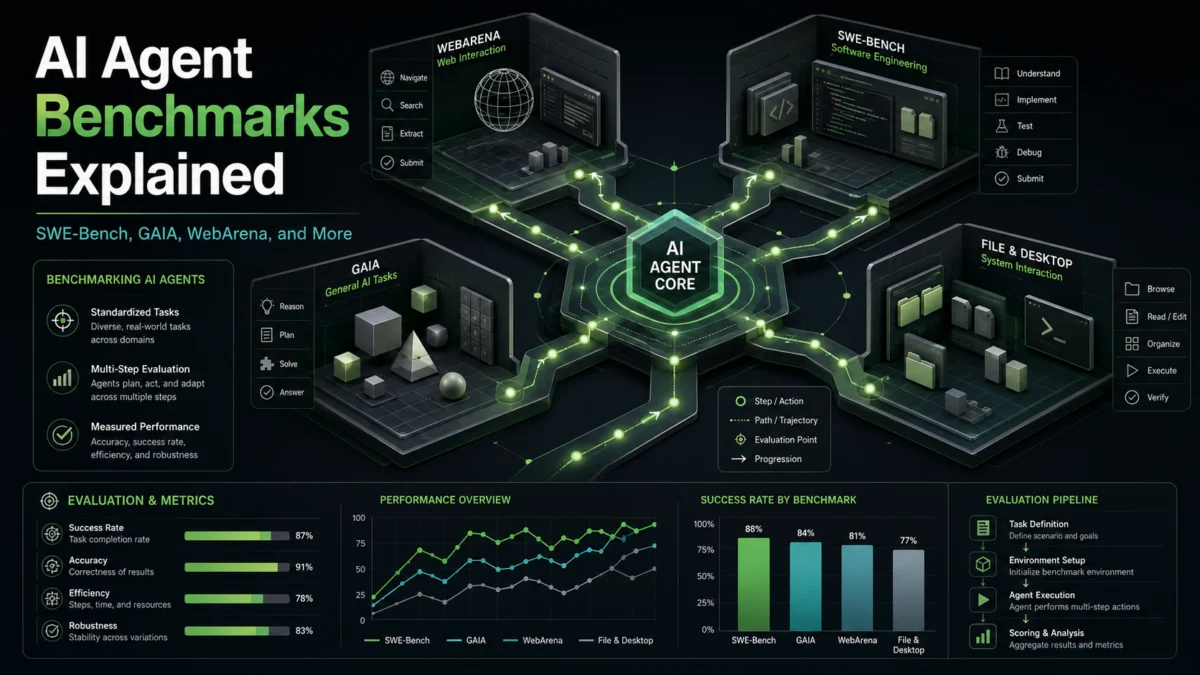

The artificial intelligence industry has reached a pivotal junction where raw parameter counts and static language modeling benchmarks no longer suffice for enterprise-level deployments. As the focus shifts from generative text models to autonomous "agents"—systems capable of executing multi-step workflows, navigating digital environments, and utilizing external software—the industry has scrambled to create new evaluation frameworks. Today, providers compete for dominance on leaderboards like SWE-bench, GAIA, and WebArena. However, for organizations tasked with integrating these agents into production environments, these metrics often serve as poor proxies for actual reliability. Understanding the divergence between benchmark performance and real-world utility has become a critical competency for engineers and stakeholders alike.
The Evolution of Evaluation: From Static to Dynamic
The history of AI evaluation is rooted in the "one-shot" paradigm. Early benchmarks like MMLU (Massive Multitask Language Understanding), introduced in 2020, were designed to assess a model’s world knowledge and reasoning capabilities through static, multiple-choice questioning. By 2021, HumanEval and MBPP emerged, focusing on the ability of models to write functional code snippets from scratch. These tests functioned like a traditional written exam: the model provides a single output, and a deterministic judge verifies the correctness.
The current shift toward agentic evaluation marks a departure from this static model. Agents operate in environments—browsers, operating systems, or IDEs—where the "ground truth" is not a fixed string, but a successful state change. This evolution mirrors the transition in software testing from unit testing individual functions to end-to-end integration testing. An agent must maintain context over dozens of steps, handle intermittent failures in API responses, and demonstrate persistent memory. This shift is not merely additive; it is a fundamental change in the definition of a "correct" AI behavior.
Critical Analysis of Current Benchmarking Frameworks
The current cohort of benchmarks provides granular data, yet each comes with inherent limitations that developers must interpret with caution.
SWE-bench and the Software Engineering Standard
SWE-bench, developed by researchers at Princeton, represents the gold standard for software engineering agents. By requiring models to solve real-world GitHub issues in popular Python repositories, it forces the agent to navigate complex file structures and dependency trees. The introduction of "SWE-bench Verified" was a necessary corrective measure, as initial data showed that automated grading could be gamed by models that produced "correct" patches that were, in fact, non-idiomatic or insecure. Despite its prestige, SWE-bench remains a narrow window into capability. It measures the ability to manipulate code, but it does not evaluate the long-term maintainability or the architectural integrity of the resulting patches.
GAIA: Measuring Multi-Modal Reasoning
GAIA (General AI Assistants) attempts to solve the problem of "triviality" in benchmarks. While many models can answer factual queries via search, GAIA tasks are designed to require complex orchestration—such as downloading a PDF, extracting a table, performing a calculation, and synthesizing a summary. Data from the GAIA leaderboard suggests that while models are becoming increasingly adept at tool use, they frequently fail when the "search" step produces irrelevant or noisy data.
WebArena and OSWorld: Simulating the Human Interface
WebArena and its successor/companion frameworks focus on the "last mile" of AI integration: the UI. By placing agents within sandboxed browser environments or full desktop operating systems (as in the case of OSWorld), these benchmarks test the agent’s ability to interact with pixels, coordinates, and menus. The primary challenge here is environmental fragility. Research indicates that as much as 20% of agent failure in these environments can be attributed to UI jitter or unexpected system latency, rather than a failure of the model’s underlying reasoning.
The "Hidden" Costs of Performance
A major point of contention among industry analysts is the total absence of efficiency metrics in public leaderboards. In a production setting, a model that achieves 80% accuracy through an exhaustive, multi-hour "chain-of-thought" process may be commercially unviable compared to a 70% accurate model that completes the task in seconds.
The following table summarizes the primary dimensions missing from current public leaderboards:
| Metric | Why It Matters for Production | Status in Current Benchmarks |
|---|---|---|
| Latency | Impacts user experience and real-time response capability. | Generally ignored. |
| Cost (Compute) | Determines the ROI of deploying an agent. | Not standardized. |
| Safety/Boundary | Ensures the agent does not perform unauthorized actions. | Mostly qualitative. |
| Error Recovery | Measures the system’s resilience to "black swan" inputs. | Poorly documented. |
The Contamination Problem
A persistent issue threatening the validity of these benchmarks is data contamination. Because the internet is the training corpus for Large Language Models (LLMs), there is a statistically high probability that the specific tasks in WebArena or the test cases in SWE-bench have been ingested during pre-training. When an agent "solves" a benchmark, it is difficult to determine whether the model is engaging in genuine multi-step reasoning or if it is performing high-level pattern matching against a memorized solution. Leading AI labs have begun to implement "hidden test sets" to mitigate this, but the industry lacks a standardized, third-party audit mechanism to verify that training data and test data remain strictly separated.
Implications for Enterprise Adoption
For the Chief Technology Officer or the Lead Engineer, the implication is clear: public benchmarks are a directional compass, not a roadmap. They are highly effective for filtering out models that lack basic competence in a specific domain (e.g., coding or web navigation). However, they cannot predict how an agent will behave when faced with the specific, idiosyncratic, and often messy workflows of a private enterprise.
Official responses from major AI research institutions suggest a move toward "private evaluation suites." Industry leaders are increasingly advocating for a "bring-your-own-benchmark" (BYOB) approach. By creating a custom evaluation dataset—comprising real, anonymized logs from their own internal systems—organizations can test agents against the actual failures they encounter in production.
Conclusion: A Shift Toward Custom Evaluation
The era of relying on generic leaderboards to dictate enterprise AI strategy is coming to a close. While SWE-bench, GAIA, and OSWorld are vital for advancing the state of the art, they represent a laboratory-controlled environment that rarely mirrors the chaotic reality of production. Moving forward, the most successful organizations will be those that treat these public benchmarks as a preliminary screening tool, while investing heavily in internal evaluation infrastructure.
The industry is currently in a phase of rapid iteration, where the "leaderboard race" is fueled by marketing incentives as much as scientific progress. For practitioners, the priority must remain on building robust, observable, and measurable systems that prioritize safety and error recovery over the incremental gains in test scores. Ultimately, the true value of an AI agent will not be found in its ability to solve a standardized test, but in its ability to navigate the unique, unscripted, and high-stakes requirements of the organizations it is hired to support. As these technologies mature, the divide between "benchmark-optimized" systems and "production-ready" systems will likely become the defining narrative of the next decade of AI development.
