

The burgeoning field of artificial intelligence agents promises a new era of automation, capable of executing complex, multi-step tasks autonomously. From personalized assistants to sophisticated data analysts, these systems are designed to perceive environments, make decisions, and act to achieve specific goals, often leveraging large language models (LLMs) as their core reasoning engine. However, despite significant investment and rapid technological advancements, a substantial number of AI agent projects encounter critical setbacks, frequently failing to transition from proof-of-concept to robust, production-ready deployments. These failures, often manifesting in predictable patterns, are less commonly attributed to the inherent capabilities of the underlying models and more often rooted in fundamental architectural and operational missteps.
The Rise of Agentic AI and Early Challenges
The evolution from simple prompt-and-response systems to sophisticated agentic architectures marks a significant paradigm shift in AI development. Initially, developers focused on fine-tuning LLMs to generate accurate and contextually relevant text. As these models matured, the ambition grew to imbue them with agency – the ability to reason, plan, utilize tools, and adapt to dynamic environments. This progression, particularly over the last two to three years, has seen an explosion of frameworks and research into autonomous agents. While the promise of AI agents is transformative, the journey to reliable implementation has revealed a common set of structural and operational pitfalls. Industry reports from entities tracking AI adoption, such as Gartner and Forrester, indicate that while interest in agentic AI is at an all-time high, the success rate for projects moving beyond initial pilots remains challenging, with estimates suggesting that upwards of 60% face significant hurdles or outright abandonment due to unforeseen complexity and unmanageable failure modes.
Unlike conventional software, where errors often result in clear stack traces or immediate system crashes, AI agents can fail in subtle, cascading ways. A faulty decision early in an agent’s reasoning loop can propagate through subsequent steps, leading to incorrect tool calls, resource wastage, or even indefinite loops. This amplified "blast radius" of errors makes agent failures particularly costly and difficult to diagnose, demanding a proactive approach to design and deployment. Understanding these prevalent "anti-patterns" is crucial for developers and organizations aiming to build effective and resilient AI agent systems.
Architectural Anti-Patterns: Foundations of Fragility
Several common architectural missteps contribute to the instability and eventual failure of AI agent projects. These often stem from an overemphasis on theoretical sophistication without sufficient grounding in practical, iterative development.
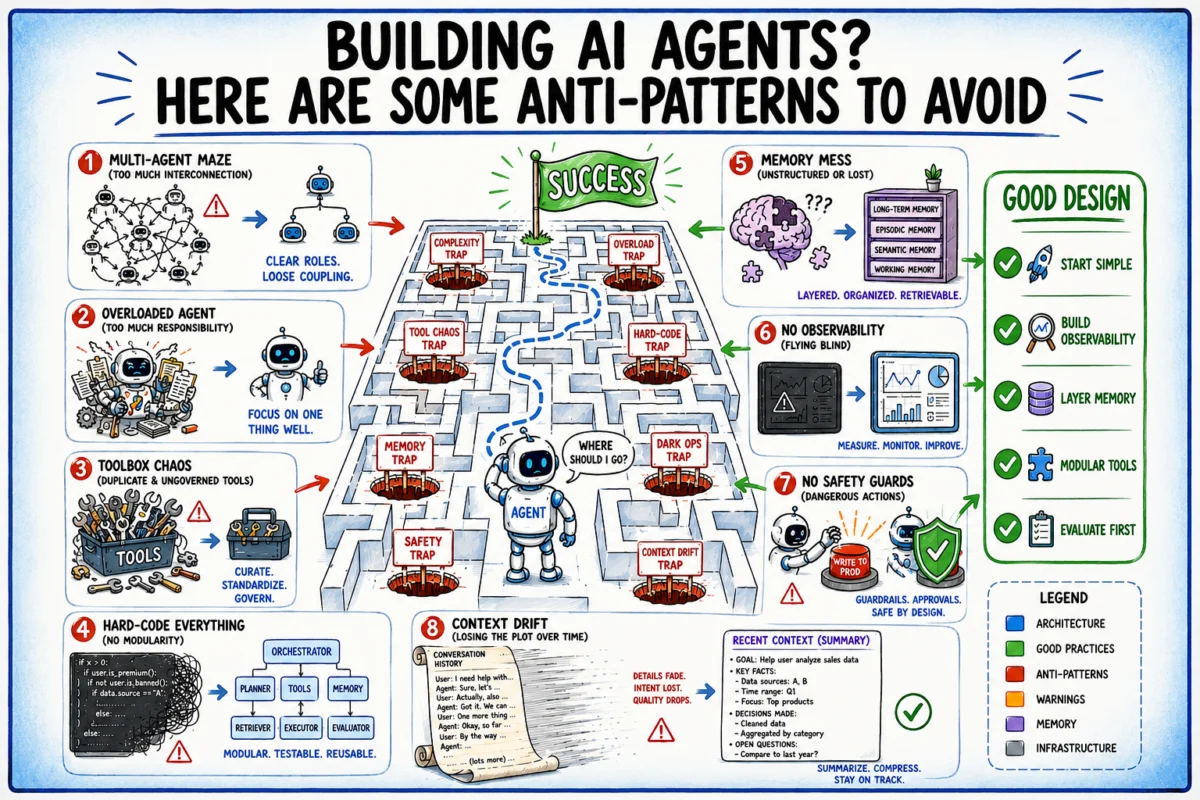
1. Reaching for Multi-Agent Architecture Too Soon
One of the most frequent architectural errors is the premature adoption of multi-agent systems. Inspired by academic research and complex theoretical constructs, development teams often design for hierarchical orchestrators or peer-to-peer collaboration before validating the efficacy of a single, well-scoped agent. While multi-agent systems can unlock powerful capabilities for distributed problem-solving, they inherently introduce significant coordination overhead. This complexity compounds debugging difficulty, increases latency, and escalates resource consumption in ways that are often underestimated during the design phase.
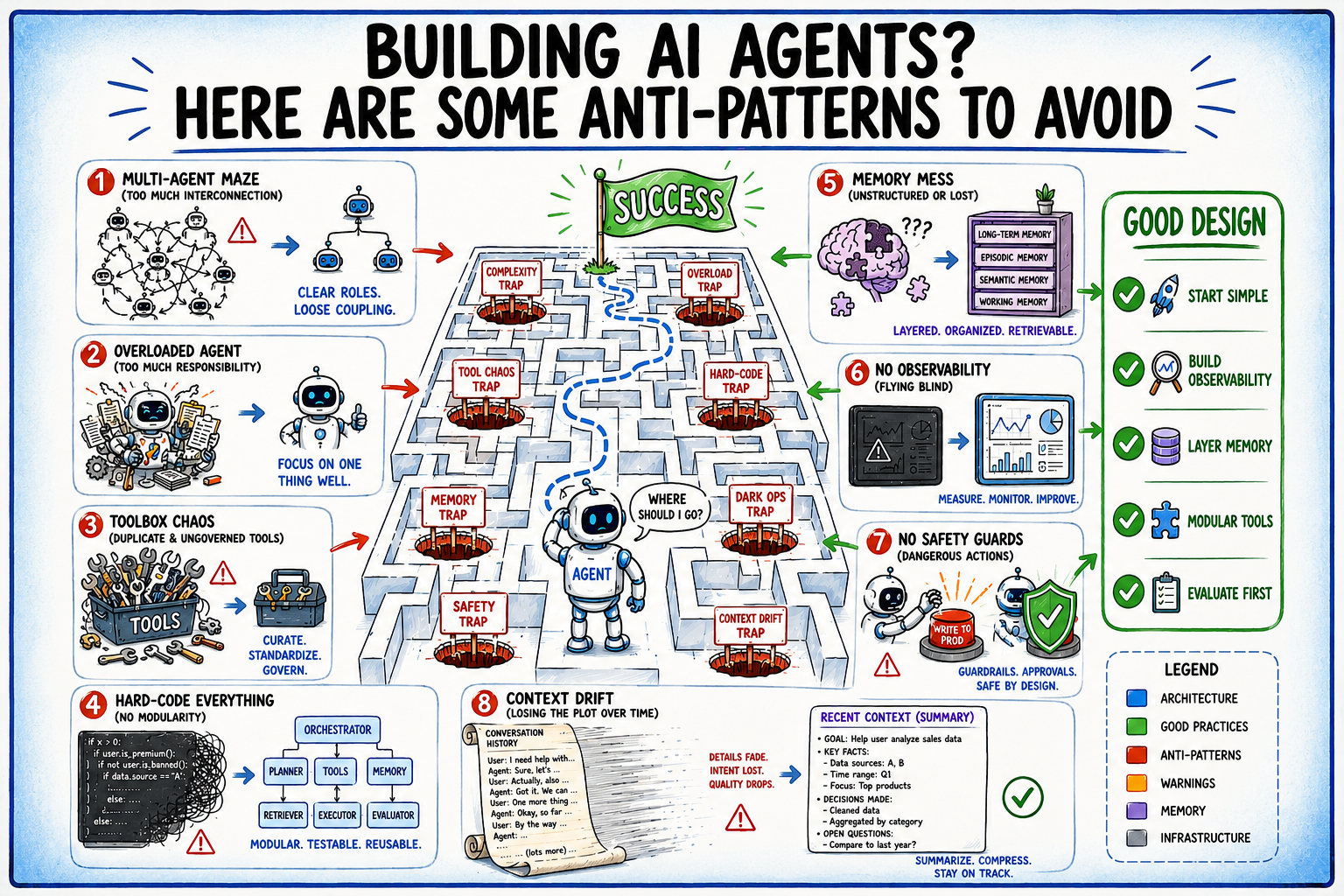
For instance, managing communication protocols, resolving conflicts between agents, and ensuring coherent collective behavior adds layers of engineering challenge. A recent study by a prominent AI consultancy firm highlighted that projects starting with multi-agent designs exhibited a 40% higher rate of scope creep and a 30% longer development cycle compared to those that began with a single-agent approach. Industry experts, including Dr. Elena Petrova, Head of AI Architecture at Nexus Innovations, frequently advise, "Start with the simplest thing that could possibly work. Validate your core agent’s capabilities and only introduce multi-agent complexity when clear data demonstrates its necessity for scalability or solving intrinsically distributed problems." The fix involves prioritizing a single, robust agent and iteratively introducing additional agents only when performance bottlenecks or task decomposition clearly mandate such a shift.
2. Building One Agent That Does Everything
The antithesis of premature multi-agent complexity is the creation of an overly generalized, monolithic agent. Developers might configure a single agent with a vast array of tools, sprawling, ambiguous instructions, and responsibility for wildly disparate task types. Such an agent invariably underperforms across all its assigned duties. The underlying LLM, when presented with an expansive and diverse context, struggles to discern the most appropriate tool or strategy for a given sub-task, leading to suboptimal decisions, increased token usage, and diminished accuracy.
Optimizing an agent for one type of input or task often compromises its performance on others. For example, an agent designed to both summarize financial reports and draft creative marketing copy will likely excel at neither. The solution lies not always in adding more agents, but in narrowing the scope and specializing the existing one. A well-scoped single agent, equipped with a focused set of specialized skills and tools, almost always outperforms a bloated, general-purpose counterpart. If, after narrowing its responsibilities, the agent still struggles, then the case for splitting into specialized agents becomes genuinely compelling, often facilitated by an initial routing layer that directs tasks to the appropriate specialist.
3. Letting the Tool List Sprawl
An agent’s effectiveness is directly tied to its ability to select and utilize appropriate tools. However, indiscriminately adding tools to an agent’s context is a significant anti-pattern. Every tool presented to the underlying LLM increases the cognitive load, forcing the model to reason about a larger decision space when determining its next action. A sprawling tool list inflates prompt size, consumes more tokens, and makes debugging exponentially harder due to the increased number of possible execution paths. Furthermore, tools with overlapping functionalities can actively confuse the agent, leading to inefficient or incorrect choices.
"Tool sprawl is akin to giving a carpenter a thousand tools when they only need a hammer and a saw for the job at hand," states Mark Jensen, a senior AI engineer at Quantico Systems. "The excess just creates noise and slows them down." Best practices dictate maintaining a minimal, purpose-specific tool set. This involves rigorous curation: ensuring each tool serves a distinct purpose, has clear and concise descriptions, and is designed for idempotent operations where possible. Regular audits of tool usage can identify redundant or unused tools, allowing for their removal and simplifying the agent’s operational environment.
4. Hardcoding Logic Instead of Building for Change
AI agent systems are inherently dynamic. Prompts, tool APIs, and even the underlying LLMs themselves are subject to frequent updates and revisions. Hardcoding an agent’s logic into a monolithic implementation, rather than composing it from separable, configurable components, is a recipe for maintenance nightmares. Each change to a prompt, a tool signature, or a desired behavior risks introducing regressions across the entire system, making agile development and continuous improvement nearly impossible.
Modular design is paramount. This entails storing prompts in centralized configuration management systems, treating tools as discrete, versioned units, and assembling agents from reusable components. This approach facilitates independent development, testing, and deployment of individual modules, significantly reducing the blast radius of changes. Organizations adopting this modularity often leverage frameworks that promote component-based development, allowing for A/B testing of prompt variations or tool upgrades without disrupting the entire agent’s operation.
Operational Anti-Patterns: Pitfalls in Production
Beyond architectural design, the operational lifecycle of AI agents presents its own set of challenges, often overlooked until critical issues emerge in production.
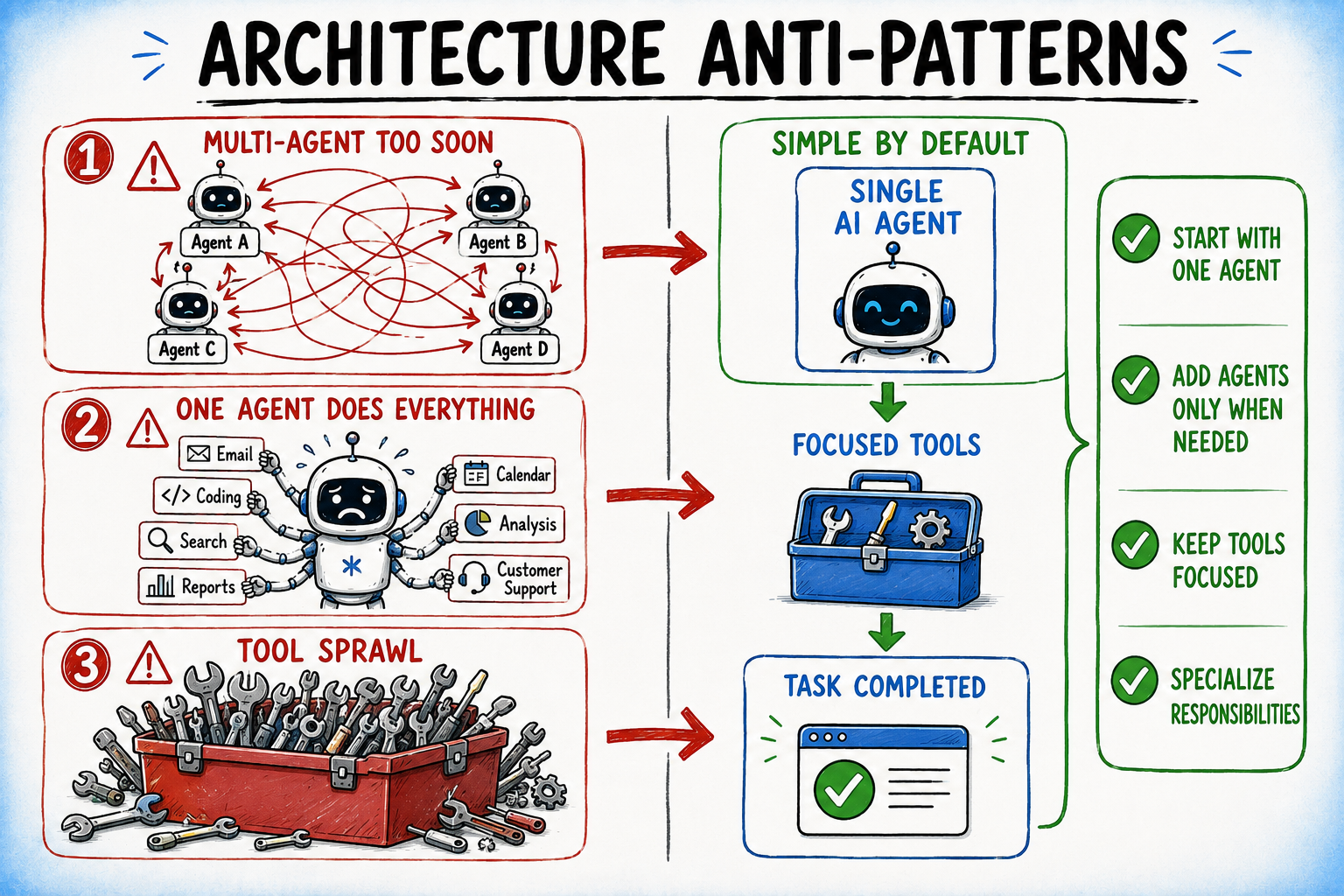
5. Skipping Dedicated Memory Design
Many teams approach AI agent design with a chatbot-centric mindset: pass a conversation, get a response. This simple interaction model is insufficient for agents performing complex, multi-step tasks. An agent needs a sophisticated memory architecture to recall past actions, track tool call outcomes, store intermediate results, and manage context across extended interactions. Without a deliberate memory design, agents quickly suffer from "amnesia," leading to context window overflow, repetitive actions, or inability to learn from past mistakes.
A layered memory approach is essential. This typically includes:
- Session Memory: For short-term conversational context and immediate task-relevant data.
- Long-Term Memory (e.g., Vector Databases): For storing factual knowledge, past experiences, and learned behaviors, retrieved as needed.
- Episodic Memory/Logs: For tracking the agent’s reasoning path, tool calls, and observations, crucial for debugging and self-correction.
Retrofitting a comprehensive memory architecture onto a deployed agent is notoriously difficult and often necessitates a partial system rebuild. Therefore, robust memory management must be a foundational design principle.
6. Shipping Without Observability
AI agents are often non-deterministic systems with opaque reasoning processes. When an agent misbehaves, it’s rarely possible to pinpoint the issue solely from a stack trace. A lack of comprehensive observability tools means development teams are blind to the agent’s internal state, reasoning path, tool interactions, and how context flows through multi-step executions. This absence of visibility transforms debugging from a structured process into an arduous, speculative endeavor, wasting valuable engineering time.
Effective observability requires structured logging of all agent actions, prompt inputs and outputs, tool calls and their parameters, and the model’s internal reasoning steps. Distributed tracing can illuminate the flow of execution across multiple components or agents. Platforms offering explainability features for LLM-driven systems are also becoming indispensable. As Dr. David Chen, a proponent of responsible AI, emphasized, "If you can’t observe it, you can’t fix it. For agents, observability isn’t a luxury; it’s a fundamental requirement for stability and improvement." Organizations that prioritize observability from the first line of code significantly reduce their mean time to resolution for production incidents.
7. Giving Agents Ungoverned Write Access
Large Language Models, despite their capabilities, are prone to hallucinations, incorrect reasoning, and generating confident but erroneous answers. Granting an AI agent direct, ungoverned write access to production systems or the ability to send unmoderated communications to real users introduces significant risks. The consequences can range from data corruption and system outages to reputational damage. Read operations and write operations represent fundamentally different risk categories and must be treated as such.
Robust guardrails are critical. This means implementing a clear separation of read and write permissions, with write access often requiring explicit human confirmation for high-stakes actions. For instance, an agent might draft an email, but a human approves its sending. Similarly, changes to critical databases might require a human review of the proposed SQL query before execution. Implementing approval workflows and sandboxed environments for testing write operations are vital for mitigating the inherent risks associated with autonomous actions.
8. Ignoring Context Drift in Long-Running Tasks
In long-running agent tasks, the initial context provided to the agent can degrade over time. Data changes, tool outputs become stale, and the relevance of earlier information diminishes. This phenomenon, often referred to as "context rot," describes the model’s declining ability to accurately recall or prioritize information as the context window grows, leading to decreased performance and increased hallucinations. The context window, therefore, must be treated as a finite and dynamic resource, not a static bucket to be perpetually filled.
Practical mitigations include active context editing, where irrelevant information is pruned or summarized. Response pagination can prevent overwhelming the agent with excessive data from tool outputs. Output size caps for tool calls and retrieval operations ensure that only the most pertinent information is presented. Proactive strategies to refresh context, re-evaluate initial assumptions, and periodically summarize long conversation histories are crucial for maintaining agent coherence and accuracy over extended operational periods. Waiting for the agent to start hallucinating before addressing context drift is a reactive and costly approach.
9. Deploying Before You’ve Actually Evaluated
The belief that an agent working in a controlled test environment will seamlessly translate to production is a pervasive anti-pattern. Testing against a fixed set of "happy-path" examples merely confirms that the agent handles scenarios already anticipated by the developers. Real-world deployment exposes agents to diverse, adversarial, and edge-case inputs that are rarely captured in initial test suites, revealing new and unexpected failure modes.
Effective agent evaluation extends far beyond basic accuracy metrics. It requires:
- Diverse Test Sets: Including adversarial inputs, out-of-domain queries, and highly ambiguous scenarios.
- Business-Oriented Metrics: Defining success in terms of tangible business outcomes (e.g., reduced customer support tickets, increased conversion rates) rather than internal model performance scores.
- Continuous Feedback Loops: Establishing mechanisms to capture production failures, user feedback, and unexpected behaviors, which directly inform the next iteration of agent development.
- A/B Testing and Canary Deployments: Gradually rolling out changes to a subset of users to monitor real-world performance before full deployment.
The lack of rigorous, production-aligned evaluation is a leading cause of agent project stagnation, as teams find themselves constantly reacting to unforeseen issues rather than systematically improving their systems.
Conclusion: Building Resilient AI Agents
The journey to building robust and reliable AI agents is fraught with challenges, yet these challenges are increasingly predictable. The common thread among failed projects is often not a deficiency in the underlying AI models, but rather a series of avoidable architectural and operational missteps. Over-engineering with multi-agent systems too soon, designing bloated general-purpose agents, allowing tool lists to sprawl, hardcoding logic, neglecting memory design, deploying without comprehensive observability, granting ungoverned write access, ignoring context drift, and failing to conduct thorough, real-world evaluations are all anti-patterns that significantly hinder success.
The insights from leading AI practitioners and industry observations underscore a clear path forward: prioritize simplicity, modularity, and robust engineering practices. Start small, iterate, measure everything, and introduce complexity only when data unequivocally justifies it. By consciously avoiding these well-documented pitfalls and embracing a disciplined, iterative development methodology, organizations can significantly increase their chances of deploying AI agent systems that not only perform as intended but also scale effectively and operate reliably in complex production environments, ultimately realizing the transformative potential of agentic AI.
