
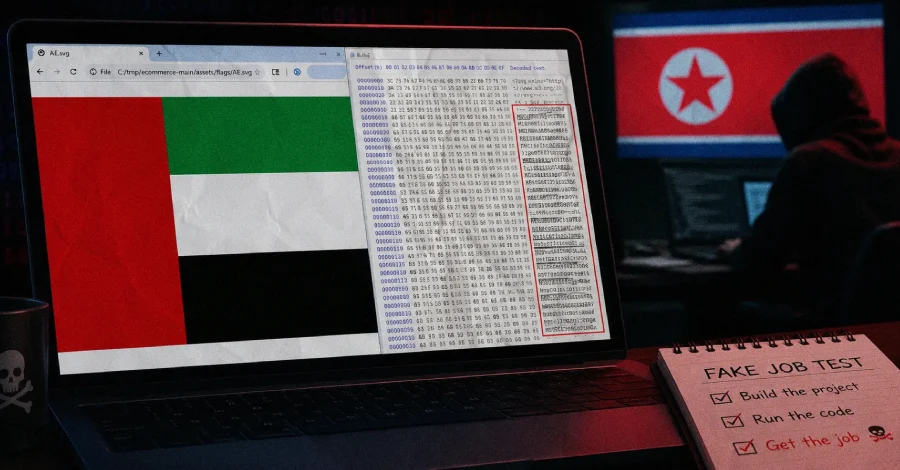

North Korean threat actors, operating under the moniker REF9403 and linked to the persistent "Contagious Interview" campaign, have escalated their tactics by employing advanced steganography within innocuous-looking SVG image files to conceal malicious payloads. This sophisticated method is part of a broader social engineering operation that leverages fake job postings and deceptive coding challenges to compromise software developers, ultimately aiming to pilfer sensitive data and cryptocurrency holdings. The revelation, detailed in a report by Elastic Security Labs on July 17, 2026, underscores the relentless and evolving nature of state-sponsored cyber warfare emanating from the Democratic People’s Republic of Korea (DPRK).
The recent campaign represents a significant refinement in the threat actors’ operational capabilities, particularly in their malware delivery mechanisms. Elastic Security Labs identified that any user who executed the compromised development project would unknowingly trigger a meticulously crafted four-stage payload. This insidious package, aligned with the notorious OTTERCOOKIE malware, is designed for comprehensive data exfiltration, encompassing a browser credential and crypto wallet stealer, a dedicated file stealer, a robust Socket.IO-based remote access trojan (RAT), and a clipboard stealer. This multi-pronged attack framework ensures maximum data compromise from infected systems.
Escalation of Social Engineering Tactics: Targeting Developer Communities
The findings by Elastic Security Labs highlight a disturbing trend: the continued and intensified targeting of software developers by state-sponsored hackers. These individuals, often possessing elevated access to critical systems and intellectual property, represent high-value targets for groups aligned with the DPRK. Their motivations are typically twofold: financial gain, often through the illicit acquisition of cryptocurrency, and intelligence gathering, aimed at bolstering the regime’s capabilities and circumventing international sanctions.
A novel initial access avenue was observed in this particular iteration of the Contagious Interview campaign, a sophisticated social engineering operation that has been active since at least December 2022. Elastic’s cybersecurity arm, responsible for the Dutch enterprise search and observability platform, discovered the campaign after the threat actors directly targeted members of its community Slack workspace. This marked a departure from previously documented attack vectors, indicating an adaptation by the attackers to infiltrate collaborative developer environments.
In late May 2026, a user identified as "Maxwell" posted messages within the #jobs Slack channel, advertising a seemingly legitimate and appealing opportunity. The post sought an experienced developer to assist with upgrading an e-commerce platform to a "modern, scalable architecture." The job description was meticulously crafted to appear credible and attractive to skilled professionals, specifying contemporary technologies such as Next.js (v14), NestJS, PostgreSQL, Auth.js, and Stripe integration. Such detailed requirements lend an air of authenticity, designed to disarm potential targets.
The Deceptive Workflow: From Lure to Compromise

Developers who expressed interest in this enticing opportunity were subsequently moved into private direct message conversations. This transition from a public channel to a private one is a common tactic in social engineering, allowing the attackers to establish a more personal rapport and apply tailored psychological manipulation. Within these private exchanges, the unsuspecting candidates were instructed to complete a "coding assessment" as a prerequisite for the purported job offer.
This coding assessment, a seemingly innocuous and standard component of many tech hiring processes, served as the critical pivot point for the attack. The assignment involved cloning and executing a trojanized repository, a common ploy in Contagious Interview campaigns. Unbeknownst to the victim, this repository, while appearing to contain functional code relevant to the job description, was meticulously embedded with malware. The primary objectives of this malicious code were the exfiltration of valuable data and the establishment of a persistent Socket.IO-based backdoor, granting the attackers covert remote access to the developer’s system.
Steganography: The Art of Concealed Malware Delivery
The ingenuity of this campaign lies in its use of steganography to evade detection. The repositories distributed by the threat actors incorporated fully functional and legitimate-looking code, designed to operate without raising immediate suspicion. However, nestled within these seemingly benign projects was malicious code ingeniously concealed within SVG (Scalable Vector Graphics) image files. SVG files, being XML-based, can contain various elements, including script tags or comments, making them a suitable medium for steganographic embedding.
Elastic Security Labs elaborated on this technique: "While these legitimate-looking projects run perfectly fine, the malicious code is triggered silently behind-the-scenes." The malware payload itself was fragmented and disguised as base64-encoded data, cleverly hidden within HTML comments across multiple SVG flag images. These images, such as "AE.svg" (United Arab Emirates flag) and "AF.svg" (Afghanistan flag), appeared to be nothing more than ordinary graphical assets within the project’s ‘assets’ directory. Yet, each file harbored an injected comment block containing a segment of the Base64-encoded malicious data.
The fragmented payload was then meticulously reassembled by a JavaScript file, specifically "serverValidation.js," which was also present within the compromised repository. This script was engineered to execute the complete malware payload seamlessly and silently. Furthermore, the attack chain was designed to ensure persistence, meaning the malware would be executed automatically every time the server (or the developer’s local development environment, if configured as such) was booted, maintaining a continuous foothold for the attackers. This level of sophistication underscores a clear intent for long-term compromise and data harvesting.
OTTERCOOKIE: A Multifaceted and Evolving Threat
The primary payload deployed in this campaign exhibited significant functional overlap with OTTERCOOKIE, a formidable cross-platform malware that first surfaced in September 2024. OTTERCOOKIE has undergone rapid evolution, demonstrating the threat actors’ continuous investment in their malicious toolset. By May 2025, an updated version, OtterCookie v4, had emerged, incorporating advanced capabilities such as virtual machine (VM) detection, designed to identify and potentially evade analysis in sandbox environments.

Microsoft, in a report issued in March 2026, had already highlighted the sophisticated trajectory of OTTERCOOKIE’s development. The tech giant noted that the malware had "evolved from a basic tool for executing remote commands and searching for crypto keys into a modular program capable of broader data theft." Its expanded capabilities include the ability to check for VM environments, install communication clients like Socket.IO for command-and-control (C2) infrastructure, exfiltrate diverse information, execute arbitrary shell commands, and dynamically load other modules to collect specific data, all while reporting results back to the attackers.
The current iteration of the malware, as observed by Elastic, incorporates four distinct and potent modules:
- Browser Credential and Cryptocurrency Wallet Stealer: This module is designed to compromise sensitive login credentials stored in web browsers and siphon off funds from various cryptocurrency wallets, a primary objective for DPRK-linked financially motivated groups.
- File Stealer: This component systematically searches for and exfiltrates files matching a specific list of extensions, allowing attackers to target documents, code, or proprietary information.
- Socket.IO-based Remote Access Trojan (RAT): This module establishes a persistent backdoor, enabling attackers to maintain remote control over the compromised system, execute arbitrary shell commands, and further explore the network.
- Clipboard Stealer: This module captures content copied to the clipboard, potentially harvesting passwords, cryptocurrency wallet addresses, or other sensitive information temporarily held there.
Additionally, the malware possesses the capability to drop Windows executables, further expanding its versatility and potential for follow-on attacks or system manipulation.
Targeting AI Tooling and Broader Implications for Supply Chains
A particularly noteworthy aspect of OTTERCOOKIE’s file-stealing capabilities is its focus on artificial intelligence (AI) coding tooling extensions. The malware specifically targets files with extensions such as .claude, .cursor, .gemini, .windsurf, .pearai, and .llama. This targeted approach strongly suggests that the threat actor is actively refining its arsenal to harvest as much information as possible related to emerging AI development, reflecting a strategic interest in cutting-edge technologies and intellectual property. The acquisition of AI-related code, models, or research could provide the DPRK with significant strategic advantages.
Furthermore, the Elastic report indicates functional overlaps between this campaign and other North Korea-linked activities. Specifically, some aspects of the data stealer and trojan used in this operation mirror those distributed via bogus npm packages, which masqueraded as Rollup polyfill tooling. This confluence of tactics suggests that the threat actors are not relying on a single vector but are actively pursuing multiple propagation methods to maximize their reach and effectiveness, adapting to various developer environments and workflows.
The broader implications of this campaign are profound, particularly concerning supply chain security. As Elastic aptly states, "This campaign reinforces that developers remain a prime target, where the compromise of a single individual can provide the initial access needed to enable far-reaching supply chain attacks against downstream organizations." The unique position of developers, often with elevated privileges and access to source code, build pipelines, and production environments, makes them an attractive gateway for adversaries. The success of such operations "underscores how compromising an individual developer can provide a path to much broader organizational impact," potentially leading to widespread data breaches, intellectual property theft, or even the introduction of backdoors into critical software.
The Persistent Threat of North Korean Cyber Warfare

The Democratic People’s Republic of Korea has long been recognized as a formidable state actor in the global cyber landscape. Groups attributed to the DPRK, such as the infamous Lazarus Group, Kimsuky, and Bluenoroff (APT38), have been implicated in a wide array of malicious activities, ranging from large-scale financial theft to sophisticated espionage and disruptive attacks. Their primary motivations are largely driven by the need to circumvent international sanctions, generate revenue for the regime, and advance its military and technological capabilities.
Past campaigns have frequently targeted financial institutions, defense contractors, cryptocurrency exchanges, and research entities worldwide. The "Contagious Interview" campaign, active since late 2022, exemplifies their strategic shift towards targeting human vulnerabilities through elaborate social engineering. This approach bypasses many traditional technical security controls, relying instead on deception and trust. The consistent refinement of their malware (like OTTERCOOKIE) and delivery methods (like SVG steganography and Slack lures) highlights a well-resourced and highly adaptive adversary.
Recommendations and Future Outlook
In light of these persistent threats, cybersecurity experts and organizations are issuing urgent calls for heightened vigilance. Developers, in particular, must exercise extreme caution when evaluating unsolicited job offers, even those appearing in trusted community channels. Recommendations include:
- Verification: Always independently verify the legitimacy of job offers and recruiters through official company channels, not just direct messages.
- Sandboxing: Execute coding challenges and unfamiliar code in isolated, sandboxed environments to prevent potential malware from impacting core systems.
- Multi-Factor Authentication (MFA): Implement MFA on all accounts, especially those related to development environments, code repositories, and cryptocurrency wallets.
- Security Awareness Training: Regular training for all employees, particularly developers, on identifying social engineering tactics and phishing attempts.
- Endpoint Detection and Response (EDR): Deploy robust EDR solutions that can detect anomalous behavior and advanced threats, including steganography-based attacks.
- Supply Chain Security Audits: Organizations should conduct regular audits of their software supply chain to identify and mitigate potential vulnerabilities introduced through third-party components or developer compromises.
The continuous evolution of North Korean cyber tactics, marked by the use of novel techniques like SVG steganography and the exploitation of developer community platforms, underscores the dynamic nature of cyber threats. As technology advances, so too do the methods of state-sponsored actors seeking to exploit it. The compromise of a single developer can indeed trigger a cascade of detrimental impacts, making proactive security measures and an informed, skeptical approach paramount for individuals and organizations alike in safeguarding against these increasingly sophisticated adversaries.
