
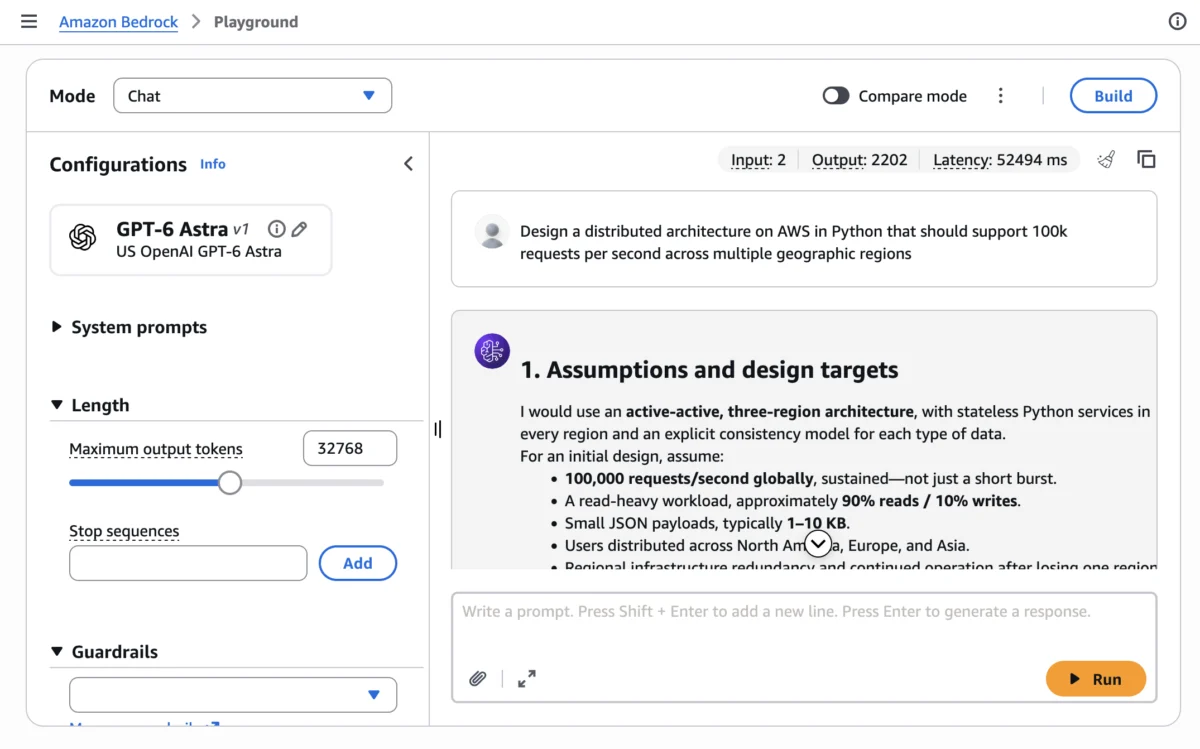

The crisp transition into mid-September in New York City traditionally signals an acceleration in seasonal commerce, but within the technology sector, it marks a parallel surge in enterprise product deployments. This year, Amazon Web Services (AWS) has anchored its autumn release calendar around major artificial intelligence integrations, highlighted by a landmark infrastructure announcement that merges OpenAI’s most advanced frontier model with Amazon Bedrock. For enterprise organizations navigating complex computational and analytical workflows, the integration of cutting-edge foundational models into secure, managed cloud environments represents a pivotal shift in how scalable AI is deployed.
The headline development—the general availability of OpenAI’s GPT-6 Astra on Amazon Bedrock—brings an unprecedented level of machine reasoning, professional-grade synthesis, and autonomous task execution to AWS customers. This rollout represents the culmination of a multi-year trend toward deepening interoperability between leading frontier model developers and enterprise-grade cloud providers. As organizations increasingly move beyond exploratory generative AI pilots toward mission-critical deployments, the demand for high-capacity models supported by robust data governance, stringent security controls, and scalable infrastructure has reached an inflection point.
Architectural Overview and Technical Capabilities of GPT-6 Astra
At the core of this announcement is the debut of GPT-6 Astra, designated by OpenAI as its most sophisticated model architecture to date. Designed specifically to tackle demanding professional environments, the model introduces several foundational advancements over its predecessors, moving past simple text generation into complex, multi-step problem solving and autonomous execution.
One of the most notable technical specifications of GPT-6 Astra is its expansive context window, capable of processing up to 1 million input tokens in a single request. This high capacity fundamentally alters how software engineers, legal teams, and enterprise researchers interact with large repositories of information. Rather than fragmenting data into smaller chunks or relying on imprecise retrieval-augmented generation (RAG) approximations, users can input entire multi-million-line codebases, extensive multi-year corporate contracts, or comprehensive regulatory documentation libraries directly into the model. GPT-6 Astra can subsequently analyze, reconcile, and synthesize these massive inputs, identifying discrepancies, cross-referencing clauses, or refactoring legacy software systems with unprecedented precision.
Furthermore, the model exhibits significantly enhanced reasoning and judgment capabilities, engineered to minimize hallucinations and deliver reliable, deterministic outputs suitable for regulated industries. Alongside these analytical upgrades, GPT-6 Astra introduces advanced computer and browser-use capabilities. This enables the model to interact dynamically with software interfaces, execute multi-step digital workflows, and autonomously navigate web-based platforms to retrieve and process data in real time.
Integration and Security Architecture on Amazon Bedrock
Deploying a model of this magnitude within an enterprise framework requires rigorous security, access control, and data privacy guarantees. Through Amazon Bedrock, organizations can access GPT-6 Astra using standard, supported APIs or configure integrated developer environments such as ChatGPT Work and Codex to interface seamlessly with the model.
To mitigate enterprise concerns regarding data exposure and intellectual property leakage, AWS and OpenAI have implemented strict governance guardrails. Inference data processed through Amazon Bedrock is explicitly excluded from being used to train or fine-tune foundational models, ensuring that proprietary corporate assets remain confidential. Additionally, customers retain full control over their workloads by leveraging established AWS security services, including AWS Identity and Access Management (IAM) for granular access control, AWS CloudTrail for comprehensive auditing of model invocation activity, and Virtual Private Cloud (VPC) configurations to isolate network traffic.
Complementing these infrastructure-level controls, OpenAI is introducing new enterprise plugins for ChatGPT Work. These extensions are designed to scale Astra’s browser-use capabilities safely across standard enterprise software applications, allowing administrative teams to automate repetitive administrative, logistical, and technical tasks without compromising organizational security postures.
Industry Context and the Evolution of Generative AI Deployment
The integration of OpenAI’s flagship model into Amazon Bedrock reflects a broader maturation phase within the artificial intelligence market. Over the past three years, enterprise adoption has evolved through distinct phases: initial experimentation with basic large language models, a subsequent focus on workflow automation and specialized fine-tuning, and now, a definitive shift toward enterprise-wide integration of autonomous agents and multimodal reasoning engines.

Historically, organizations faced a difficult trade-off between leveraging the absolute highest-performing frontier models—which were often restricted to closed, standalone consumer platforms—and utilizing secure, enterprise-ready cloud architectures that offered reliable compliance frameworks. By bridging this gap, cloud providers are attempting to capture the growing share of enterprise budgets dedicated to digital transformation and AI infrastructure.
Market analysts note that the productivity gains realized by organizations deploying advanced AI agents are increasingly tied to workflow redesign rather than mere tool adoption. Enterprises that restructure their operational processes to accommodate autonomous multi-step reasoning models consistently report higher efficiency yields compared to those simply substituting legacy software with conversational interfaces. The capability of models like GPT-6 Astra to autonomously operate within browser environments and execute cross-platform tasks represents a critical stepping stone toward true enterprise automation.
Developer Ecosystem and Future Outlook
Alongside the GPT-6 Astra launch, the AWS ecosystem continues to expand its support network for modern application developers. Through resources such as the AWS Builder Center, developers have access to collaborative platforms designed to share solutions, troubleshoot complex integrations, and stay abreast of rapid infrastructural updates. The frequency of these updates underscores the accelerated pace of innovation currently defining the cloud and artificial intelligence sectors.
As the enterprise AI market matures, the differentiation between competing cloud platforms will likely hinge on their ability to offer seamless access to state-of-the-art models while maintaining uncompromised security, compliance, and cost-efficiency. The general availability of GPT-6 Astra on Amazon Bedrock serves as a bellwether for the industry, demonstrating that the future of enterprise computing relies on a collaborative ecosystem where infrastructure providers and frontier model developers converge to meet the rigorous demands of global commerce. Industry observers will be closely monitoring adoption metrics and early enterprise case studies in the coming months to measure the real-world operational impact of these advanced multimodal reasoning systems at scale.
