

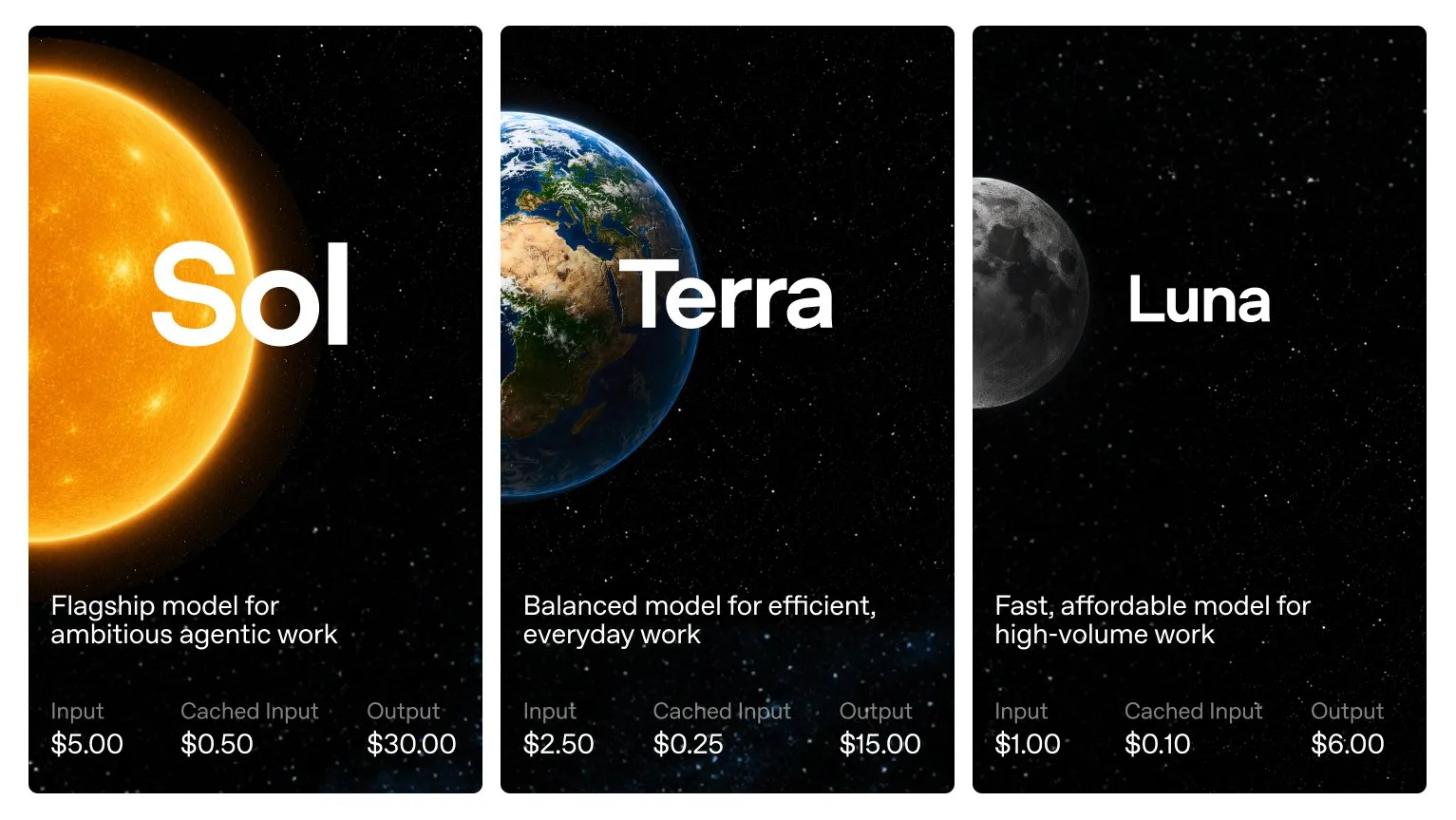
OpenAI has officially launched its latest flagship artificial intelligence model, GPT-5.6, making it available to the general public today. This significant release marks a departure from the company’s traditional numerical model designations, introducing a new naming convention with the introduction of "Sol," the premium model. Alongside Sol, OpenAI has also rolled out two more accessible siblings: "Terra," positioned as an everyday model, and "Luna," a more budget-friendly option. This strategic tiered release follows a brief, two-week restricted preview period managed by the U.S. Department of Commerce, which granted access to approximately 20 trusted partners.
This shift to named models signifies a new phase for OpenAI, moving beyond purely numerical identifiers to delineate distinct capability tiers. Sol, the apex model, is now accessible, promising state-of-the-art performance. Terra is engineered to offer performance comparable to GPT-5.5 but at half the price, aiming to democratize access to advanced AI capabilities for a wider range of users and applications. Luna, the most economical option, further expands OpenAI’s market reach by catering to users with more cost-sensitive needs. This tiered approach suggests a dynamic pricing and capability structure, allowing each model to evolve independently based on its specific performance benchmarks and market demand.
The pricing structure for Sol has been detailed, with input and output tokens priced at $5 and $30 per million, respectively. This positions Sol as a premium offering in the AI market. For context, the cost of tokens is a crucial metric for developers and businesses integrating AI into their services, as it directly impacts operational expenses. Tokens represent the smallest units of information that an AI model can process, and per-token pricing is standard for API services. The introduction of Terra and Luna suggests a strategy to capture different segments of the market, from enterprise-level applications requiring top-tier performance to smaller businesses and individual developers seeking cost-effective solutions.
Beyond the model tiers, OpenAI has also introduced new control mechanisms for Sol. Users can now leverage a "max reasoning effort" setting, allowing the model to dedicate more computational resources and time to complex problem-solving tasks, thereby potentially enhancing its depth of analysis and accuracy. Furthermore, an "ultra mode" has been integrated, which enables Sol to delegate specific tasks to specialized sub-agents, a feature designed to optimize performance and efficiency for intricate workflows. This modular approach to AI execution hints at a more sophisticated architecture, allowing for specialized problem-solving through distributed AI processing.
Competitive Landscape and Pricing Analysis

The launch of GPT-5.6, particularly Sol, places OpenAI directly in competition with other leading AI providers, with pricing becoming a critical differentiator. OpenAI’s pricing for Sol at $5/$30 per million tokens positions it within the higher tier of the market. For comparative analysis, Anthropic’s Claude Fable 5 is priced at $10/$50 per million tokens, while Google’s Gemini 3.1 Pro commands $2/$12 per million tokens. xAI’s Grok 4.5 is positioned aggressively at $15/$75 per million tokens.
The international AI landscape also presents significant competitive pressures, particularly from China. DeepSeek’s V4 Pro is available at a substantially lower rate of $1.74/$3.48 per million tokens, and Xiaomi’s MiMo v2.5 Pro offers an even more competitive price point of $1/$5 per million tokens. This comparison illustrates that while Sol represents OpenAI’s premium offering, it operates in a market where significant price competition exists, especially from Asian tech giants. OpenAI appears to be balancing its premium positioning with the introduction of more affordable options like Terra and Luna, aiming to cater to a broad spectrum of market demands.
Performance Benchmarks and Capabilities
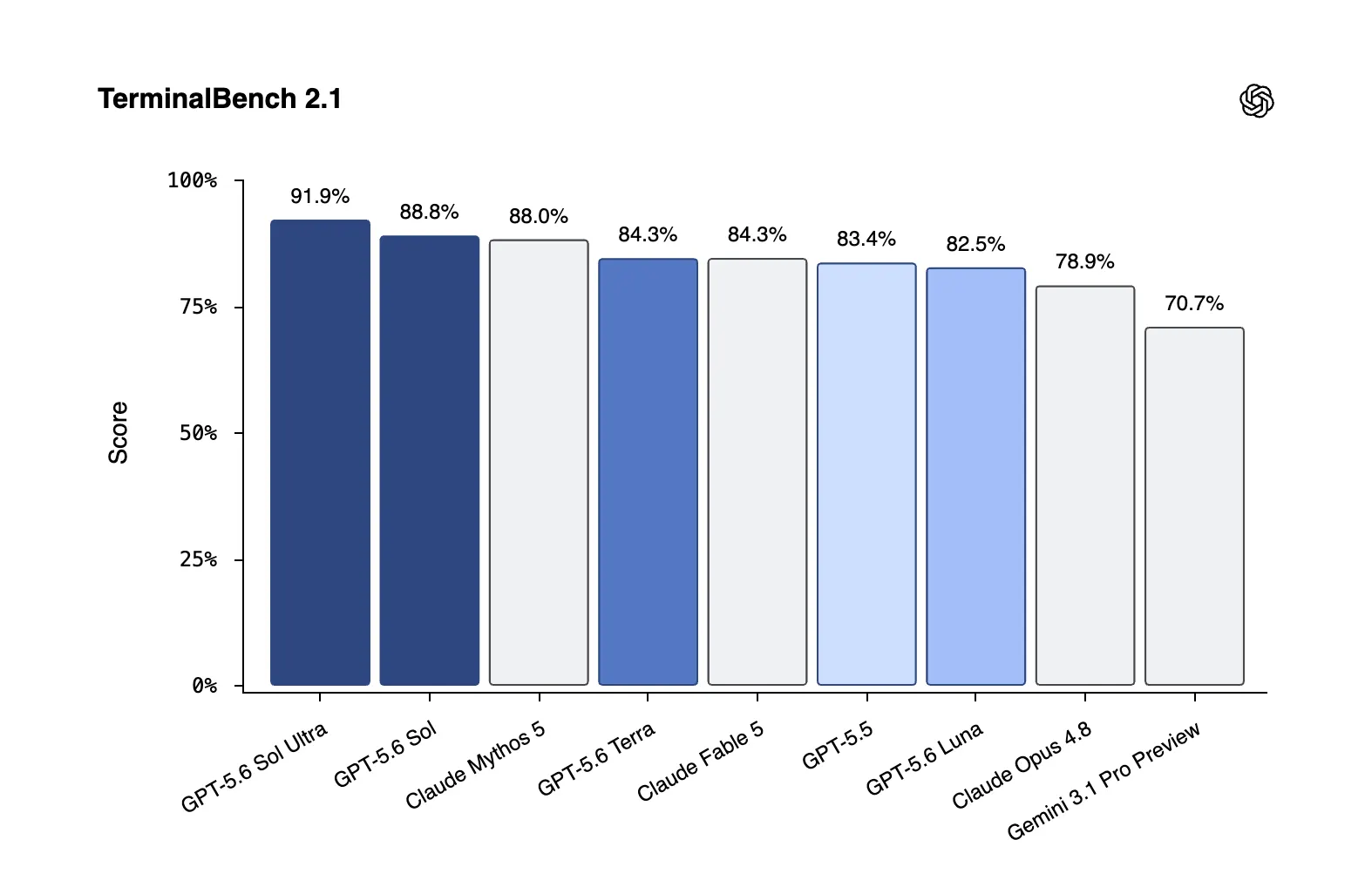
Early performance data released by OpenAI highlights Sol’s impressive capabilities across various benchmarks. On the Terminal-Bench 2.1, a test designed to evaluate a model’s proficiency in command-line workflows, planning, tool utilization, and iterative problem-solving, Sol achieved remarkable results. In its ultra configuration, Sol successfully completed 91.9% of tasks, with the standard Sol configuration not far behind at 88.8%.
These figures place both configurations of Sol ahead of several prominent competitors. Anthropic’s Claude Mythos 5 scored 88.0%, Claude Fable 5 achieved 84.3%, and Claude Opus 4.8 recorded 78.9%. Google’s Gemini 3.1 Pro Preview trailed the field with a 70.7% success rate on this specific benchmark. The Terminal-Bench 2.1 is particularly relevant for developers and IT professionals, as it directly assesses the AI’s utility in practical, real-world computing tasks.
OpenAI also focused on Sol’s cybersecurity prowess, reporting strong performance on the ExploitBench. This benchmark measures a model’s ability to identify and exploit software vulnerabilities. Sol reportedly matched the performance of the restricted Mythos Preview while utilizing approximately one-third of the tokens compared to its competitor. Importantly, OpenAI asserts that Sol still adheres to its internal "Cyber Critical" safety framework, indicating that despite its advanced capabilities in this domain, it has not crossed predefined ethical or safety thresholds. This careful balance between offensive capability and safety is a critical aspect of responsible AI development.
Expert and Early Adopter Reactions
The initial reactions from early testers and prominent figures in the AI community have been largely positive, offering valuable insights into Sol’s real-world performance and potential impact. Theo, a well-known AI developer, YouTuber, and CEO of the AI platform T3 Chat, described Sol as "world leading in computer use" and indicated that it addressed his prior concerns with GPT-5.5. Theo specifically noted Sol’s "incredible determination," citing its ability to engage in extended tasks for up to a day without explicit goals, and its sophisticated understanding of sub-agents.
Dan Shipper, whose team at Every extensively tested GPT-5.6 for a month, provided a nuanced comparison to Anthropic’s Fable. He characterized GPT-5.6 as akin to a "Porsche," emphasizing its excellence as a daily driver for knowledge work and coding, while describing Fable as a "warp drive," suggesting it is reserved for more extraordinary or distant tasks. This analogy highlights Sol’s balance of power, speed, and day-to-day usability.
Researcher Daichi Konno, who also had early access, observed that Sol demonstrably surpasses GPT-5.5 and closely rivals Fable 5. However, Konno noted that Anthropic’s model may still hold an edge in creative writing tasks. A particularly noteworthy observation from Konno was that Sol’s safety mechanisms did not trigger when presented with life-science related queries. He posited that this characteristic could position Sol as a default choice for research and work in the biological sciences.
Industry Dynamics and Future Outlook
The launch of GPT-5.6 arrives amidst a highly dynamic and competitive AI landscape. Leaked information and industry speculation suggest that GPT-5.6 may represent the culmination of the 5.x series, with the next major iteration, GPT-6, potentially built on a significantly larger foundational model and expected to arrive within approximately one month. This rapid pace of development is a hallmark of the current AI race.
The timing of Sol’s release is also strategic, coinciding with several other significant market movements. Anthropic’s Fable 5, which recently returned to global availability after export controls were lifted on July 1, has transitioned to a usage-credit-only model after its 50% weekly allowance expired on July 7. This shift in Fable 5’s accessibility could influence user migration patterns.
The frontier of AI is becoming increasingly crowded. SpaceXAI launched Grok 4.5 just yesterday, offering a product that Elon Musk described as "roughly comparable to Opus 4.7, but much faster," and at a significantly lower price point. Meta also entered the fray this morning with the release of Muse Spark 1.1, its first paid model. While neither Grok 4.5 nor Muse Spark 1.1 are reported to lead the pack in all benchmarks, their emergence underscores the intense competition among major tech players to offer cutting-edge AI solutions.
In this context, Google stands out as the major U.S. AI laboratory that has not yet refreshed its flagship model in this recent wave of releases. Its current top-tier offering, Gemini 3, launched in November 2025, making it the oldest among the current leading frontier models from OpenAI, Anthropic, xAI, and Meta, all of which have seen significant updates within the past week. This sustained period without a major flagship update from Google may indicate a strategic pause or a focus on upcoming advancements. The continuous innovation and rapid iteration observed across the industry highlight the accelerating pace of artificial intelligence development and its profound implications for various sectors.
