

The landscape of open-source artificial intelligence tooling is undergoing a fundamental transformation as Anomaly formally unveils OpenCode 2.0. Arriving approximately three months after its initial public beta phase, this major architectural overhaul introduces a persistent, unified background service that links terminal, web, and desktop interfaces. Furthermore, the release brings a completely re-engineered API, a modular embeddable SDK, and native support for asynchronous background execution of subagents and shell commands.
Developed by the team behind Serverless Stack (SST)—including founders Jay V and Frank Wang, alongside prominent engineer Dax Raad—OpenCode has captured the attention of software engineers globally. The platform’s GitHub repository has surged past 212,000 stars and nearly 30,000 forks. This latest iteration is designed to address the complex demands of millions of daily users, providing a more robust, adaptable foundation capable of scaling alongside rapid advancements in AI agent capabilities.
The Evolution of OpenCode: From Serverless Roots to Multi-Model Freedom
The origins of OpenCode trace back to the serverless development ecosystem, where its creators established a reputation for building scalable infrastructure tools for Amazon Web Services (AWS). When Anomaly shifted its focus toward AI-assisted development, the core design philosophy centered on granting developers absolute freedom over the underlying artificial intelligence models powering their workflows.

This commitment to model flexibility proved critically important in early 2025. Following policy adjustments by industry leaders like Anthropic—which restricted unauthorized third-party harness access to Claude Pro and Max credentials—developers faced mounting pressure to find alternative routing methods. OpenCode filled this vacuum effectively, allowing technical teams to seamlessly switch between competing proprietary and open-weight models without friction.
Market validation for this architectural approach has grown steadily. Throughout 2025 and 2026, the open-source coding agent ecosystem witnessed increased corporate consolidation and developer adoption. Notably, Anaconda’s acquisition of Kilo—another open-source coding agent that had previously rebuilt its command-line interface and Visual Studio Code extension on top of OpenCode—highlighted the platform’s rising utility as foundational infrastructure for broader developer tooling.
Despite its rapid adoption, the journey to version 2.0 encountered minor logistical hurdles. Anomaly’s iterative, continuous-deployment strategy over the preceding months led to some confusion within developer communities regarding stability and missing formal release notes. Monday’s official deployment of the 2.x changelog series definitively resolves these ambiguities, establishing version 2.0 as the stable production standard and outlining the technical rationale behind its creation.
A Unified Client-Server Architecture
At the heart of OpenCode 2.0 is a profound structural shift in how the coding agent executes tasks and communicates across different device interfaces. While rudimentary client-server plumbing existed in earlier iterations, it remained largely underutilized outside of power-user environments.

In version 2.0, this architecture is fully operationalized. A single, automated background service initializes upon system startup, acting as a centralized hub for all interactions. Consequently, terminal, browser, and desktop clients now interface directly with the same persistent background process.
This design paradigm unlocks new operational workflows. A developer can initiate a complex debugging session within the terminal interface, seamlessly transition to the desktop or web application to review progress, and execute automated maintenance scripts that hook into the local service simultaneously. Furthermore, programmatic clients can autonomously discover and communicate with the local instance, facilitating scheduled background tasks or secure network exposure for remote pairing applications.
Redesigned API and Embeddable SDK
Accompanying the unified backend is a ground-up redesign of OpenCode’s application programming interface. Anomaly’s engineering team has openly acknowledged that the legacy API evolved organically alongside the broader industry’s evolving understanding of AI agent utilities, resulting in a fragmented developer experience.
The newly introduced API grants autonomous agents significantly higher degrees of environment control. Agents are now equipped to programmatically generate Git worktrees for isolated feature development, transfer active sessions between workspaces, or autonomously detect and terminate unresponsive sub-processes. Access to these capabilities is facilitated through the newly minted @opencode/client package, which natively supports standard JavaScript as well as Effect-based paradigms.

In tandem, Anomaly has released an embeddable software development kit under the @opencode/sdk nomenclature. This library enables software teams to embed OpenCode directly into proprietary enterprise applications and serverless environments, such as Cloudflare Durable Objects. By leveraging the same codebase as the command-line interface, the SDK maintains full protocol compatibility with standard OpenCode clients while offering extensive customization options.
Code Mode and Efficient Context Management
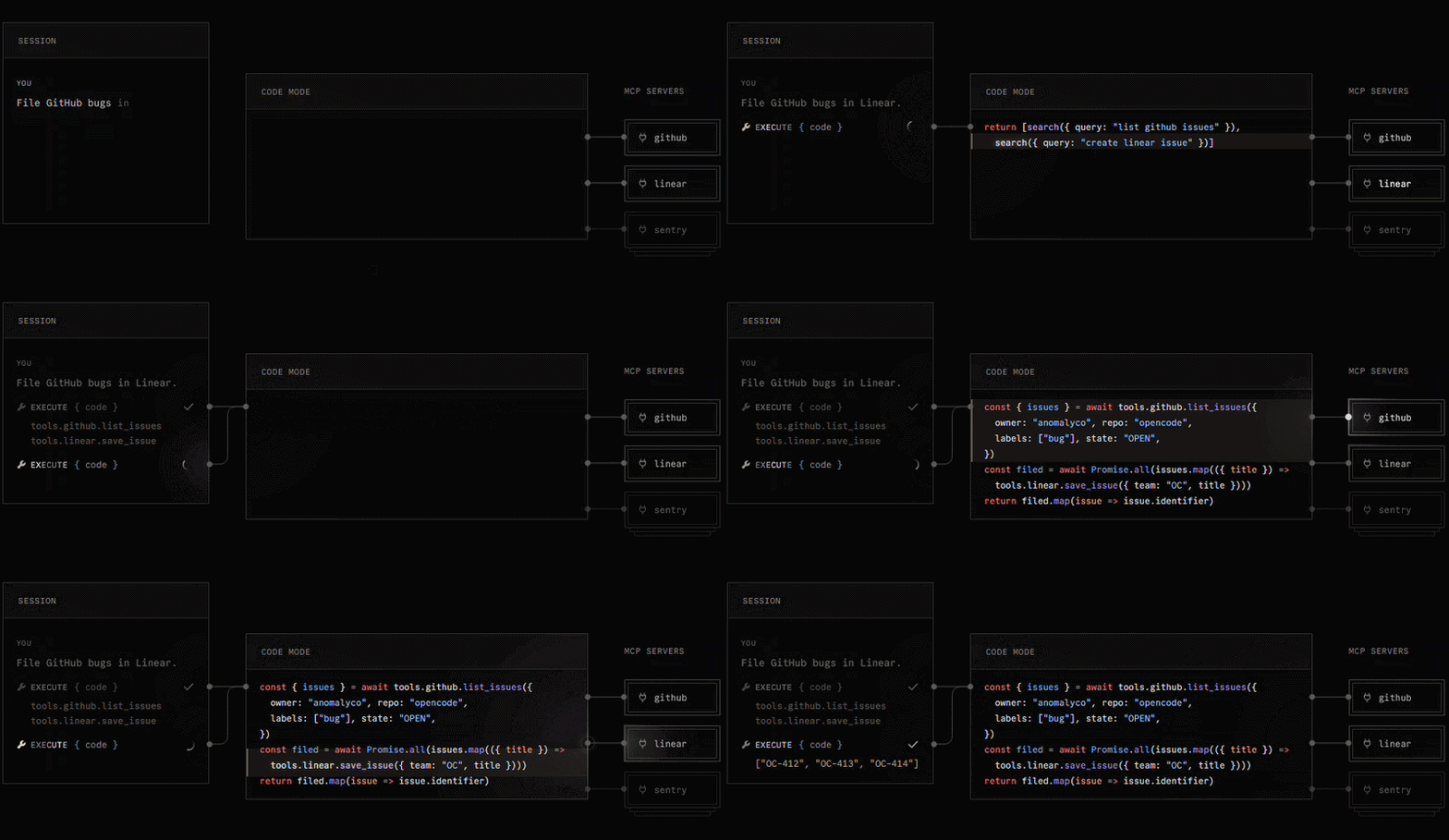
Interoperability with external tools via the Model Context Protocol (MCP) has also been fundamentally optimized in version 2.0 through a mechanism termed Code Mode. Historically, integrating numerous external tools and OpenAPI endpoints caused significant context bloat, consuming valuable model token space with extensive tool definitions.
Code Mode addresses this inefficiency by utilizing a lightweight JavaScript interpreter packaged within @opencode/codemode. Instead of forcing the model to process exhaustive static tool schemas, Code Mode translates MCP servers and API endpoints into executable functions. The agent writes succinct JavaScript code to invoke multiple tools and parse their outputs within a single execution cycle.
For example, an enterprise developer can integrate hundreds of third-party services—ranging from issue trackers like Linear to code repositories like GitHub—without degrading model performance or exhausting context limits. Anomaly has designated Code Mode as the default execution standard for all MCP servers in version 2.0, substantially improving the practical viability of large-scale agentic integrations.

Asynchronous Execution and Subagent Concurrency
To minimize developer friction during long-running computational tasks, OpenCode 2.0 introduces native background execution capabilities for both secondary agents and terminal commands.
Developers are no longer forced to wait for synchronous task completion. A primary agent can delegate specialized operations, such as code reviews or security audits, to a subagent running an alternative AI model, while the developer continues working uninterrupted on the main codebase. Similarly, resource-intensive shell operations—such as executing comprehensive test suites or compiling large applications—run asynchronously. The primary agent receives automated telemetry notifications upon task completion, and users retain the ability to push active foreground tasks into the background via designated keyboard shortcuts.
Plugin Ecosystem Upgrades and Migration Path
The modernization of OpenCode 2.0 extends to its internal extension architecture. Anomaly reports that over 80 internal plugins have been rewritten to reflect the new API standards, enhancing overall system stability and maintainability. Terminal interface plugins have graduated from experimental status to fully supported production components, complemented by hot-reloading capabilities that allow developers to integrate new plugins during active sessions without restarting their workflow.
These sweeping architectural improvements, however, necessitate deliberate migration steps for existing users. Due to the extensive nature of the overhaul, plugins engineered for OpenCode 1.0 are not compatible with version 2.0, and integrations relying on legacy server APIs will require updates.

Existing users transitioning to the new ecosystem can initiate the upgrade by executing opencode upgrade --major via the command line or entering the /update command in the terminal interface. To ensure stability across production environments, automated background updates have been disabled, requiring developers to explicitly authorize the major version transition.
