

The traditional landscape of semiconductor benchmarking is undergoing a fundamental shift as Quadric introduces a fully automated, industrial-scale profiling system within its Chimera Software Development Kit (SDK) and DevStudio environment. By automating the recompilation and re-profiling of its entire library of over 300 artificial intelligence models across a vast array of hardware configurations with every software release, Quadric is challenging the industry standard of static, hand-picked performance data. This move toward transparency and Continuous Integration/Continuous Deployment (CI/CD) in the Neural Processing Unit (NPU) space aims to eliminate the "performance drift" that often occurs between a product’s initial datasheet release and its actual deployment in silicon.
In the contemporary semiconductor market, the "model zoo"—the collection of pre-optimized AI models provided by hardware vendors—has frequently been criticized as a stagnant marketing tool rather than a functional engineering resource. Typically, a vendor ports a select few models once, benchmarks them on a single, idealized silicon configuration, and publishes the resulting frames-per-second (FPS) figures in a product brief. However, as compilers evolve and System-on-Chip (SoC) architects demand specific memory or core configurations, these published numbers often lose relevance. Quadric’s new approach seeks to rectify this by ensuring that the performance data visible to customers in DevStudio is the direct output of the latest compiler version, reflecting real-world conditions rather than "best-case" scenarios.
The Evolution of NPU Benchmarking and the Port-Once Fallacy
Historically, the process of benchmarking an NPU has been a manual, labor-intensive endeavor. When a hardware vendor releases a new processor core, the engineering team must manually tune the graph compiler to maximize throughput for specific neural network architectures. This leads to a bottleneck where only the most popular models, such as ResNet-50 or MobileNet, receive regular updates. For an SoC architect, this creates a significant information gap. If the target application requires a specialized transformer model or a unique sensor-processing network, the architect is often forced to enter into non-disclosure agreements (NDAs) and wait weeks for a sales-driven engineering team to provide custom benchmark data.

Quadric’s Chimera GPNPU (General Purpose NPU) architecture addresses this by treating model compilation as a software-scale industrial process. By applying CI/CD principles—the same methodologies used in high-stakes enterprise software development—Quadric ensures that every model in its 300+ library is re-validated whenever the SDK is updated. This prevents the "zoo rot" that occurs when compiler optimizations improve performance for new models but are never retroactively applied to older ones in the catalog.
Technical Chronology: From SDK Release to DevStudio Integration
The workflow established by Quadric represents a departure from the "snapshot" method of performance reporting. The process follows a rigorous chronological sequence that ensures data integrity:
- SDK Update: Whenever Quadric’s engineering team introduces a new optimization or feature to the Chimera SDK, a global trigger initiates a massive compute job.
- Matrix Recompilation: The entire model zoo—comprising hundreds of diverse architectures for vision, audio, and signal processing—is recompiled using the updated graph compiler.
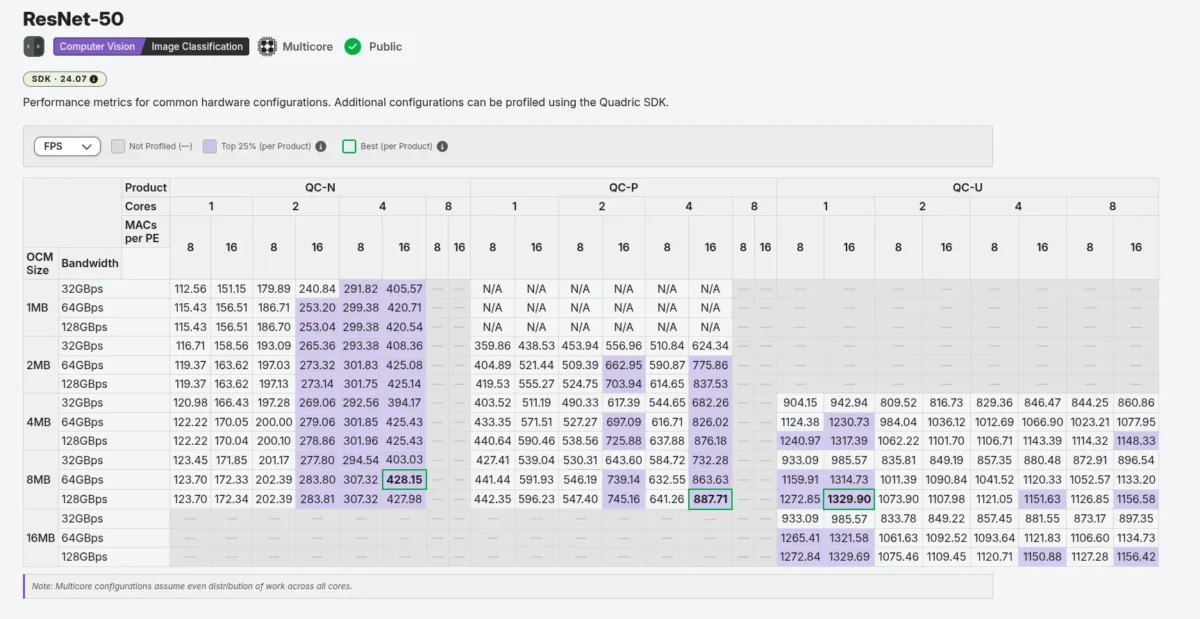
- Parametric Profiling: These models are not just run once. They are simulated across a parametric configuration space. This includes variations in Multiply-Accumulate (MAC) widths, L2 memory sizes, and varying levels of external memory bandwidth.
- Data Surfacing: The results are automatically pushed to DevStudio, Quadric’s cloud-based development environment. This allows users to see a "pass/fail" matrix and precise performance metrics for every configuration.
- Customer Access: SoC architects can log in and browse the data immediately, seeing the exact performance "floor" for their specific hardware constraints without needing a direct consultation with the vendor.
This timeline ensures that the "math always works." By tying the performance data directly to the build artifacts of the SDK, Quadric removes the possibility of human error or the "cherry-picking" of data that often occurs in marketing-led benchmarking.
Supporting Data: The Impact of Parametric Sweeps
The complexity of modern SoC design requires more than just a single performance number. Architects must balance power, area, and performance (PPA). Quadric’s automated system provides a multi-dimensional view of how an NPU performs under different constraints. For instance, a model might perform exceptionally well with 2MB of L2 cache but see a 40% performance degradation if the architect reduces that cache to 512KB to save silicon area.

By providing a performance matrix that covers core counts, MAC widths, and bandwidth variations, Quadric allows architects to perform "dimensioning" with high confidence. The data provided includes per-region profiling, which breaks down where time is spent during execution: compute cycles, memory movement, or MAC utilization. This level of granularity is essential for identifying bottlenecks in the data path.
Data from recent releases suggests that this automated approach has allowed Quadric to demonstrate consistent performance gains. As graph compilers are still early in their maturity curve, software-driven optimizations can often yield 10% to 20% improvements in throughput without any changes to the underlying RTL (Register Transfer Level) of the hardware. Quadric’s system makes these gains immediately visible across the entire model zoo, rather than just a few "hero" models.
Industry Reactions and the Shift Toward Transparency
Industry analysts have noted that Quadric’s strategy mirrors the shift seen in the broader software industry toward "open telemetry" and transparent reporting. While many NPU vendors gate their performance data behind sales meetings to control the narrative, Quadric’s self-serve model suggests a high degree of confidence in their compiler’s ability to handle diverse workloads.
"The traditional model of ‘benchmarketing’ is becoming a liability for SoC architects who are on tight schedules," noted one industry consultant specializing in edge AI. "If an architect can see a live matrix of performance across 300 models, they can make a licensing decision in days rather than months. It shifts the burden of proof from the salesperson to the software itself."

Furthermore, Quadric’s approach addresses the "long tail" of AI models. While the industry often focuses on the top 10 most popular models, real-world applications often rely on older or highly customized networks. By validating 300+ models, Quadric provides a safety net for developers who aren’t using the latest "trendy" architecture but still require high-performance execution.
Broader Impact and Implications for the Semiconductor Sector
The implications of Quadric’s automated benchmarking extend beyond just marketing. It represents a fundamental change in how hardware-software co-design is executed. By providing a "live" look at performance, Quadric is effectively offering a "digital twin" of their NPU’s performance characteristics.
For the wider semiconductor industry, this sets a new benchmark for accountability. If one vendor provides a transparent, self-serve performance matrix, it puts pressure on others to move away from static datasheets. This could lead to a standardized "Consumer Reports" style of evaluation for NPUs, where performance is measured across a standardized suite of configurations rather than isolated, best-case scenarios.
Moreover, the use of CI/CD in hardware development signals the increasing importance of the software stack in the AI era. As NPUs become more complex, the hardware is only as good as the compiler that targets it. Quadric’s commitment to refreshing its data with every SDK release highlights that an NPU is a living product that improves over time through software, rather than a static piece of silicon.

In conclusion, Quadric’s integration of a 300+ model zoo into an automated, transparent profiling pipeline within DevStudio marks a significant milestone in the maturation of the edge AI market. By providing SoC architects with concrete, up-to-date data that reflects the current state of their compiler technology, Quadric is removing the friction and opacity that have long plagued the silicon licensing process. As the industry moves toward more complex and varied AI workloads, this level of transparency and industrial-scale automation will likely become the expected standard for any vendor claiming a leadership position in the NPU space. Architects can now move past the "port once" era and enter an era of continuous, data-driven hardware selection.
